Storing Chanel Long-Term: Boxes, Dust Bags, Humidity
If your Chanel is going into storage for more than a month, whether for a season, a move, or simply because you rotate a large collection, the box-versus-dust-bag decision and the humidity in the space matter more than almost anything else you do day to day. This article is for anyone storing a Chanel bag for 30 days or longer and wants a system, not a guess.
Should you keep the Chanel box
The rigid Chanel box that comes with a new bag is a display and transport object first, a long-term storage solution second. It protects against crushing and dust extremely well, but most Chanel boxes are not acid-free archival cardboard, and prolonged contact between raw cardboard and leather can, over years, contribute to slight discoloration or a musty smell if the box has ever been in a damp environment.
That said, discarding the box outright is not the right move for most owners. The box is useful for:
- Long-distance transport, where crush protection matters more than anything else.
- Resale, where original packaging materially affects value on the secondary market.
- Very long-term storage (6+ months) of a bag you rarely use, provided the bag is stuffed and wrapped in acid-free tissue or a cotton pillowcase before it goes in, rather than resting directly against the cardboard.
For a bag in regular rotation, even one used only every few weeks, keeping it in a closet in its dust bag with a shaped insert is more practical and just as protective, since it avoids repeated box lid removal, which stresses hinges on the box itself and adds handling risk to the bag.
The black-and-white dust bag: what it actually does
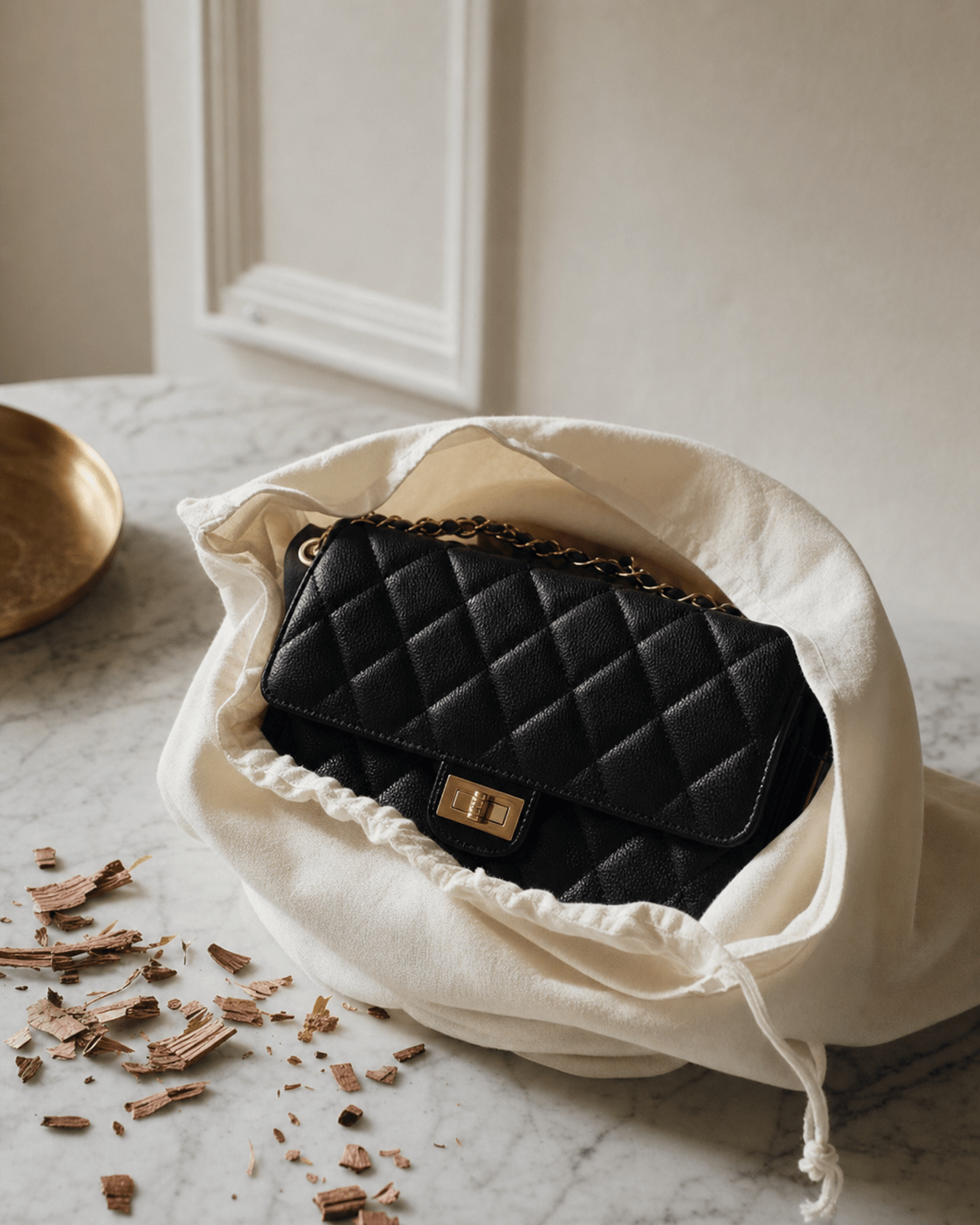
The dust bag's job is exactly what its name says: it keeps dust, light, and surface abrasion off the bag when it is not enclosed in a box. It is not a humidity barrier, and it will not protect against a genuinely humid closet or a leak. Chanel's dust bags are a breathable cotton-blend fabric specifically because sealing leather in a non-breathable material traps whatever moisture is already in the leather and encourages mold or a musty smell over time.
Two practical rules for the dust bag itself:
- Always stuff the bag before placing it in the dust bag. An unstuffed bag inside a dust bag inside a closet will develop creases at the gusset and corners within weeks.
- Never store the bag inside a sealed plastic bin while also inside the dust bag for long stretches. Plastic bins block airflow entirely and are one of the most common causes of long-term mildew smell in stored bags, even when the space looks clean.
Ideal closet conditions for long-term storage
Chanel caviar and lambskin both do best in a stable environment of 18-21°C (64-70°F) and 40-55% relative humidity. Stability matters more than hitting an exact number: a closet that swings from 30% to 70% humidity across seasons stresses the leather far more than one that sits at a constant 55%.
Practical closet setup
- Store bags on a shelf, not on the floor, where humidity and temperature swings are more extreme.
- Keep bags away from exterior walls in climates with cold winters, since exterior walls run colder and can sit closer to the dew point, inviting condensation.
- Avoid closets adjacent to bathrooms or laundry rooms, both of which spike ambient humidity regularly.
- Leave a few centimeters of space between bags and between bags and the closet wall to allow airflow.
Silica gel: how much and where
Silica gel packets absorb ambient moisture in the immediate microclimate around the bag, which matters most inside a sealed box or a densely packed closet where air does not circulate freely. For a single bag in a box, one 10-20 gram packet is sufficient. For a closet section holding several bags, a rechargeable silica gel canister (the kind that can be dried out in an oven and reused) placed on the shelf does more work than several small desiccant packets scattered loosely.
Replace or recharge silica gel every 3-6 months in humid climates, and check packets after any season change, since a fully saturated packet stops absorbing and can even release moisture back into the space.
Do you need a dehumidifier, and what size
If your home does not run central air conditioning for a large part of the year, or you live somewhere with regular relative humidity above 60%, a dedicated dehumidifier for the closet or dressing room is worth the cost of the bags it protects. Sizing guidance:
- A small closet (under 1.5 cubic meters / ~50 cubic feet) is well served by a compact electric or thermo-electric dehumidifier rated for a small room, run continuously or on a humidity-triggered cycle.
- A walk-in closet or dressing room benefits from a mid-capacity dehumidifier (roughly 10-12 liters/day extraction capacity) paired with a simple hygrometer so you are working from a real number, not a guess.
- Whatever size you choose, place a hygrometer on the same shelf as your bags. This is the single cheapest tool that actually tells you whether your storage setup is working.
Box vs. dust bag for storage beyond 30 days: the actual decision
For storage runs of 30 days or more, here is the practical breakdown:
- 30-90 days, bag will be used again soon: dust bag, stuffed, on a shelf, with a shaped insert like a purse pillow insert to hold the flap's shape and keep the quilting from creasing against itself.
- 90+ days, seasonal or infrequent use: dust bag inside the original box, stuffed and wrapped in acid-free tissue, box stored upright on a shelf, never stacked under other boxes.
- Indefinite storage, bag not in active rotation: same as above, plus a silica gel packet inside the box and a check-in every 2-3 months to confirm no moisture, odor, or hardware tarnish has developed.
The one scenario where box storage is clearly worse than dust bag alone is a genuinely humid home without climate control. In that case, a sealed cardboard box can trap ambient moisture against the leather for months at a time, while an open shelf with just the dust bag and good airflow lets the bag breathe.
Common mistakes
- Storing an unstuffed bag in its box for months. The flap and gussets will develop set-in creases that are difficult to fully relax later.
- Using plastic storage bins as a moisture barrier. They do the opposite: they trap whatever moisture is already present and prevent it from escaping.
- Forgetting to check on a bag in long-term storage. A bag that goes untouched for 6+ months should still get a quarterly check for hardware tarnish, odor, or moisture, not just a look when you finally take it out to wear.
- Assuming the dust bag alone regulates humidity. It blocks dust and light, not moisture. Humidity control comes from the room, not the bag's own packaging.
Expert tip
Write the storage date on a small sticky note inside the dust bag or tape it to the box before sealing a bag away for the season. It sounds unnecessary until you are staring at four identical black dust bags eight months later trying to remember which one has been sitting the longest, and therefore which one needs the next silica gel refresh or humidity check first.
Closing thought
Long-term Chanel storage comes down to three levers: a stable, moderate-humidity environment, a stuffed bag that holds its shape, and a storage method (box, dust bag, or both) matched to how long the bag will actually sit. None of it requires exotic equipment, just a hygrometer, some silica gel, and a shaped purse pillow insert to do the structural work that tissue paper alone cannot. For the broader principles behind all of this, see our pillar guide, How to Store Luxury Handbags Properly, along with our model-specific guides on storing a Classic Flap and storing a Boy Bag, both of which cover this same box-versus-dust-bag decision in the context of a specific model.