How to Store a Bottega Veneta Intrecciato Bag
Woven leather does not fail the way any other luxury bag material fails. A smooth leather panel scuffs and scratches as a single continuous surface. Intrecciato is not a single surface at all, it is hundreds of individual leather strips interlocked under tension, and that construction creates failure modes that simply do not exist on a Birkin, a Neverfull, or a Classic Flap. Corners loosen strip by strip. Dust bag interiors snag individual weave points instead of sliding smoothly across a flat surface. A single finger of sustained pressure can leave a permanent indentation that a smooth panel would simply absorb and release. Storing a Bottega Veneta bag well means understanding the weave as an engineering problem, not just a texture.
This guide covers intrecciato's storage-specific risks: corner and edge loosening, snagging on rough interior linings, permanent indentation from point pressure, and the structural differences between hobo silhouettes like the Jodie and structured pieces like the Cassette and Andiamo.
Why intrecciato needs its own protocol
Three facts about the weave's construction drive everything in this guide:
- The surface is made of interlocked strips, not a continuous panel. Each strip is woven under tension against its neighbors, which means damage to one strip or one weave point does not stay contained the way a scratch on smooth leather does. It can loosen the strips around it.
- Corners and edges carry the most structural stress. Wherever the weave turns a corner or meets a seam, the strips are under the most tension and have the least surrounding support, making these the first places loosening actually starts.
- The textured surface interacts differently with what touches it. A rough or textured interior surface, a stiff dust bag seam, a rough shelf edge, can catch on the raised, woven texture in a way it never would on a flat panel, snagging individual strips rather than merely creating surface friction.
Corner and edge loosening: the weave's primary risk
Every woven leather panel is under some baseline tension, the strips are interlocked tightly enough to create the tight, structured weave Bottega Veneta is known for. That tension is stable under normal handling but has real limits, and corners and edges are where those limits get tested first.
Why corners loosen before flat panels do
A flat section of intrecciato has strips supported on every side by their neighbors, distributing any stress across a wide area of interlocked leather. At a corner or an edge where the weave terminates into a seam, strips have support on fewer sides and absorb a disproportionate share of any stress placed on that area, whether from handling, setting the bag down repeatedly on a hard corner, or sustained pressure in storage. Over time, this uneven stress can loosen the weave at these termination points, sometimes visible as a slightly raised strip end or a small gap where a strip has pulled slightly away from its interlocking neighbor.
What actually accelerates corner loosening
Setting a structured piece down repeatedly on the same corner, storing the bag in a position where its own weight rests on a single corner or edge for extended periods, and any sustained pressure from a neighboring object pressing against a corner in storage all accelerate this specific failure mode. Store woven leather bags with their weight distributed across their base or a supportive shape, not balanced on a single corner or edge, and give corners real clearance from anything else on the shelf.
Snagging: why dust bag material matters more here than anywhere else
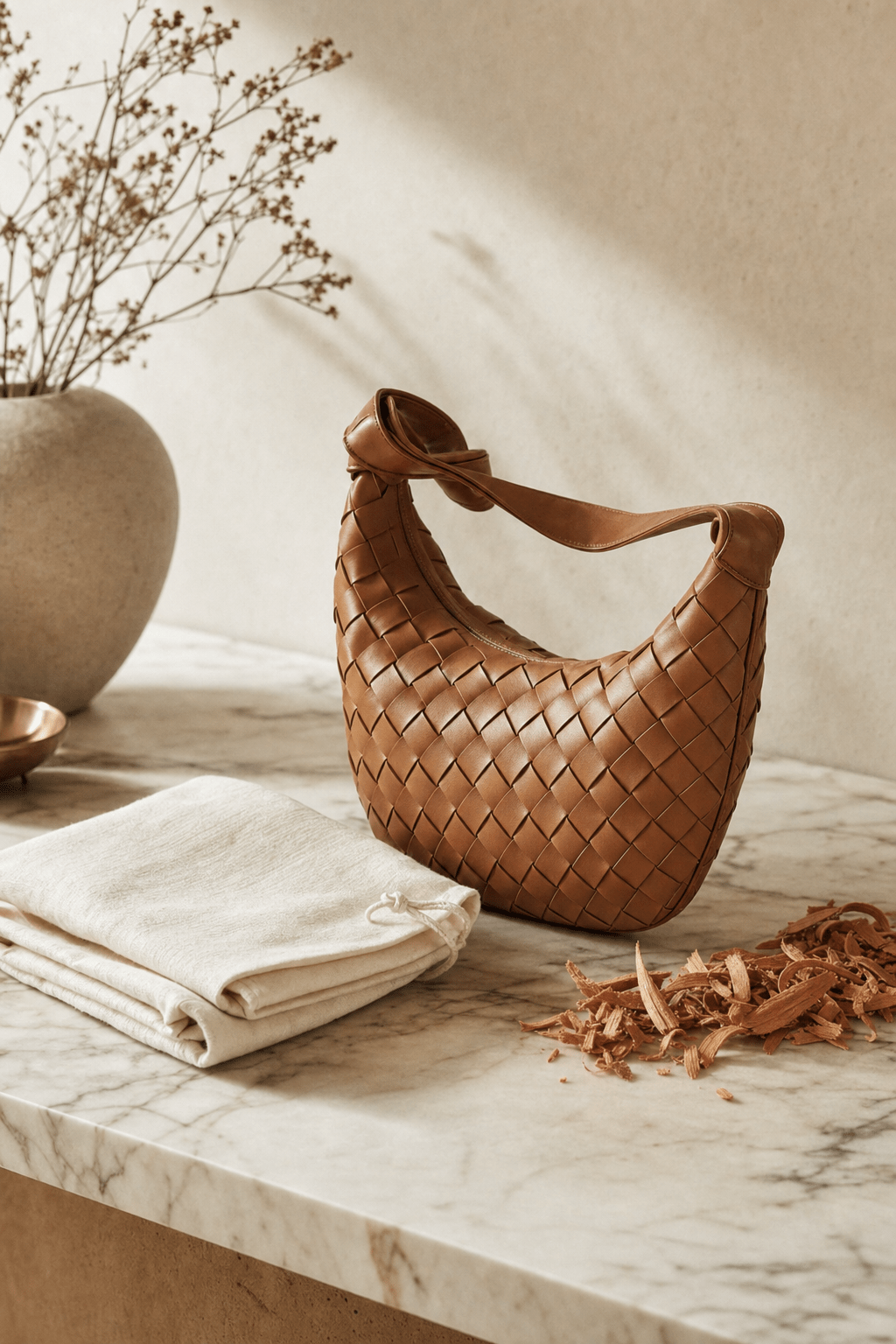
Every bag in this library benefits from a dust bag, but intrecciato has a specific reason to be picky about which one. The weave's surface is genuinely textured, with each strip's edge sitting slightly raised relative to where it crosses its neighbor, and a rough-textured or loosely woven interior lining, a stiff cotton dust bag with a coarse weave, a poorly finished seam, can catch on these raised edges in a way that a flat leather panel's smooth surface never experiences.
Choose a smooth-lined or silk dust bag
A silk-lined dust bag, or at minimum a smooth, tightly woven cotton bag without a rough interior finish, glides across the intrecciato surface without catching. A coarse-weave or heavily textured fabric dust bag is a real snag risk for this material specifically, more so than for smooth leather bags, where a slightly rougher dust bag interior is more of a theoretical than practical concern. If your existing dust bag has a noticeably textured interior, consider it a liability for a woven leather bag even if it works fine for everything else in your collection.
Handle with attention during transitions
Beyond storage itself, be mindful when sliding the bag in and out of a dust bag, a drawer, or a shelf space with any rough edges. The moment of contact during handling, not just prolonged static storage, is when a raised strip is most likely to catch on something and pull.
Permanent indentation from point pressure
Because intrecciato is woven rather than a solid panel, pressure concentrated at a single point behaves differently than it would on smooth leather. A smooth panel under point pressure, another bag's buckle resting against it, for instance, tends to absorb the pressure and largely release it once the pressure is removed. A woven panel under the same point pressure can have the strips at that exact location compressed or displaced in a way that does not fully spring back, leaving a visible indentation or flattened patch even after the pressure source is gone.
What creates this risk in storage
Stacking bags, resting a heavier object against a woven panel, or storing the bag in a space so tight that a shelf bracket or a neighboring bag's hardware presses into the weave for weeks at a time are the most common causes. Unlike a scuff, which is a surface-level cosmetic issue, a set indentation changes the woven structure itself at that point and is far more difficult to correct, sometimes requiring a specialist to manually work the strips back into position, with mixed results depending on how long the pressure was sustained.
Common mistakes with intrecciato storage
- Resting the bag on a single corner repeatedly. Corners have less surrounding support in the weave and absorb a disproportionate share of any stress placed there.
- Using a coarse or heavily textured dust bag. The raised weave surface can snag on rough interior fabric in a way smooth leather panels do not experience.
- Stacking bags or resting objects against a woven panel. Point pressure on woven leather can create a permanent indentation that a smooth panel would simply absorb and release.
- Letting a hobo silhouette like the Jodie collapse fully empty for extended periods. Without an internal frame, the weave itself takes on stress at the fold lines rather than the bag holding a supported shape.
- Ignoring a small gap or raised strip at a corner. Left unaddressed, an isolated loosened point can widen as surrounding strips lose some of their neighboring support.
Hobo silhouettes vs. structured pieces
Bottega Veneta's intrecciato appears across silhouettes with very different internal structure, and that structure changes how the weave experiences storage stress even though the material risks described above apply to all of them.
The Jodie: soft, hobo, and prone to collapse
The Jodie is an unstructured hobo silhouette with no internal frame, which means it collapses in on itself when stored empty, similar in principle to how the Neverfull collapses without stuffing. But where the Neverfull's canvas simply creases and slouches, the Jodie's woven leather takes on that fold stress directly in the weave itself, and repeated, sustained folding at the same crease lines can gradually work those specific weave points looser than the rest of the bag. Stuff the Jodie gently with acid-free tissue for storage, enough to prevent a hard fold line at the same spot every time, without packing it so full that the weave stretches at the seams.
The Cassette: structured and more forgiving
The Cassette has a more structured, boxier shape that holds its silhouette without heavy reliance on internal stuffing, which removes the fold-stress problem the Jodie faces. Its weave is still vulnerable to corner loosening, snagging, and point-pressure indentation, the same as any other intrecciato piece, so structure protects against one failure mode without protecting against the others.
The Andiamo: structured with more surface area at risk
The Andiamo shares the Cassette's structured build but with more total exterior surface in woven leather on many versions, which means proportionally more of the bag's surface carries the corner, snag, and indentation risks described throughout this guide. Its structured shape holds up well without stuffing, but give it the same careful attention to corner clearance and dust bag material as any other woven piece.
Expert tip: rotate which corner touches down
If you tend to set a woven Bottega Veneta bag down the same way every time, its base and one or two corners take a disproportionate share of the wear over months and years. Get in the habit of varying how you set the bag down and which edge faces outward on the shelf. This is a small, easy habit that spreads stress across more of the weave rather than concentrating it in the same handful of stitch and strip junctions every single time.
Where to keep it: shelf position matters more here
Give every woven leather bag real clearance from its neighbors on a shared shelf, more than you might give a smooth leather bag of similar size. Corners and edges should not press against another bag's hardware, buckle, or frame edge, and the bag itself should rest on a supportive base rather than balanced on a single point. A structured piece like the Cassette or Andiamo can generally sit upright on its own base without additional support; a hobo silhouette like the Jodie benefits from light stuffing to avoid a hard, repeated crease line in the same spot every time it goes into storage.
For the underlying principles behind humidity, shelving, and rotation that apply across every brand in this library, see the pillar guide on how to store luxury handbags properly. Those rules apply to woven leather too, adjusted for the specific vulnerabilities the weave itself introduces. For the deeper material mechanics behind everything in this guide, see our companion piece on woven leather care: the Bottega playbook.
Closing thoughts
Intrecciato asks you to think about storage differently than any other material in this library, because it is not a surface, it is a structure. Give corners real clearance, choose a smooth-lined dust bag over a textured one, keep point pressure away from the weave entirely, and match your stuffing approach to whether you own a structured piece or a hobo silhouette. Handled with that understanding, the weave that makes a Cassette, a Jodie, or an Andiamo so distinctive holds its integrity for decades rather than loosening quietly in the exact spots most owners never think to check.