Article: Woven Leather Care: The Bottega Playbook

Woven Leather Care: The Bottega Playbook
Intrecciato looks like a texture. It is actually a construction method, and that distinction explains almost everything about how Bottega Veneta's woven leather behaves, fails, and ages differently from every other material in this library. Instead of a single hide panel, an Intrecciato surface is built from dozens or hundreds of individual leather strips, each one threaded over and under its neighbors and anchored at the edges. That structure is what gives woven leather its distinctive give and drape, and it is also what creates a category of damage that simply does not exist on a smooth Birkin or a quilted Chanel flap: a single loosened strip that ripples, gaps, or pulls out of a weave that otherwise looks intact.
This is the cornerstone reference for woven leather care: how Intrecciato was engineered and why, how the different weave sizes behave, how to inspect a woven bag for the early signs of strip failure, and the conditioning, cleaning, and color-transfer rules that differ meaningfully from smooth-leather care.
Why Intrecciato exists: reinforcement, not decoration
Bottega Veneta introduced its signature woven leather in 1966, and the motivation was structural before it was aesthetic. Thin, supple leathers drape beautifully but tear and stretch easily on their own. Weaving narrow strips of that same thin leather into an interlocking lattice distributes stress across dozens of individual anchor points instead of concentrating it across one continuous panel. A smooth hide panel fails along whichever line takes the most load. A woven panel spreads that load sideways through the weave, which is why Intrecciato bags made from genuinely thin, soft lambskin can carry real weight without stretching out of shape the way an equivalent smooth-leather bag would.
The unintended consequence of that engineering choice is a different failure mode. A smooth hide fails as a sheet: it scuffs, scratches, or cracks across its surface. A woven hide fails at the level of the individual strip: a single strip can loosen at its anchor point, slip out of its neighbors, or fray at a cut edge, and the surrounding weave can remain completely intact while that one point degrades. Understanding this distinction is the foundation of every practical rule in this guide.
How woven leather is actually built
Each Intrecciato strip is cut to a consistent width, skived thin enough to interlace without bulking up at the crossings, and threaded through slits in the strips running the opposite direction, over-under, over-under, in a basket-weave pattern. The strips are typically lambskin or calfskin, chosen for suppleness rather than the thicker hides used for smooth structured bags. At the panel edges, strip ends are folded under and secured, usually with adhesive and stitching, to a backing layer that gives the weave its shape and prevents unraveling from the border inward. That backing layer matters more than most owners realize: as long as it stays intact, a slipped strip is a cosmetic nuisance, not a breach. Once the backing delaminates or tears, usually from prolonged moisture or a sharp catch, the weave above it has nothing anchoring it, and small problems become large ones.
Weave sizes and what each is actually for
Bottega Veneta has produced Intrecciato at several distinct scales over the decades, and the size is not just a style choice. It changes how the bag handles, how durable it is against daily wear, and how it should be cared for.
Maxi Intrecciato uses the widest strips in a loose, oversized weave. It reads as bold and casual, but the wide strips and open gaps mean each one carries more load and is easier to catch on a zipper or rough surface, so Maxi pieces need the most care around catch points. Large and Medium Intrecciato are the traditional mid-scale weaves used across most of Bottega's core leather goods, balancing texture with a tighter, more secure structure than Maxi. Small and Mini Intrecciato use narrower strips in a denser weave that distributes load across more anchor points per square inch, generally making it more resistant to an individual strip loosening under normal use, though each strip is more delicate on its own. Nano and micro weaves, the finest Bottega produces, read almost as a textured surface rather than an obvious weave, and their extremely narrow strips make professional restoration the only realistic option if a strip fails.
How to inspect a woven bag for strip failure
Loosening strips do not appear randomly across a woven panel. They concentrate at predictable stress points, and knowing where to look catches problems while they are still small and inexpensive to fix. Start at the corners: base corners and the corners where a gusset meets the front or back panel take the most repeated flexing and abrasion, and this is where strips loosen first on almost every woven bag. Check handle attachment points and strap drops next, since anywhere hardware pulls against the weave under sustained, repeated, directional tension is a second concentration point that can work a strip loose faster than ambient wear would. Run a hand across the surface, not just your eyes: a loosened strip is often easier to feel than to see, especially in tighter weaves, and catching it before it visibly gaps or pulls free is the difference between a five-minute fix and a more involved repair. Finally, look for fraying at any cut edge you can see, typically hidden at seams, zipper gussets, and interior edges, where the leather is exposed rather than folded and secured.
Professional restoration for popped strips
A single popped or loosened strip is a known, common repair, not a crisis, provided it is addressed before the surrounding weave starts to shift or before the strip fully detaches and is lost. Bottega Veneta offers its own repair service through its boutiques and client services for exactly this kind of issue, and it is generally the safest first call for an authentic piece, since the technicians are trained on the brand's specific weave construction and have access to matching leather stock. Independent restoration specialists with woven-leather experience are a reasonable second option, particularly for older or discontinued pieces where brand repair may be slower to access. What you should avoid is a home fix with craft glue or an improvised needle-and-thread repair using substitute leather. A mismatched patch or amateur re-weave is visually obvious against factory-consistent strips, and it can create a new stress point at the repair boundary.
Common woven leather mistakes
- Ignoring a single loose strip because "the rest of the bag looks fine." Isolated strip failures rarely stay isolated if left under continued tension and handling.
- Overconditioning the weave. Excess conditioner pools and cakes between strips rather than absorbing evenly across a single sheet, and it collects dust as it does.
- Using a stiff brush or aggressive scrubbing on stains. This can work grit into the gaps between strips rather than lifting it off the surface.
- Storing light-colored Intrecciato against dyed dust bags or fabric linings. The many small gaps and edges in a woven surface pick up transferred color more readily than a smooth panel.
- Attempting a DIY strip repair with substitute leather or glue. This is visually obvious and can create a new failure point at the repair boundary.
- Treating all weave sizes as equally durable. Maxi's wide, open weave is more catch-prone than Mini or Nano's tighter structure, and handling should adjust accordingly.
Conditioning woven leather: why the rules are different
Conditioning a smooth hide is straightforward: apply a thin, even layer across a continuous surface and let it absorb. Conditioning Intrecciato is not the same task, because the surface is not continuous. It is dozens of narrow strips with gaps, folds, and crossing points between them, and the core risk is oil buildup between strips rather than absorption into them. Conditioner applied too heavily pools in the narrow channels where strips cross and at the folded edges where strips anchor to the backing. That pooled product attracts dust and grime over time, darkens unevenly in a pattern that follows the weave rather than the overall panel, and can migrate to strips it was never applied to, leaving a blotchy, dirt-attracting sheen at the crossing points instead of the even finish conditioning is supposed to produce.
The practical fix is to use meaningfully less product than you would on a smooth bag of comparable size, apply it with a lightly dampened cloth rather than direct application, and work it across the surface rather than into the gaps. Test on an inconspicuous interior panel first, and extend the interval between treatments, since a woven surface generally needs conditioning less often than a smooth one carrying the same use.
Color transfer risk on light Intrecciato
Pale woven leather, particularly white, ivory, and light tan Intrecciato, is disproportionately vulnerable to color transfer compared to smooth leather in the same tones, for a structural reason: a woven surface has far more edges and gaps than a flat panel, and dye from denim, dark fabric, or newsprint can work into those crevices in a way it cannot on a sealed, continuous surface. Once dye has migrated between strips, it is very difficult to fully lift out, since cleaning has to reach into narrow channels rather than wipe across an open plane.
The preventive standard for light Intrecciato is stricter than for light smooth leather: avoid direct contact with unwashed new denim, keep the bag off dark upholstery and dyed fabric surfaces, and store it in its own breathable dust bag rather than resting against other bags, since even brief contact during storage can transfer color if either surface is under any humidity or pressure.
Woven leather vs. quilted leather: a useful comparison
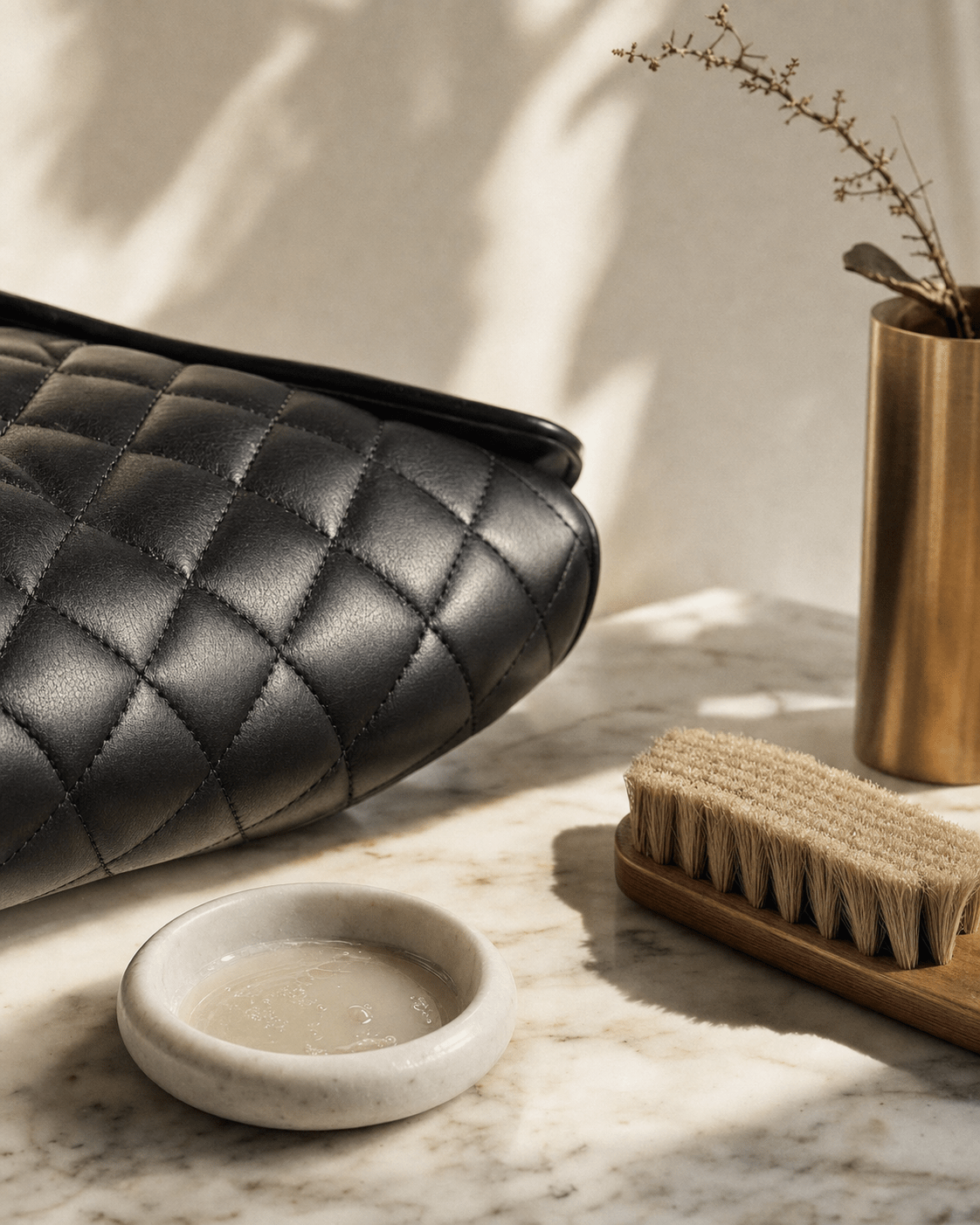
It is worth contrasting Intrecciato with Chanel's quilted lambskin, since both are decorative leather treatments that add structure, and both fail in ways specific to their construction. Quilted leather is a single continuous hide panel stitched into a diamond pattern over a layer of padding, so its failure points are the stitching itself, which can loosen or tear at the seam, and the leather surface between seams, which scuffs and creases like any smooth hide. Damage on a quilted bag concentrates along stitch lines and corners. Woven leather has no equivalent padding layer and no single continuous hide to scuff as a sheet; its vulnerability is distributed across every strip and crossing point instead. In practice this makes Intrecciato somewhat more resistant to the surface scuffing that shows prominently on smooth or quilted leather, since marks tend to disperse across the texture rather than reading as one visible flaw. The trade-off is the strip-level failure mode that quilted and smooth leather simply do not have.
Why Intrecciato ages more gracefully than most leathers, with proper care
Woven leather has a real advantage that most care guides underplay: its texture is inherently forgiving of the kind of light surface wear that would show clearly on a smooth hide. Fine scuffs, minor scratches, and the general softening of the leather's surface sheen tend to disappear into the weave's texture rather than standing out as a visible flaw, in the way a comparable mark would on a glossy calfskin or box leather panel. This is part of why well-maintained vintage Intrecciato from decades ago can still look presentable, where a smooth-leather bag from the same era would show its age far more plainly.
That advantage only holds if the structural side is maintained: strips inspected and caught early when they loosen, conditioning kept light and infrequent, and light-colored pieces protected from dye transfer. Owners who treat Intrecciato as a set-and-forget texture, ignoring early strip issues because the overall bag still looks fine, are the ones who eventually end up with a repair bill or a permanently gapped panel. Owners who inspect periodically and act promptly get the material's real advantage: a bag that visually ages better than almost anything else in the luxury leather category.
Expert tip: the corner-and-crossing check
Build a habit of a thirty-second check every few months: run your fingers along all four base corners and the handle attachment points, feeling for any strip sitting higher or looser than its neighbors, then glance at the crossing points on any light-colored panel for early signs of dust buildup or discoloration. This single habit catches the two most common and most preventable Intrecciato problems, strip loosening and crossing-point grime, at the stage where they are still a five-minute fix rather than a professional restoration.
Cleaning woven leather day to day
Routine cleaning should stay minimal and gentle. A soft, dry microfiber cloth wiped across the surface after use removes dust before it works into the gaps between strips. For a light surface stain, a barely damp cloth with no soap, dabbed rather than rubbed, is the safest first step; aggressive rubbing pushes debris into the weave's crevices instead of lifting it away. Avoid saturating the leather, since moisture that reaches the backing layer dries far more slowly than moisture on an exposed smooth panel, and prolonged dampness there is a common cause of delamination. For anything beyond a light surface mark, a specialist familiar with woven leather is the safer route over any home remedy involving solvents or degreasers.
Closing thoughts
Intrecciato rewards a different kind of attention than smooth leather. It does not punish surface wear the way a glossy hide does, but it does punish neglect at the strip and crossing-point level in ways owners of smooth-leather bags never have to think about. Inspect the corners and attachment points periodically, keep conditioner light and infrequent, protect pale weaves from dye transfer, and treat a loosened strip as a small, fixable problem rather than something to ignore until it is not small anymore. Handled this way, woven leather is one of the more resilient materials in the luxury leather category, not despite its construction, but because of it. For general storage principles that apply across every material, see the pillar guide on how to store luxury handbags properly, and for humidity-specific risks that affect the backing layer beneath any woven panel, see how humidity destroys luxury leather.