Skip to content

Cart

Your cart is empty

Article: How Humidity Destroys Luxury Leather (and What to Do About It)

How Humidity Destroys Luxury Leather (and What to Do About It)

Humidity does more damage to luxury leather than almost any other single factor, and it damages leather in two opposite directions at once. Too much moisture and leather grows mold, its dyes migrate, and its hardware corrodes. Too little moisture and the same leather dries out, cracks, and loses the fibers that give it strength. Most owners think of humidity as a hot-climate or rainy-season problem. It is actually a year-round, every-climate problem, and the swings between wet and dry do more harm than either extreme held steady.

This is one of the most consequential things you can understand about leather care, because the damage is invisible until it isn't. A bag can sit in a closet for eighteen months, look fine every time you glance at it, and have quietly been drying out or absorbing moisture the whole time. Here is the actual mechanism, what each extreme does, and how to hold a stable environment regardless of where you live.

Leather is hygroscopic, and that is the whole problem

Leather is a hygroscopic material, meaning it absorbs and releases moisture from the surrounding air continuously, trying to reach equilibrium with whatever environment it sits in. This is true of the hide itself and, to a lesser extent, of the fabric linings, adhesives, and even some dyes used in construction. A bag is not a sealed object. It is porous, constantly exchanging water vapor with the room around it.

That exchange is normal and, at the right humidity level, harmless. The collagen fibers in tanned leather need a certain amount of bound moisture to stay flexible, roughly the same principle as skin needing hydration to stay supple. The trouble starts when the surrounding air pushes that moisture level too high or too low, or swings between the two faster than the leather can settle.

The target: 45–55 percent relative humidity, held steady

The consensus among conservators, leather chemists, and boutiques that store archival pieces is a relative humidity band of 45 to 55 percent, held as close to constant as practical. Notice this is a range, not a single number, and that "held steady" is doing as much work in that sentence as the percentages themselves. A closet that swings from 35 percent in January to 70 percent in July is arguably worse for a bag than a closet that sits at a flat, slightly-off 40 percent all year, because swings force the leather to keep re-equilibrating.

What high humidity actually does (above roughly 60 percent RH)

High humidity is the more visually dramatic failure mode, and the one most owners already associate with damage. The mechanisms behind each symptom:

  • Mold and mildew. Mold spores are present in essentially all indoor air and need only a food source, a surface, and moisture above roughly 60 to 65 percent RH sustained for days at a time to establish a colony. Leather's natural oils and residual skin oils are enough food source, and in a dark, still closet with no airflow, mold can establish visible growth within one to two weeks in the worst cases. Suede and unlined fabric interiors are more vulnerable than finished smooth leather because they hold moisture longer and offer more surface texture for spores to colonize.
  • Sticky, tacky finishes. Some finished leathers, particularly patent and coated calfskins, have a surface treatment that turns tacky in sustained high humidity combined with heat — a chemical softening of the finish layer, not just surface moisture. Repeated cycles of tackiness followed by drying can leave the finish permanently dull or textured where it was once glossy.
  • Hardware tarnish and brass corrosion. Metal hardware corrodes electrochemically, and that reaction accelerates sharply in humid air. Brass reacts with moisture and atmospheric compounds to form a dulling patina; on hardware with a brass core under gold plating, sustained humidity can cause the plating to lift or bubble as corrosion forms underneath it.
  • Dye migration. High humidity increases the mobility of dye molecules within leather and between leather and anything touching it — tissue paper, a dust bag, an adjacent bag's hardware. Light leathers in contact with darker leathers or dyed fabrics are especially vulnerable to visible dye transfer, since moisture carries the dye molecules across the contact point.
  • Adhesive breakdown in linings. Interior linings built with bonded rather than stitched panels rely on adhesives that are themselves moisture-sensitive. Sustained high humidity softens them, which is why some bags develop a loose, bubbling, or peeling lining after years in a damp environment.

What low humidity actually does (below roughly 40 percent RH)

Low humidity gets far less attention than mold and tarnish because the damage is slower and less visually alarming early on. It is no less serious over the life of a bag.

  • Drying and cracking. When ambient humidity sits persistently below 40 percent, leather releases its bound moisture into the drier air around it, and as the collagen fibers lose that moisture, the leather stiffens. Continued dryness, especially combined with heat — a closet near a heating vent, an attic in winter with the furnace running — can crack the surface finish, particularly at flex points like base corners, handle attachments, and gusset folds where the leather already bends the most.
  • Stiffening and fiber shrinkage. Beyond visible cracking, chronic low humidity causes the collagen fiber network to shrink and lose elasticity. A bag that has spent years in a very dry climate, even if it looks fine on the surface, often feels noticeably stiffer than an equivalent bag stored at proper humidity.
  • Finish crazing. Crazing is the network of fine surface cracks that appears on a finished leather's top coat when the substrate beneath shrinks faster than the finish layer can accommodate. It is common on patent and heavily pigmented leathers stored long-term in dry conditions, and once it appears it is essentially permanent.

Why swings are worse than either extreme

A bag held at a steady 38 percent RH will slowly stiffen, but predictably. A bag that swings between 30 percent in a dry winter and 65 percent in a humid summer is subjected to repeated cycles of fiber contraction and expansion, which is mechanically more damaging than either extreme sustained on its own. Leather that has been through many humidity swings often shows cracking and finish crazing years earlier than leather held at a merely suboptimal but constant humidity level.

The acclimation problem: what happens when a bag changes environments

Leather does not re-equilibrate to a new environment instantly. When a bag moves from one humidity environment to a meaningfully different one — flown from a dry Southwest city to a humid coastal one, or pulled out of climate-controlled storage into a summer rotation — it takes days to a couple of weeks, depending on thickness and finish, to reach a new moisture equilibrium. During that window the leather is in a transitional state and measurably more susceptible to stress, which is part of why bags that move frequently between very different environments tend to show wear earlier than bags that stay in one stable place. It is not the travel itself; it is the repeated re-equilibration.

Climate-specific challenges

The right corrective depends heavily on where you live, and the differences are large enough that generic advice fails a lot of owners:

  • Coastal and tropical climates: sustained ambient humidity often at 65 percent or higher, plus salt air that accelerates hardware corrosion specifically. Air conditioning helps, but only if it runs consistently rather than cycling on and off, and closets without direct AC airflow can sit meaningfully more humid than the rest of the house.
  • Arid Southwest climates: the opposite problem — ambient humidity below 30 percent for much of the year, often lowered further by heating and cooling systems. Bags here need active humidification far more than dehumidification, which surprises owners who associate leather care mainly with excess moisture.
  • Seasonal Northeast and Midwest climates: the swing climate, with humid 60 percent-plus summers followed by dry, sub-30-percent winters from indoor heating. This is the profile most likely to produce the repeated-stress swing damage described above, because one closet sees both extremes within a single year.

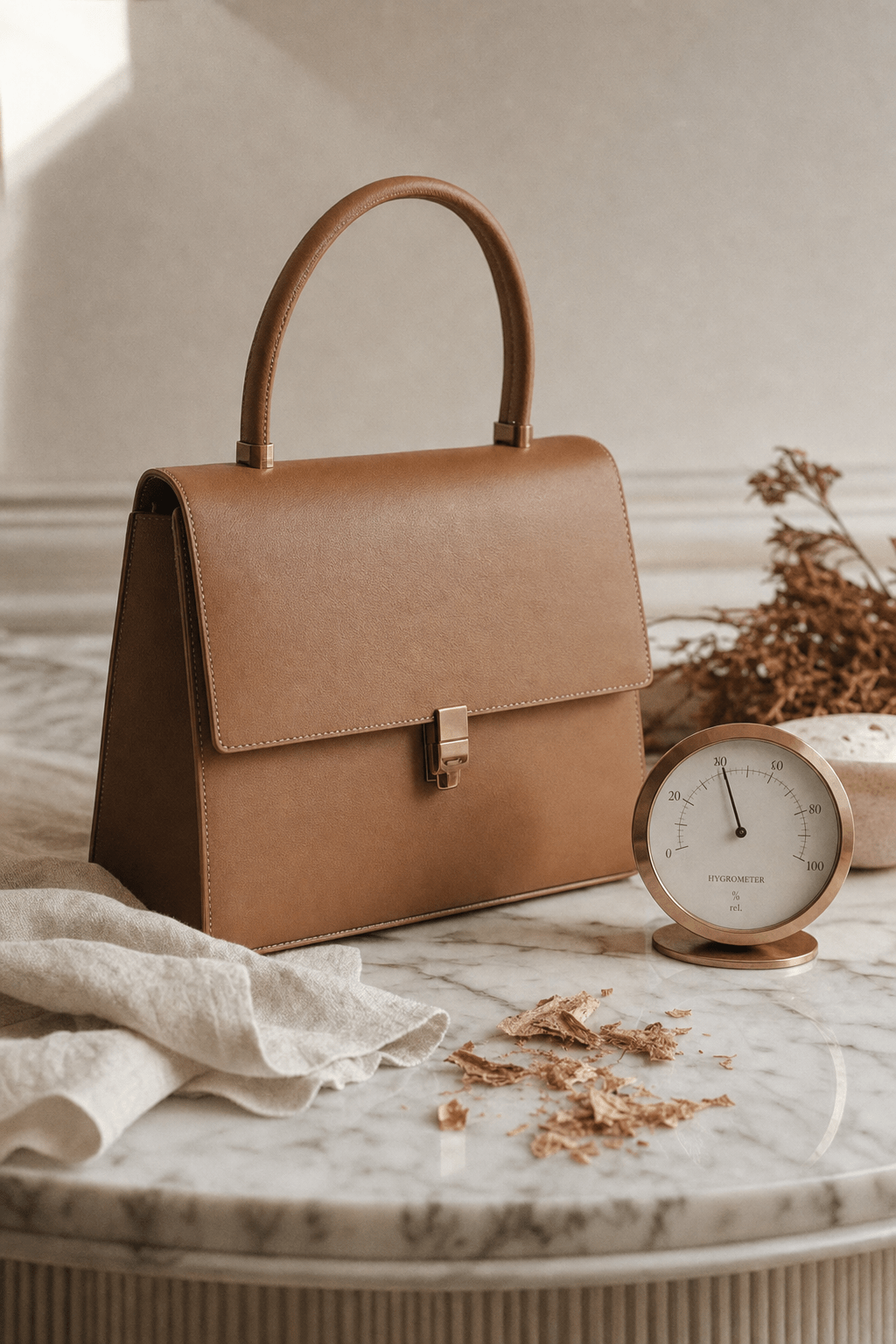
Most homes without active humidity control drift between roughly 30 and 65 percent RH over a year, tracking outdoor conditions and HVAC cycles. Closets are frequently worse than the main living space since they get less airflow — an interior closet on an exterior wall, or one in a basement or attic, can run 10 to 15 percentage points more humid or dry than the room next to it. The only way to know your actual closet humidity is to measure it, and a small hygrometer is the single best diagnostic tool for bag storage most owners never buy.

When to actually worry

Short excursions outside the 45–55 percent band are not an emergency. Leather has some buffering capacity, and a closet running at 40 percent for a few weeks in a dry spell will not meaningfully harm a bag. What warrants attention is sustained, months-long humidity well outside that range — persistent readings above 65 percent for weeks at a time, or below 30 percent for a full season. That is the threshold where mold risk becomes real on one end and cracking risk becomes real on the other.

What the professionals actually do

Archival and museum-grade leather storage relies on active climate control, not passive hope: dedicated storage rooms held at a constant temperature and humidity by equipment built for that single purpose, rather than a household HVAC system optimized for human comfort. Serious private collectors increasingly borrow the same idea at a smaller scale — a closet or cabinet with its own humidity control, rather than relying on whatever the room happens to run at. For most owners, a hygrometer plus a properly sized dehumidifier or humidifier for the specific climate, combined with shelving away from exterior walls and heating vents, gets most of the way there without a dedicated room. Our guide on storing Hermès leather in humid climates covers the equipment in more depth, and the principles apply across brands.

Expert tip: measure before you buy equipment

Do not buy a dehumidifier or humidifier based on a guess about your climate. Put a small hygrometer in the actual closet or cabinet where bags are stored and check it for two to three weeks across different weather. Some closets run drier or more humid than the rest of the house by a wide margin, and the equipment you need depends entirely on that specific reading, not on the general climate of your city.

What this means for storage in practice

The practical upshot is straightforward even though the underlying chemistry is not: hold the storage environment as close to 45–55 percent RH as you reasonably can, avoid large swings more than you avoid a merely suboptimal constant reading, and give a bag time to acclimate after any major environment change before assuming something is wrong with it. Beyond humidity specifically, the full storage protocol — shelving, dust bags, interior supports, rotation — is covered in our pillar guide on how to store luxury handbags properly, and the interior-support half is covered in our piece on why every handbag needs a dust bag, since a dust bag and a stable humidity closet solve two different halves of the same problem.

For bag-specific humidity failure modes, see why Birkins sag and how to fix it and how to store a Chanel Classic Flap. For the leather-specific side, our guides on Togo vs. Clemence vs. Epsom and caviar vs. lambskin cover how different finishes respond to the same humidity conditions.

Closing thoughts

Humidity is not a problem you solve once. It is a condition you manage continuously, because leather never stops exchanging moisture with the air around it. The fix is not exotic: a hygrometer to know what you are actually dealing with, equipment sized to your specific closet rather than your general climate, and a habit of holding the room steady rather than reacting only once a bag already shows visible damage. Get the environment right and the leather largely takes care of itself.

Read more

all Chanel

Why Chanel Bags Discolor — and How to Prevent It

Denim transfer, UV fading, moisture rings, oil absorption, and hardware tarnish each discolor Chanel leather differently. Here is what causes each one and the specific habits that prevent it.

Read more
louis-vuitton

Preventing Vachetta Patina: What Actually Works

Full prevention of vachetta patina is impossible, and most advice aimed at 'stopping' it makes the leather look worse, not better. Here is what actually slows and evens the process, and what is jus...

Read more