Building a Luxury Bag Collection: A Framework for Your First 5 Bags
Most new collectors build their bag rotation backward: they buy the bag they want most first, then spend the next two years discovering everything it cannot do. A Birkin does not replace a work tote. A trendy shoulder bag from three seasons ago does not age into a wardrobe staple. The bags that actually get carried for a decade are chosen for a role first and a feeling second, and the owners who end up with the most useful, most worn, best-holding collections are almost always the ones who thought about function before they thought about acquisition.
This is a framework for building the first five bags in a collection with intention, not a shopping list of specific SKUs. It is built around versatility over accumulation, a deliberate color and material progression, and a clear-eyed view of what belongs at each stage of a budget.
The philosophical framing: versatility over acquisition, style codes over trends
The instinct to buy the most exciting bag available is exactly backward for a first collection. A collection built around a house's enduring style codes — Chanel's quilting and chain, Hermès's structured silhouettes, Louis Vuitton's monogram canvas — ages well because those codes are designed to outlast a single season by definition. A collection built around whatever is trending in a given year ages in reverse: the bag that felt essential in the moment often feels dated within two or three years, and it rarely holds resale value the way a house classic does.
None of this means avoiding personality. It means sequencing personality correctly: build the functional foundation first, then layer in the pieces that are purely about what you love, once the foundation is actually covering your daily needs. A five-bag collection with no everyday workhorse is not really a functional wardrobe yet, no matter how impressive any individual piece is.
The five-bag framework
This framework assigns each bag a job. The specific model matters less than the role it fills, and the exact choice within each role should follow your actual life, not just what is popular.
Bag one: the everyday workhorse
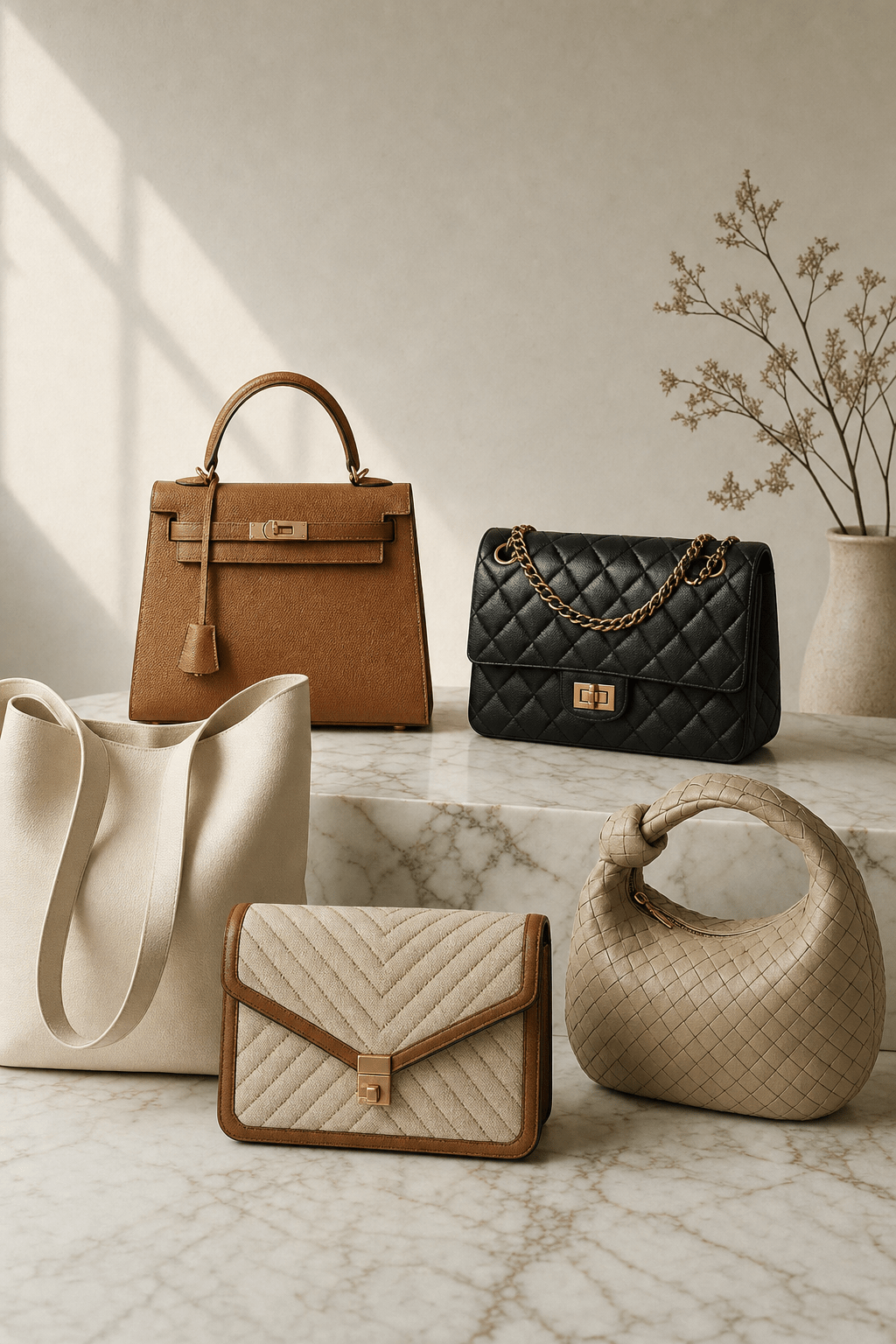
This is the bag that survives a commute, holds a laptop or a diaper bag's contents, and can be set down on a train floor without triggering panic. Structured totes built for daily volume — a Louis Vuitton Neverfull, a Bottega Veneta Cassette in a larger format, a Celine-style cabas, or a Dior Book Tote — fill this role well. This bag should be the most durable material in your collection, since it will see the most wear by a wide margin, and it should be sized for your actual daily carry, not for how it photographs. See our size comparison on the Neverfull MM vs. GM vs. PM for how to size this role correctly.
Bag two: the evening or dinner bag
Small, structured, hands-free or nearly so, and built to hold almost nothing beyond a phone, a card case, and lipstick. A Chanel Wallet on Chain or a Classic Flap in the small size fills this role for most collections, precisely because the quilted lambskin or caviar and chain strap read as finished and intentional at any dinner, wedding, or evening event without needing to match a specific outfit. This is the bag where a small, timeless silhouette matters more than interior capacity. Our guide on Chanel Classic Flap sizes breaks down which size actually functions as an evening bag versus a daytime one.
Bag three: the structured day tote
This sits between the workhorse and the evening bag: structured enough to look intentional in a client meeting or at lunch, but not so precious that you hesitate to use it on an ordinary Tuesday. A Louis Vuitton Alma BB, a Bottega Veneta Cassette in a compact size, or a similarly boxy, self-standing silhouette fills this role. The defining feature is structure: a bag that holds its shape without stuffing and stands upright on its own is doing a different job than the soft workhorse tote in slot one, even if the two overlap in size.
Bag four: the special-occasion investment piece
This is the aspirational anchor of the five, and the one most collectors want to buy first, which is exactly why it belongs fourth. A Hermès Birkin or Kelly, or a Dior Lady Dior, earns its place here because it is versatile enough for genuine regular use while also being the piece most likely to hold value over time, per our breakdown in which models actually hold value. Buying this piece before the first three foundational roles are covered usually means it gets carried constantly out of financial guilt about the price tag, which accelerates wear on the one bag in the collection that most benefits from a slower rotation. Our size guides on the Birkin 25 vs. 30 vs. 35 and Kelly 25 vs. 28 vs. 32 cover sizing this piece to actual use rather than aspiration alone.
Bag five: the personal-taste wild card
Once the first four roles are covered, the fifth bag is where personality gets to lead without a functional justification required. This is the color you love but would never buy first, the house whose codes speak to you personally rather than to resale logic, or a genuinely unusual silhouette. A Goyard tote in an unusual colorway, a Bottega piece from a design era you personally connect with, or a bold Chanel in a seasonal leather all belong here. The wild card is earned, not skipped to.
Expert tip: assign the role before you shop, not after
Before browsing, write down which of the five roles you are actually missing. Shopping with a defined gap in mind — "I need a structured day tote," not "I want a nice bag" — keeps you from buying a second version of a role you have already filled and calling it collection-building.
How to prioritize: needs first, aspiration later
The order above is not arbitrary. Bags one through three solve real, frequent problems — commuting, evenings out, client-facing days — and get carried often enough that cost-per-wear makes even a mid-tier price tag reasonable quickly. Bag four is the aspirational piece that benefits from being bought once the daily rotation is already covered, both financially and practically, since you will not feel pressure to overuse it. Bag five is pure enjoyment, appropriately positioned last because it is the easiest role to justify skipping if the budget runs out, without leaving a real functional gap in the collection.
Color logic: start neutral, add color slowly
The single most common regret among new collectors is buying a bold color too early and finding it clashes with more of their wardrobe than expected. Start the first two or three bags in neutrals that pair with nearly everything: black, cognac or saddle brown, and a deep neutral like navy or taupe. These colors also tend to hold resale value better than seasonal or trend colors, since they appeal to the widest pool of future buyers if you ever sell. Save bright colors, exotic-look finishes, and unusual hardware tones for the fourth and fifth bags, once the neutral foundation already covers daily versatility and a color choice becomes an addition rather than a risk.
Material diversity: don't buy five lambskins
It is easy to fall in love with one leather finish and buy every bag in it, and this is a mistake for reasons beyond aesthetics. Different leathers wear differently, need different care, and photograph and drape differently, so a collection built entirely in one material — five lambskin bags, for instance — ends up feeling repetitive in daily use despite looking varied on a shelf. Deliberately diversify: a durable coated canvas or caviar leather for the workhorse role, a soft lambskin or suede for the evening bag where daily abrasion is not a concern, and a structured leather like Epsom, box calf, or a heavier cowhide for the day tote and investment piece, where shape retention matters more than softness. Our guides on Togo vs. Clemence vs. Epsom and caviar vs. lambskin cover how these material choices affect both daily performance and long-term care.
The mistake of buying trendy pieces first
A bag that is trending heavily right now is, by definition, a bag a large number of other people are also buying right now, which means the market will likely be saturated with it in resale within a few years, and its cultural relevance has a shorter shelf life than a house classic. Building the first two or three slots in your collection around a current trend piece instead of a foundational role leaves you with a wardrobe gap disguised as a collection.
New vs. pre-loved, by tier
The right sourcing decision changes by role. For the everyday workhorse, buying pre-loved in excellent condition is usually the smartest financial move, since this bag will absorb the most wear regardless of its starting condition and the savings can be substantial. For the evening bag and structured day tote, either new or pre-loved works well, and the decision usually comes down to whether a specific color or hardware combination matters enough to justify paying full retail. For the investment piece, sourcing depends heavily on the brand: Hermès availability often makes resale and consignment the realistic path regardless of preference, while Chanel and Dior are more commonly available new. For the wild card, buying pre-loved from a specific design era you love is often the only way to get exactly the piece you want, since limited or discontinued colorways are rarely available new.
Budget tiers: what belongs at each level
Budget shapes which specific models fill each role, though the five-role framework holds at every tier.
- $1,500–2,500 per bag. This tier covers a strong workhorse tote and a solid structured day bag from houses like Louis Vuitton or a comparable house, along with entry-level pieces from brands where a true investment piece is out of reach. The evening-bag role at this tier often means a well-made smaller bag from a similar price bracket rather than a Chanel flap.
- $2,500–5,000 per bag. This range opens up a Chanel Wallet on Chain or small flap for the evening role, a Bottega Veneta Cassette for the structured tote role, and stronger workhorse options. It is the tier where most of the framework's first three roles become realistically achievable in well-regarded houses.
- $5,000–10,000 per bag. This is where a full-size Chanel Classic Flap, a Dior Lady Dior, or an entry Hermès piece like a Picotin or Constance becomes realistic, and where the investment-piece role starts to come into reach for some buyers, depending on availability.
- $10,000-plus per bag. This tier covers a Birkin or Kelly outright, the clearest fulfillment of the investment-piece role, along with exotic-leather or limited pieces for the wild-card role.
Whatever tier you are working within, the sequencing logic holds: cover the roles you actually use before reaching for the role that photographs best. A $2,000 workhorse tote used four days a week outperforms a $12,000 investment piece that sits in a closet because there is nowhere in your life to wear it yet.
Closing thoughts
A collection is not the same thing as an accumulation of expensive bags, and the difference is entirely in the planning. Five bags chosen for five distinct roles, in a deliberate color and material progression, will get carried more, hold value better, and feel more considered than five bags chosen because each one, individually, seemed like a good idea at the time. Start with the workhorse. Let the wild card wait. And once the collection is built, our guide on how to store luxury handbags properly covers what it takes to keep all five in the condition that made them worth building around in the first place.