Authenticating Luxury Bags: A Buyer's Checklist for the Secondary Market
The counterfeit market for luxury handbags has changed in a way most buyers have not caught up to. A decade ago, a fake was usually identifiable at a glance: wrong font, cheap hardware, an obviously synthetic lining. Today's best counterfeits, commonly called super-fakes, replicate stitching patterns, hardware weight, interior stamps, and even the specific smell of vegetable-tanned leather closely enough to fool casual inspection and, in some documented cases, fool experienced resellers as well. Authentication is no longer a formality you do out of caution. It is a skill and a process, and treating it casually on a five-figure secondary-market purchase is one of the more expensive mistakes a collector can make.
This is the cornerstone authentication reference for the secondary market: the three-tier authentication ecosystem available to buyers, the universal anchors that apply across every brand, the brand-specific tells worth knowing, red flags in listings, how to safely engage an authenticator before you buy, and what to actually do if you discover you were sold a fake.
Why authentication matters more now than ever
The gap between a convincing counterfeit and a genuine bag has narrowed dramatically over the past several years, driven by counterfeiters gaining access to better materials, more accurate pattern data, and in some cases genuine components sourced from supply chain leaks. Super-fakes can replicate the correct leather grain, the correct hardware plating and weight, and stitch counts that pass a casual visual check. Some are convincing enough that they occasionally pass initial screening at consignment platforms before being caught by deeper inspection or, in rare cases, are not caught at all.
The financial stakes have also grown alongside the counterfeit quality. A decade ago, a buyer fooled by a low-quality fake was typically out a few hundred dollars. Today, the same lapse in diligence on a five-figure Birkin, a discontinued Chanel, or a rare Louis Vuitton collaboration piece can mean losing tens of thousands of dollars with very little practical recourse if the purchase happened through an unprotected private-party channel. The rise in value at stake is itself a reason the authentication process deserves more rigor than it did when counterfeits were easier to spot and the money on the line was smaller.
This does not mean authentication is hopeless. It means the bar for a confident authentication has risen, and relying on outdated advice, like checking for a serial number sticker that a brand phased out years ago, or trusting a listing's included authentication card at face value, is no longer sufficient on its own. It means combining several of the layers below rather than relying on any single check.
The three-tier authentication ecosystem
Tier one: visual inspection you can do yourself
This is the first pass every buyer should do regardless of what else follows: examining stitching, hardware, interior stamps, leather texture, and overall proportions against known reference points for the specific model and era. It catches obvious and moderate-quality fakes reliably. It does not reliably catch a genuine super-fake, and buyers should not treat passing a visual self-check as full authentication for anything above a moderate price point.
Tier two: third-party authentication services
Independent authentication services, such as Authenticate First, Real Authentication, and Entrupy, examine bags using a combination of trained human expertise and, in Entrupy's case, a microscopic image-matching database trained on verified genuine and counterfeit examples. These services generally offer a fast turnaround, a written certificate or report, and a level of specialization that most individual buyers cannot replicate on their own. They are not infallible, and different services occasionally disagree on a borderline item, but they represent a meaningfully higher confidence level than self-inspection alone, and are the standard recommendation for any purchase where real money is at stake.
Tier three: brand-direct authentication
Most luxury brands do not offer authentication as a public service, and several explicitly decline to authenticate items for owners who did not purchase directly from the brand, citing legal and liability concerns rather than a technical inability to do so. Some brand boutiques will informally decline to service an item they identify as counterfeit during a repair intake, which functions as a kind of indirect authentication, but this should not be relied upon as a purchase-time verification method, since it typically only happens after you already own the item.
Universal authentication anchors that apply across brands
Stitching regularity
Genuine luxury leather goods are produced with remarkably consistent stitch length, spacing, and tension across an entire bag, reflecting both quality machinery and, for some brands, significant hand-finishing by trained artisans. Irregular stitch spacing, visibly uneven tension, or stitches that wander slightly off a straight line are common tells on lower- and mid-tier counterfeits, though top-tier super-fakes have closed much of this gap and should not be relied on alone.
Leather smell and feel
Genuine vegetable-tanned and chrome-tanned leathers used by major luxury houses have a distinct smell and hand-feel that is difficult, though not impossible, for counterfeiters to replicate exactly, particularly the specific supple density of high-grade calfskin or lambskin versus the flatter, sometimes chemical smell of lower-grade or bonded leather substitutes used in many counterfeits. This is a skill built through handling many genuine examples, and it is one of the reasons experienced resellers and authenticators develop an instinct that is difficult to teach through a written checklist alone.
Hardware weight and finish
Genuine hardware on major luxury bags is typically solid metal with substantial weight, a smooth, consistent plating, and engraved or stamped logos with clean, precise edges. Lightweight, hollow-feeling hardware, plating that shows brassy or uneven color at the edges, or logos with soft, slightly blurred engraving are common counterfeit indicators, though again, the best counterfeits have improved hardware sourcing significantly in recent years.
Interior stamps and date codes
Interior heat stamps, embossed logos, and date or serial codes follow specific, brand-defined formats, fonts, and placement conventions that change over specific periods. A stamp in the wrong font, wrong location, or a date code format inconsistent with the bag's apparent production era is a strong red flag, though this requires knowing the specific brand's conventions for the relevant period, which is where brand-specific research or a specialist becomes necessary.
Dust bags and boxes: authentic but commonly counterfeited too
A correct dust bag, box, and accompanying paperwork can support authenticity but should never be treated as proof on their own, since packaging is itself commonly counterfeited or, less maliciously, is sometimes swapped between a genuine bag and a counterfeit by resellers, whether through error or intent. Packaging is corroborating evidence at best, never a standalone authentication method.
Brand-specific tells worth knowing
Hermès blindstamps
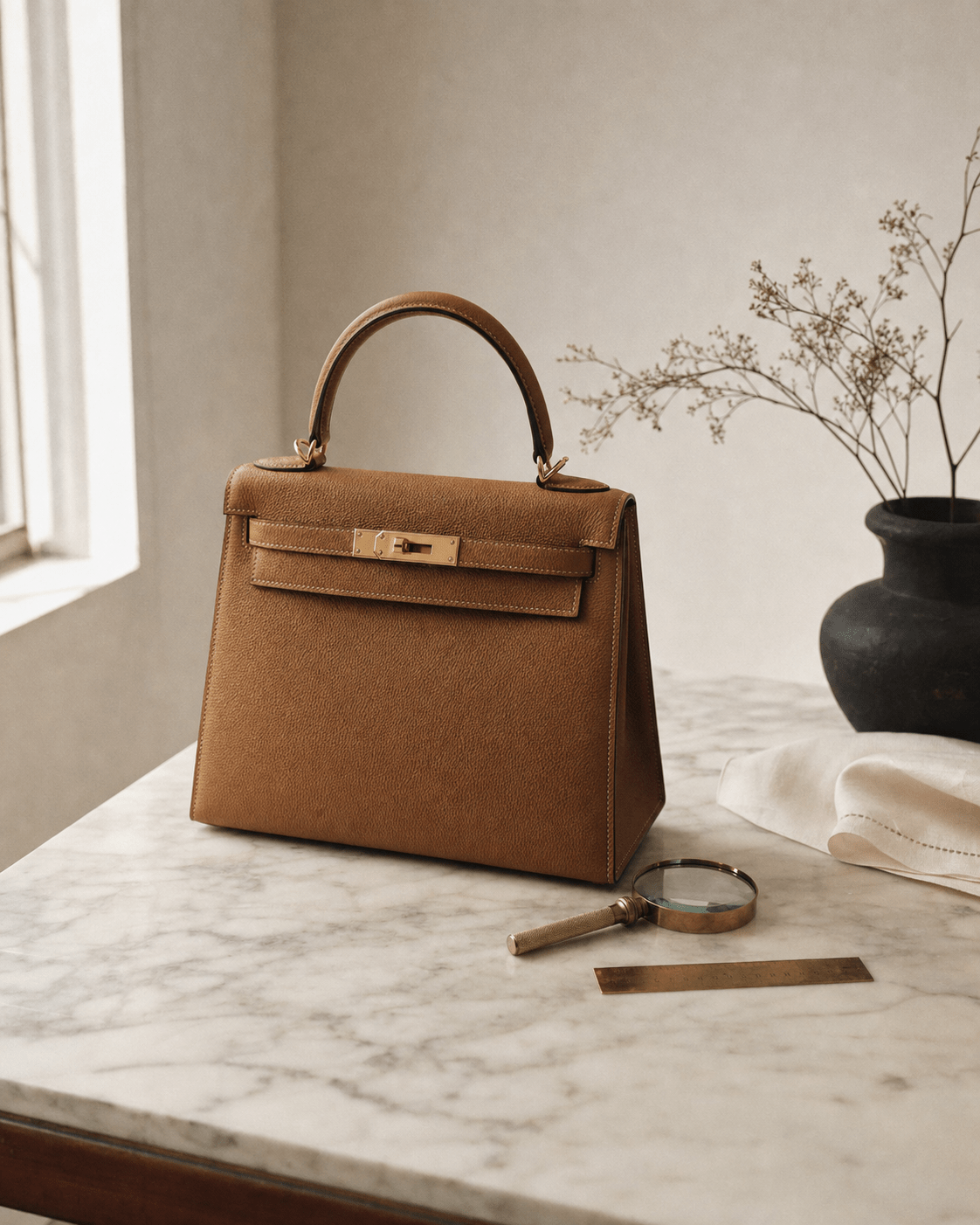
Hermès stamps a craftsman's blindstamp and a date stamp inside its bags, using a letter-and-shape system that changed over the decades and is well documented among specialists. Blindstamp placement, depth, and the specific letter-shape combination for a given production year are all checkable details, though counterfeiters have gotten considerably better at replicating the visual appearance of these stamps in recent years, making stamp inspection alone insufficient for a high-value Birkin or Kelly purchase.
Chanel authenticity cards and the 2021 serial number change
Chanel historically included a serial number sticker and matching authenticity card with each bag, and older guides built entire authentication approaches around checking this number against known valid ranges. Chanel discontinued the traditional serial sticker system in 2021, transitioning to a different, less publicly documented internal tracking approach. This means outdated advice telling buyers to simply check a serial number against a public range is no longer reliable for bags made after that transition, and buyers relying on serial-number checklists found through a general search should confirm the advice reflects the post-2021 system, not the older one.
Louis Vuitton date codes phased out in 2021
Louis Vuitton similarly moved away from its traditional stamped date code system, which indicated factory location and production date through a letter-and-number combination, around 2021, shifting toward less externally verifiable internal systems on newer production. As with Chanel, this means date-code checklists remain useful for older bags but are not a complete authentication method for recent production.
Dior microchips on 2021-and-later pieces
Dior introduced embedded authentication microchips on select pieces starting around 2021, allowing verification through near-field communication scanning in some cases. This is a meaningfully different authentication paradigm from stamp or stitching inspection, and it is only available on pieces produced after the feature's introduction, meaning it does not help with earlier Dior bags.
Bottega Veneta and Goyard: no serial numbers, so provenance matters more
Bottega Veneta and Goyard have historically not used individual serial numbers or date codes on most of their leather goods, which shifts the authentication burden more heavily onto construction quality, hardware, and provenance documentation than it would for a brand with a checkable internal numbering system. For these brands specifically, purchase history, receipts, and the reputation of the seller carry more relative weight than they would for a brand where a specific code can be checked against known formats.
How condition and originality interact with authentication
A genuine bag that has been heavily repaired, has had hardware replaced with non-original parts, or has been relined by a third-party restorer can complicate an otherwise straightforward authentication, since some of the details an authenticator would normally check, original stitching, original hardware, an untouched interior stamp, may no longer be fully original even though the bag itself is genuine. This is different from counterfeiting, but it matters for value and should be disclosed by any honest seller. Ask directly whether a bag has had any repairs, part replacements, or restoration work, and treat a seller's reluctance to answer this question as its own kind of red flag, separate from the authenticity question itself.
Red flags in secondary-market listings
- A price meaningfully below the going secondary-market rate for that specific model and condition. A steep discount on a genuinely desirable, high-demand piece is one of the most reliable red flags there is.
- Stock photos instead of photos of the actual item. Any listing unwilling or unable to provide original photos, including close-ups of stamps, stitching, and hardware, should be treated with suspicion.
- Vague or evasive answers about provenance. A seller who cannot or will not explain where and when the bag was purchased, especially for a higher-value piece, is a warning sign worth taking seriously.
- Pressure to complete the transaction quickly or off-platform. Sellers pushing a buyer toward a direct payment method outside a platform's buyer protections are frequently trying to avoid the scrutiny or recourse those protections would provide.
- Reused or stock-photo authenticity certificates. A generic-looking certificate that does not appear to specifically match the item's individual details is not meaningful evidence of anything.
When to walk away
Walk away from a listing when a seller refuses additional photos of specific verification points, when the price and provenance story do not add up together, when a seller becomes evasive or hostile in response to reasonable authentication questions, or when your gut sense after handling similar genuine pieces does not match what you are looking at, even if you cannot articulate exactly why. Experienced collectors consistently describe a specific instinct that develops from handling many genuine examples, and dismissing that instinct because a bag otherwise "checks the boxes" is a common way buyers talk themselves into a bad purchase.
How to safely engage an authenticator before you buy
For a private-party or marketplace purchase, request detailed photos of every standard verification point, stitching, hardware close-ups, interior stamps, any date or serial codes, and the overall bag from multiple angles, before sending any payment. Submit these to a third-party authentication service and get a written opinion before finalizing the purchase, not after. Many services can render an opinion from photos alone within a day or two for a modest fee, which is a small cost relative to the price of a mistaken purchase. If a seller refuses to provide the specific photos an authenticator requests, treat that refusal itself as meaningful information.
Common authentication mistakes
- Relying on an outdated serial-number checklist. Chanel and Louis Vuitton both moved away from their traditional public numbering systems around 2021, and older guides do not reflect this.
- Treating a matching dust bag and box as proof of authenticity. Packaging is commonly counterfeited or swapped and should only ever be corroborating evidence.
- Skipping third-party authentication on a high-value purchase to save a modest fee. The fee is a small fraction of the risk on anything above a moderate price point.
- Assuming Bottega Veneta or Goyard pieces can be checked against a serial number. Neither brand uses one on most pieces, which makes provenance and seller reputation more important, not less.
- Ignoring a steep discount because the rest of the listing looks convincing. Price that is meaningfully below market for a desirable model is one of the most reliable red flags available.
- Paying outside a platform's protected payment system to "save on fees." This eliminates your recourse if the item turns out to be counterfeit.
What to do if you were sold a fake
Chargebacks
If you paid by credit card, a chargeback through your card issuer is often the fastest path to recovering funds for a counterfeit item, particularly if you have a written third-party authentication opinion confirming the item is not genuine. Card issuers generally have a specific dispute window, so act promptly rather than waiting.
Platform policies
Reputable resale platforms, including those referenced below, generally have specific counterfeit policies and buyer protections, and reporting the issue directly through the platform, with your authentication documentation attached, is usually the first and most effective step for a marketplace purchase.
Small claims court
For a private-party sale outside any platform protection, small claims court is a realistic option for recovering funds on a counterfeit sale, particularly with a written authentication opinion and a documented paper trail of the transaction. The process varies by jurisdiction, but it does not require an attorney in most small claims systems and is designed to be accessible for exactly this kind of dispute.
Expert tip: buy from reputable consignors with authenticity guarantees
Platforms like Fashionphile, The RealReal, Rebag, and Vestiaire Collective build in-house or third-party authentication into every listing and back it with an explicit authenticity guarantee, meaning the platform, not just the individual seller, stands behind the item. This does not make authentication irrelevant. It shifts a meaningful share of the diligence burden onto an organization with dedicated authentication infrastructure and financial accountability if they get it wrong, which is a materially different risk profile than a private-party marketplace transaction with no such backing.
Closing thoughts
Authentication used to be a five-minute visual check. It is now a layered process that combines self-inspection, brand-specific knowledge, and, for anything of real value, a third-party opinion before money changes hands. The buyers who get burned are rarely the ones who did no research at all; they are usually the ones who did a reasonable-sounding checklist from an outdated guide and stopped there, on a bag good enough to pass exactly that checklist. Combine the tiers, trust a documented red flag over a convincing story, and treat a reputable consignor's guarantee as a real risk reduction, not a formality. For the storage and care practices that keep a verified genuine bag in the condition that supports its resale value going forward, see the pillar guide on how to store luxury handbags properly.