Skip to content

Cart

Your cart is empty

Article: Why Tissue Paper Is Ruining Your Bags

Why Tissue Paper Is Ruining Your Bags

Most people storing a handbag with tissue paper are using the wrong tissue paper, and a fair number are using the right idea in the wrong quantity. Regular white tissue — the kind sold in gift-wrap aisles, the kind stuffed into shopping bags at checkout — is acidic, and acidic paper yellows and weakens leather over months and years of direct contact. This is not a fringe concern. It is one of the most common, least-understood causes of slow discoloration in stored handbags, and it is entirely avoidable once you know what to actually buy.

Here is what acid content actually does to leather, why some "acid-free" tissue can still cause problems, and what to use instead, including when a shaped support beats tissue outright.

Why regular tissue paper is a problem

Most inexpensive tissue and wrapping paper is made from wood pulp that retains lignin, an acidic compound naturally present in wood fiber. Left in prolonged contact with another material, that acidity migrates — a process conservators call acid transfer or acid migration. On leather, sustained contact with acidic paper accelerates yellowing, particularly on light and undyed leathers, and can contribute to a subtle embrittlement of the surface over years of repeated storage cycles. The paper does not need to look damaged itself for this to happen; the acidity is a property of the pulp, not something you can see.

This is the same reason archives and museums do not store textiles, photographs, or leather goods in contact with standard paper. The library and conservation world solved this problem decades ago with archival-grade acid-free tissue, and that same standard applies directly to handbag storage.

Acid-free tissue: the baseline you actually want

Acid-free tissue is manufactured or treated to remove lignin and buffer the paper to a neutral or near-neutral pH, so it does not transfer acidity into whatever it touches. This is the minimum standard for any tissue paper that will sit inside a bag or against leather for weeks or months at a time. It is inexpensive, widely available from archival and packaging suppliers, and the single easiest upgrade most bag owners can make to their existing storage routine.

The buffered vs. unbuffered distinction, and why it is counterintuitive

Within acid-free tissue there is a further split that trips up even careful owners: buffered and unbuffered. Buffered tissue has an alkaline reserve added during manufacturing, typically calcium carbonate, which actively neutralizes acids that migrate into the paper over time. This makes buffered tissue the better choice for cellulose-based materials — cotton, linen, most paper archives — because it protects against acids from an external source.

Leather and silk are the counterintuitive exception. Both are protein-based materials, and the alkaline buffering agents in buffered tissue can be too high a pH for them, potentially contributing to dryness or fiber degradation in leather over very long exposure, and yellowing in silk specifically. For leather handbags, the correct choice is unbuffered acid-free tissue — neutral pH, no added alkaline reserve. This detail is where a lot of well-intentioned tissue purchases go slightly wrong: shoppers see "acid-free" and assume that is the full spec, when buffered acid-free tissue is actually the wrong acid-free tissue for a leather bag.

Colored tissue and dye transfer

Color is its own separate risk, independent of acid content. Dyed tissue paper, including tissue that is otherwise acid-free, can transfer color onto light leathers through prolonged direct contact, especially in humid conditions where moisture helps mobilize dye molecules between the paper and the leather surface. This includes the colored tissue that comes standard in boxes from Chanel, Louis Vuitton, and other luxury houses — tissue that is often genuinely acid-free but still dyed, which does not eliminate the dye-transfer risk.

For light-colored, pale, or undyed leathers specifically, use plain white or natural unbuffered acid-free tissue rather than any colored variant, regardless of how "safe" the dye is marketed to be. For dark leathers, dye transfer from tissue is a much smaller practical concern, since any minor transfer is not visible against a dark surface.

How much tissue is actually enough

Owners tend to fall into one of two failure modes here, and both cause problems. Using no tissue at all leaves a structured or quilted bag unsupported, which allows the panels to collapse and crease over time — a separate but related failure covered in depth in our piece on why Birkins sag and how to fix it. Overstuffing is the opposite mistake: packing so much tissue into a bag that it stretches the leather, gussets, and seams beyond their resting shape, which is a particular risk with soft, unstructured leathers that have little internal resistance to being pushed outward.

The right amount fills the bag to roughly its natural, worn shape — full enough that the sides, corners, and any quilting hold their intended form, but not so full that the bag looks visibly rounder or more swollen than it does when carried normally. Loosely crumpled sheets, rather than tightly wadded balls, distribute more evenly and are easier to judge by feel.

Common tissue paper mistakes

  • Using regular gift-wrap or shopping-bag tissue. Standard tissue is acidic and will yellow leather over months of direct contact.
  • Assuming "acid-free" is the whole spec. Buffered acid-free tissue is the wrong acid-free tissue for leather and silk; unbuffered is correct.
  • Using colored tissue on light leather. Even acid-free colored tissue can transfer dye onto pale leather, especially in humid storage.
  • Overstuffing. Too much tissue stretches soft leather and seams beyond their resting shape.
  • Never replacing old tissue. Tissue degrades and absorbs ambient moisture over time, and old, saturated tissue is doing less than it appears to.

Tissue as a support vs. a pillow: they are not the same job

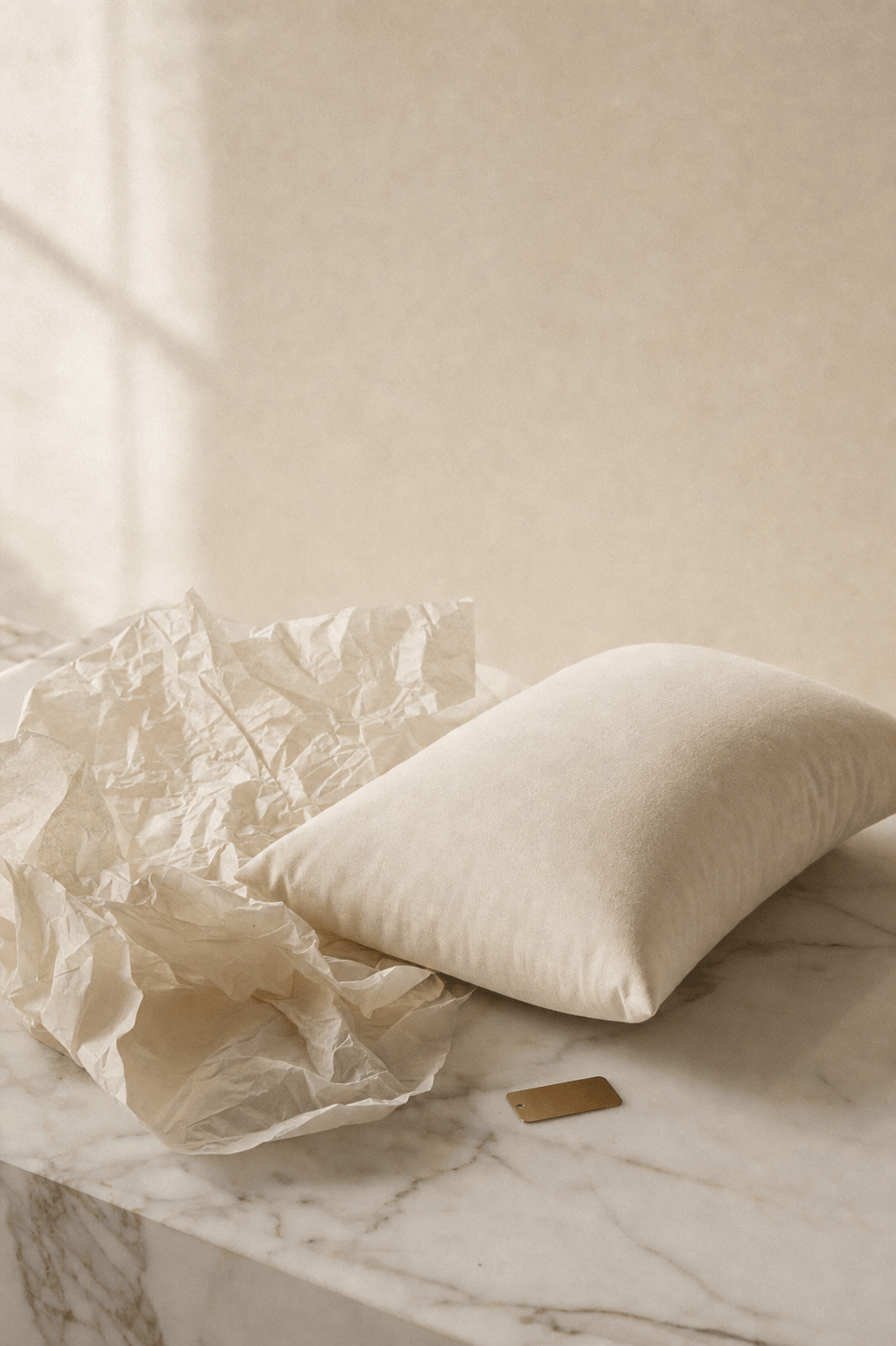
Tissue paper is a temporary, adjustable filler. It can be shaped roughly to a bag's interior, but it shifts, compresses, and settles over weeks of storage, which means the shape it holds on day one is not necessarily the shape it holds three months later. A shaped pillow insert, by contrast, is built once to a specific silhouette and holds that shape consistently for as long as it sits inside the bag, without the gradual settling and re-fluffing that tissue requires.

For short-term storage — a bag put away for a week or two between wears — tissue is entirely adequate. For long-term storage, seasonal rotation, or any bag with a shape that matters a great deal to its resale value, a shaped insert is the more reliable long-term option, precisely because it does not need to be checked and re-fluffed the way tissue does. Fabrinique's purse pillow inserts for the Hermès Birkin are built to that bag's specific silhouette for exactly this reason, and similar shaped inserts exist for other structured bags.

Replacement schedule

Tissue paper is not a permanent fixture. It absorbs ambient moisture over time, can pick up faint odors from a closet or storage box, and gradually loses the loft that lets it hold a bag's shape. Replace the tissue inside a stored bag every few months during an extended storage period, and always replace it if the bag has been exposed to any humidity, spill, or odor that the tissue may have absorbed. This is a five-minute task that is easy to skip precisely because old tissue does not look obviously different from fresh tissue at a glance.

The tissue that came in your box

The tissue paper packed into a new bag's box from Chanel, Louis Vuitton, or Hermès is generally fine for the short term — boutiques do not want to damage their own product before it reaches you, and boutique packaging tissue is typically better quality than gift-wrap tissue. The caveat is the same as above: it is often colored, and colored tissue against light leather carries the same dye-transfer risk regardless of who made it. For a bag going into long-term storage rather than staying in weekly rotation, swap the original box tissue for plain unbuffered acid-free tissue or a shaped insert, and keep the original tissue separately if you want it for authenticity or resale purposes.

Expert tip: keep the box tissue, but don't rely on it long-term

There is no need to throw away the tissue your bag arrived in — some buyers and appraisers view original packaging as a small point in favor of authenticity. Just do not treat it as your long-term storage solution. Move it aside, use proper unbuffered acid-free tissue or a shaped insert for actual storage, and keep the original tissue in a drawer rather than in contact with the bag for years at a stretch.

What to actually buy

For most owners, the practical decision is between two options. Unbuffered, acid-free archival tissue is inexpensive, widely available, and correct for short and medium-term storage of any leather handbag, provided you use enough of it and replace it periodically. A shaped pillow insert costs more upfront but requires no replacement schedule, holds the bag's silhouette more consistently over long storage periods, and is the better choice for bags in long-term rotation or bags whose resale shape matters — solving the stuffing question permanently rather than requiring you to get the tissue type, color, and quantity right every single time.

For the fuller storage picture beyond stuffing specifically — shelving, dust bags, humidity — see our pillar guide on how to store luxury handbags properly. Stuffing and the dust bag that goes over it solve two different halves of the same problem, which our piece on why every handbag needs a dust bag covers in more depth.

Closing thoughts

Tissue paper looks like the most trivial part of handbag storage, which is exactly why it gets the least attention and the most mistakes. Regular tissue is acidic and will yellow leather over time. Buffered acid-free tissue is the wrong kind of acid-free for leather. Colored tissue risks dye transfer on light bags regardless of acid content. None of these are difficult problems to avoid — they just require knowing that "acid-free" on a label is not automatically the full answer, and that a shaped pillow insert removes the question entirely for a bag you care about keeping in shape for years.

Read more

Silica Gel, Dehumidifiers, and Cedar: What Actually Works in a Bag Closet

Ask five handbag owners how they control humidity in their storage closet and you will get five different answers: a few silica packets saved from a shoebox, a cedar block bought because it smelled...

Read more
cannage

How to Store a Lady Dior

The Lady Dior's rigid frame prevents slouching, but that same structure shifts the real risks to cannage stitch tension, lambskin surface marking, corner scuffing, and hardware tarnish. Here is the...

Read more