Silica Gel, Dehumidifiers, and Cedar: What Actually Works in a Bag Closet
Ask five handbag owners how they control humidity in their storage closet and you will get five different answers: a few silica packets saved from a shoebox, a cedar block bought because it smelled nice, or a vague plan to "get a dehumidifier eventually." Almost none are using enough of any of these tools to actually matter, and one of the three is popular for reasons that have little to do with what it actually does. Here is an honest, mechanism-level rating of silica gel, dehumidifiers, and cedar, and what actually works for a real bag closet.
The short version, if you want it before the detail: a dehumidifier beats a large quantity of silica gel, which beats cedar by a wide margin for leather specifically. But each tool has a real role, and the right combination depends on your climate and how much closet you are trying to control.
Silica gel: underused by almost everyone who owns it
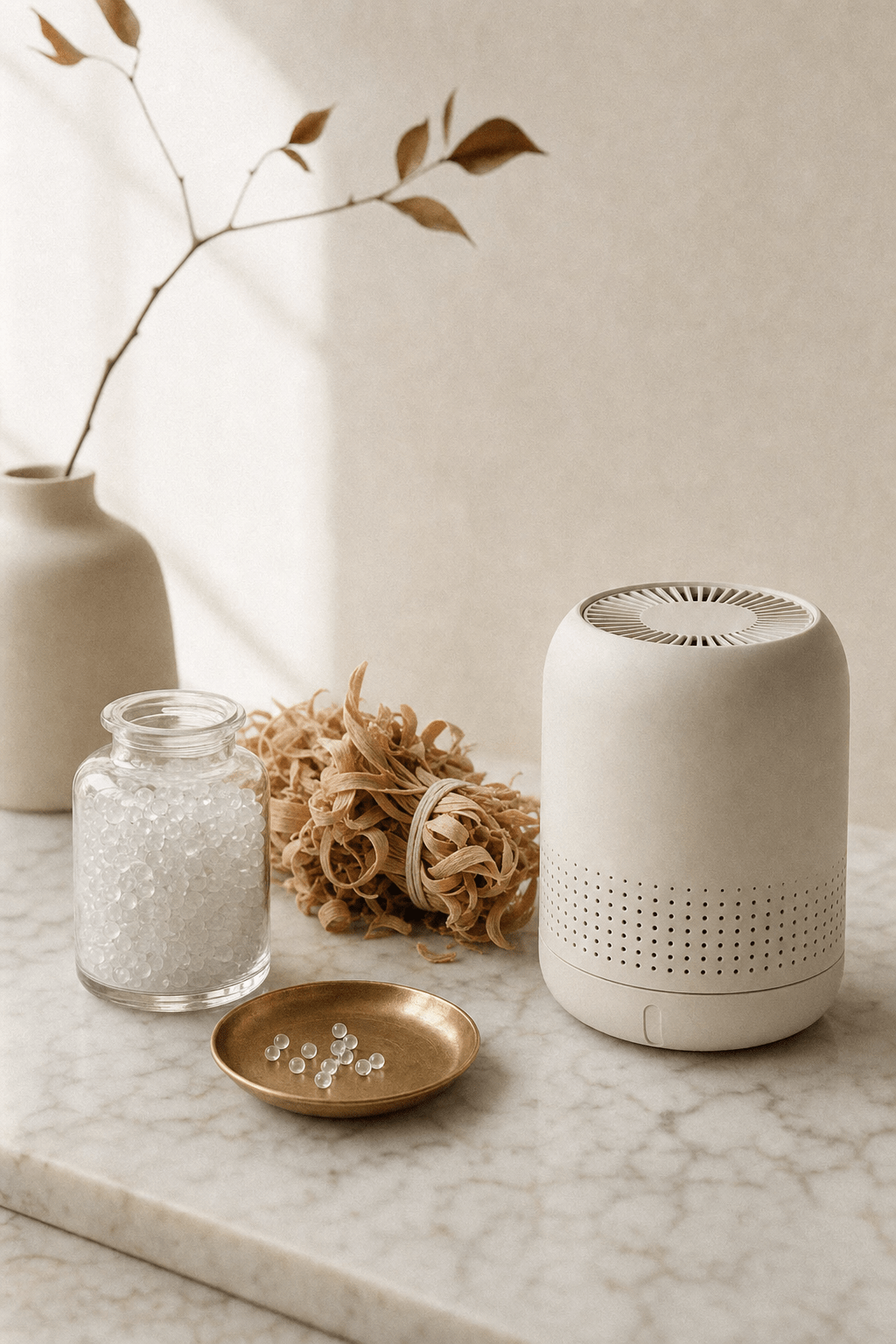
Silica gel is a desiccant — a porous material with an enormous internal surface area that physically adsorbs water vapor from the air around it, holding the moisture within its structure rather than reacting with it chemically. It is the same material in the little packets that come inside shoe boxes and electronics packaging, just usually in far too small a quantity to matter for a bag closet.
How much you actually need
This is where almost every owner underuses the tool. A single 2-gram packet saved from a shoebox does essentially nothing in a closet-sized space; it has enough capacity for the tiny sealed box it originally shipped in, not for a few cubic feet of open closet air that is constantly exchanging with the rest of the room. For a full hanging closet or a bag cabinet, you need on the order of 500 grams or more of silica gel, distributed across several containers rather than concentrated in one spot, to meaningfully buffer humidity swings. For a single shelf or a small cabinet, a few hundred grams split into two or three sachets is a reasonable starting point. Most people who say silica gel "doesn't work" are using roughly 1 percent of the quantity that would actually do something.
Recharging silica gel
Silica gel is reusable almost indefinitely, which makes the quantity requirement much less expensive than it sounds. Once it has absorbed close to its capacity, spread the beads on a baking sheet and heat in an oven at around 250°F (120°C) for two to three hours, which drives off the absorbed moisture and restores adsorption capacity. Indicator silica gel, which contains a color-changing additive, turns from blue or orange to a lighter shade or pink as it saturates, giving you a visual cue for when to recharge rather than guessing. Plain silica gel works identically as a desiccant but gives no visual signal, so you either recharge on a fixed schedule or buy indicator beads specifically for the convenience.
Replacement and recharge schedule
In a humid climate, plan to recharge silica gel every one to two months during the wettest season. In a moderate climate, every three to four months is usually sufficient. Indicator beads make this simple; without them, set a calendar reminder rather than relying on memory, since saturated silica gel sitting past its capacity is functionally doing nothing for the closet.
Dehumidifiers: the actual solution for most climates
A dehumidifier actively removes moisture from the air by drawing air across a cold coil or a desiccant wheel, condensing or capturing the water, and returning drier air to the room. Unlike silica gel, which passively buffers whatever moisture is already present, a dehumidifier continuously lowers the ambient humidity of the space, which is a fundamentally more powerful intervention for a closet that runs persistently humid.
Compressor vs. desiccant types
Compressor (refrigerant) dehumidifiers cool air across a coil to condense moisture and work best in warm, humid conditions — they lose efficiency as temperatures drop, and most stop working effectively below roughly 65°F. Desiccant dehumidifiers use a moisture-absorbing wheel and a heating element to regenerate it, and they remain effective in cooler temperatures where compressor units struggle, making them the better choice for an unheated closet, basement, or cooler climate.
Sizing to your space
Dehumidifiers are rated by pint capacity per 24 hours, and the right size depends on the square footage and how humid the space runs. A small, sealed closet or bag cabinet is usually well served by a compact mini-dehumidifier rated for a few hundred cubic feet — these are the small rechargeable or plug-in units that cost around $25 to $40 and quietly pull moisture from an enclosed space without meaningful noise or energy draw. A full walk-in closet or a dressing room, especially in a genuinely humid climate, needs a proper appliance-grade unit rated in the 20 to 30-plus pint range, which is a bigger investment but a categorically more effective one.
Expert tip: match the unit to the space, not the budget
A $30 mini-dehumidifier in a large, leaky closet will run constantly and still lose to the humidity coming in around the door. The same unit inside a small, well-sealed cabinet can hold humidity steady for weeks on a single charge or tank. Before buying, seal up obvious gaps around closet doors and vents, then size the unit to the resulting enclosed volume, not to the price point you had in mind.
Noise and energy use
Compact mini-dehumidifiers are effectively silent and draw minimal power, comparable to a phone charger, making them reasonable to run continuously in a bedroom closet. Full-size appliance dehumidifiers have an audible compressor hum, similar to a small window air conditioner, and draw meaningfully more power — a real consideration if the unit needs to run most of the day in a humid climate. Most owners with a dedicated bag closet or cabinet find the noise acceptable given that the space is not occupied space.
Cedar: pleasant, overrated for leather specifically
Cedar has a well-earned reputation in the closet and garment world, but that reputation is mostly about moths, not moisture, and the two get conflated constantly in general storage advice.
What cedar actually does
Cedar's aromatic oils are a genuine moth deterrent — the scent disrupts the ability of clothes moth larvae to feed and develop, which is why cedar-lined closets and cedar blocks are a longstanding tool for protecting wool, cashmere, and other moth-vulnerable natural fibers. Cedar also has a minor hygroscopic quality of its own; the wood itself can absorb and release small amounts of moisture, giving it a very mild, marginal buffering effect on humidity. This is real, but it is a rounding error compared to what a dehumidifier or even a modest quantity of silica gel accomplishes.
Why cedar-lined closets are overrated for leather bags
A cedar closet does essentially nothing for the humidity problems that damage leather — mold risk, hardware tarnish, drying, and cracking are all driven by ambient relative humidity levels that cedar's marginal moisture buffering cannot meaningfully move. Owners who install cedar lining expecting it to solve a damp-closet problem for their handbags are usually disappointed, because the tool is solving a different problem entirely. Cedar also offers no protection against the low-humidity, drying side of the equation at all.
When cedar actually helps
Cedar earns its place in a closet that stores moth-vulnerable materials alongside handbags — wool-lined garment bags, cashmere dust covers, felted hat boxes. If your bag closet is shared with clothing that moths would target, cedar is a reasonable, low-effort addition. If the closet holds only handbags with leather, canvas, and synthetic linings, cedar is doing very little for you beyond a pleasant smell, and should not be mistaken for a humidity solution.
Common mistakes in bag closet climate control
- Using a single silica packet and calling it done. One shoebox packet has no meaningful capacity for an open closet. You need hundreds of grams, not grams.
- Buying a cedar block expecting it to control humidity. Cedar deters moths and marginally buffers moisture. It does not replace a dehumidifier or real silica gel quantity.
- Undersizing a dehumidifier for a large or leaky closet. A mini-dehumidifier in a poorly sealed walk-in closet will run constantly without ever catching up.
- Forgetting to recharge silica gel. Saturated silica gel sitting past capacity does nothing. Set a recharge schedule or use indicator beads.
- Sealing the closet completely airtight with a dehumidifier running and no monitoring. Pair any active equipment with a hygrometer so you know the actual result, not just the effort.
Ranking and real-world recommendations by climate
In order of effectiveness for controlling humidity specifically: a properly sized dehumidifier first, a real quantity of silica gel (hundreds of grams, recharged on schedule) second, and cedar a distant third, valuable mainly for moth deterrence rather than moisture control.
- Coastal and humid climates: a proper appliance dehumidifier for the closet or dressing room is close to necessary, supplemented with silica gel packets inside dust bags and boxes for an extra layer close to the leather itself.
- Arid Southwest climates: dehumidifiers are the wrong tool entirely; the risk here is humidity too low, not too high, so a small humidifier or a humidity-buffering product is more relevant than anything in this article's dehumidifying lineup.
- Seasonal Northeast and Midwest climates: a mini-dehumidifier for summer humidity spikes, paired with attention to indoor heating dryness in winter, since the same closet swings between both extremes across the year.
- Small closets or single cabinets anywhere: a compact mini-dehumidifier plus a few hundred grams of silica gel is usually sufficient and considerably cheaper than a full appliance unit.
Whatever combination you choose, the target is the same 45 to 55 percent relative humidity band covered in our deeper piece on how humidity destroys luxury leather, which explains why that range matters and what happens on either side of it. For the broader storage protocol these tools support, see our pillar guide on how to store luxury handbags properly, and for climate-specific detail beyond what is covered here, our guide on storing Hermès leather in humid climates applies across brands, not just Hermès.
What this looks like alongside the rest of your storage setup
Humidity control is one piece of a larger system, not a replacement for the rest of it. A dehumidifier or silica gel does nothing for a bag's shape if it is stored empty and unsupported — that is the job of a properly sized interior support, which our guide on why every handbag needs a dust bag covers in depth alongside the dust bag itself. And no amount of climate equipment substitutes for periodic inspection: check on stored bags every two to three months with an actual hygrometer reading rather than a guess, and note anything that looks different.
Closing thoughts
None of these three tools is inherently wrong to use, but they are not interchangeable, and most bag owners reach for the least effective one because it is the cheapest and most familiar. A dehumidifier sized to your actual closet does the most work with the least ongoing effort. A serious quantity of silica gel, recharged on schedule, is a strong and inexpensive supplement or standalone option for smaller spaces. Cedar smells good and keeps moths away from wool, but it is not a humidity tool, and treating it like one is how otherwise careful owners end up with a damp closet they believed was under control.