Storing Hermès in Humid Climates: A Complete Playbook
Hermès leathers are engineered in France for European climates — moderate humidity, cool temperatures, stable seasons. In humid climates, this engineering works against you. Above 60% relative humidity, natural leathers develop mildew, hardware tarnishes, and adhesives fail. In Miami, Singapore, Hong Kong, or Bangkok — where 75-85% humidity is the annual baseline — you cannot store an Hermès bag the way you would in Paris.
This guide is the complete playbook for storing Hermès bags in humid climates. Read it before your next storage decision. If you already own bags in a humid climate and have never actively managed humidity, act on this today.
Why humidity is the primary Hermès enemy
Humidity above 60% causes:
- Mildew growth — starts on interior linings and spreads to leather within 30-90 days at sustained high humidity
- Hardware tarnish — palladium and gold plating oxidize faster in humid air
- Adhesive failure — the adhesives holding Hermès linings in place soften and fail over years
- Leather absorption — natural leathers like Barenia, Clemence, and Togo absorb ambient moisture and can develop musty smells
- Color transfer — vachette pieces bleed color to interior linings faster in humid conditions
- Shape degradation — humidity accelerates panel bowing and corner softening
Below 30% relative humidity — the opposite extreme — leathers dry, lose suppleness, and can crack. This is common in desert climates and heated indoor air in winter. Balance is 40-55% relative humidity year-round.
Measuring humidity in your closet
You cannot manage what you don't measure. A $15-40 hygrometer in your closet is the single highest-ROI storage tool for humid climates. Prefer digital hygrometers with min/max recording so you can see daily and weekly variation.
Take readings at multiple times over 2-4 weeks:
- Morning (usually highest humidity)
- Afternoon
- Evening
- During weather changes (storms, rainy season)
You need to understand your closet's actual range. If humidity stays under 55% most of the time, you have less to do. If it regularly exceeds 65%, you need active climate control.
The three tiers of humidity control
Tier 1: Passive protection (55-65% RH environment)
For humidity that stays mostly under 65%, passive protection is sufficient:
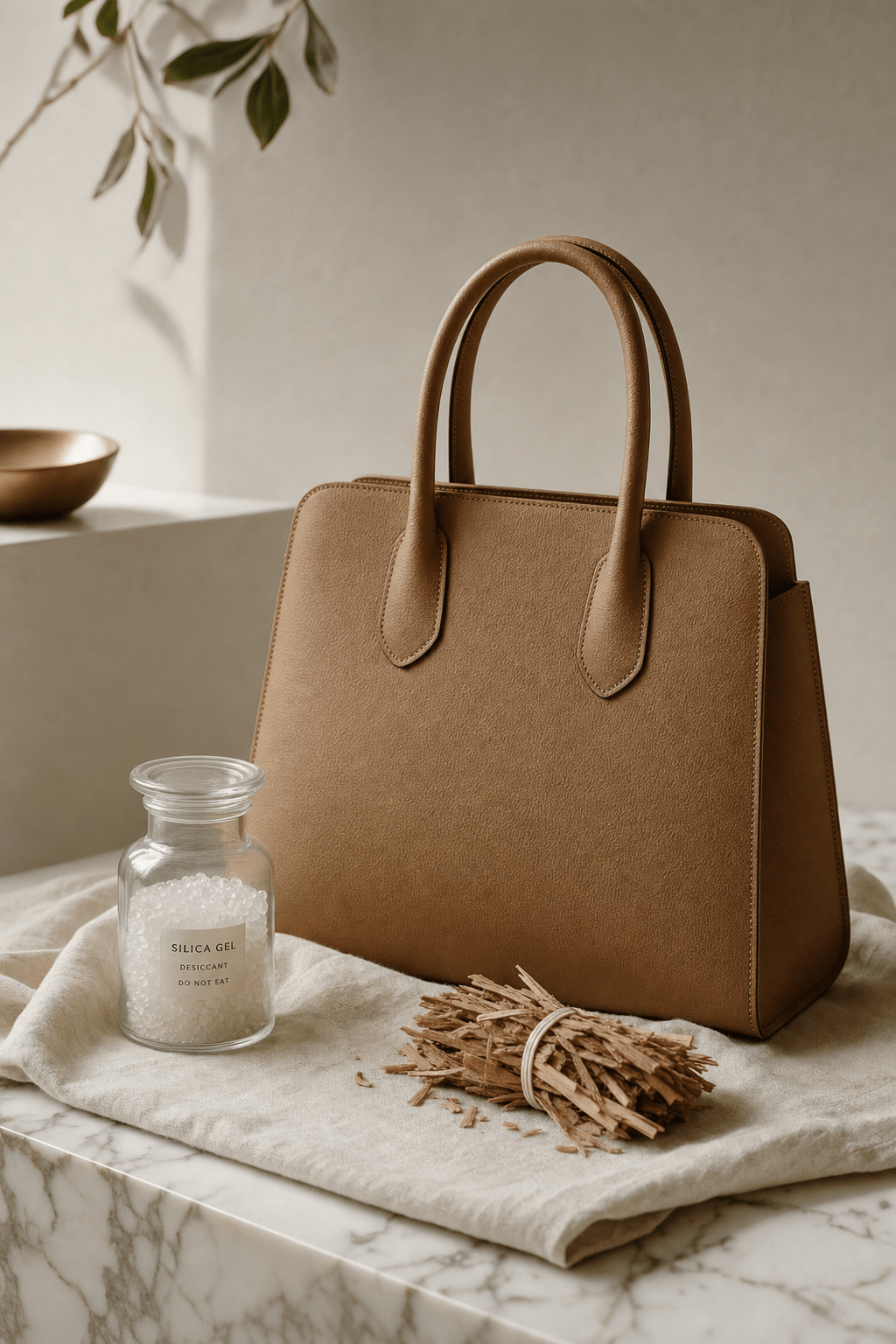
- Silica gel packets — replace regularly, one per bag stored inside its dust bag or storage box
- Rechargeable moisture absorbers — Eva-Dry E-333 or similar, one per closet
- Cedar or activated charcoal — helps with odors, absorbs some moisture
- Original Hermès orange boxes — the boxes themselves provide some protection
- Elevated storage — bags on shelves at least 12 inches above the closet floor (where humidity concentrates)
Tier 2: Active dehumidification (65-75% RH environment)
For humidity in the 65-75% range, you need active equipment:
- Small closet dehumidifier — Pro Breeze, Eva-Dry, or similar
- Sizing guide — For a walk-in closet or storage area under 300 sq ft, a 30-50 pint/day unit is appropriate
- Placement — At the center of the closet, not against a wall
- Drainage — Choose a model with continuous drainage to a nearby sink or floor drain if possible, or empty daily
- Target setting — 50% RH
- Silica gel packets — also use, as backup
Tier 3: Climate-controlled storage (75%+ RH environment)
For sustained high humidity (Miami, Singapore, Bangkok, Mumbai year-round), you need dedicated climate-controlled storage:
- Dedicated climate-controlled closet or safe — insulated space with dehumidifier and temperature control
- Whole-room dehumidification — larger units (50-70 pint/day) with continuous drainage
- Temperature control — air conditioning maintaining 65-70°F
- Regular monitoring — check the hygrometer weekly, not monthly
- Backup power — for anyone with 5+ bags, generator or battery backup for the dehumidifier during storms
Leather-by-leather adjustments
Togo
Togo is moderately humidity-resistant. Standard protocols work. Silica gel and 50% target humidity.
Clemence
Clemence is the most humidity-sensitive Hermès leather. Absorbs moisture readily. Target 45% humidity for Clemence storage — more aggressive than the standard 50%.
Epsom
Epsom's embossed finish is the most humidity-resistant. Standard protocols; less aggressive humidity control needed. Ideal for humid-climate collectors.
Swift
Swift is smooth calfskin — moderate humidity sensitivity. Standard protocols.
Box calf
Box calf's polished finish provides some humidity protection but its rigid structure can crack in extremely dry conditions. Target 45-55% humidity — narrower than the general 40-55% range.
Barenia
Vegetable-tanned leather. Most humidity-sensitive of all Hermès leathers. Requires more aggressive humidity control — target 40% — and more frequent inspection. Consider whether Barenia is the right leather for you if you live somewhere consistently above 70% humidity.
Chèvre
Goat leather is more humidity-tolerant than calfskins. Standard protocols suffice.
The closet setup for humid climates
Location
Interior closets, not exterior. Interior walls insulate better and maintain more stable temperature and humidity. Avoid closets on the north side (in Northern Hemisphere) where cold walls can cause condensation.
Sealing
The closet should close tightly. Weather-stripping around the door reduces humidity infiltration from the rest of your home during hot, humid days.
Storage furniture
Solid wood shelves are ideal — wood absorbs and releases moisture, buffering humidity spikes. Avoid metal shelves in humid climates — condensation forms on them. Avoid plastic bins — they trap moisture inside.
Bag arrangement
- Never touching each other — space of 2-4 inches between bags
- Never on the floor
- Never against exterior walls
- In their original dust bags, in their original Hermès boxes when possible
- Upright, on their feet, with pillow inserts
- Shoulder straps stored separately
Monitoring
Weekly during humid seasons. Check hygrometer readings. Inspect one bag per week for early signs of mildew (musty smell), hardware tarnish, or lining discoloration.
Signs your storage is failing
Catch problems early:
- Musty smell when you open the bag — first sign of mildew, address immediately
- Discoloration on interior lining — mildew has started
- Hardware losing shine — tarnish is forming
- Leather feels tacky or slightly sticky — humidity is causing adhesive migration
- Front panel bowing more than usual — humidity plus insufficient support
- Dust bag itself feels damp — ambient humidity is far too high
If any of these appear, immediately: check hygrometer, add or increase dehumidification, inspect all other bags in the same closet.
Expert tip
Miami and Singapore collectors often struggle with a specific pattern: closet humidity spikes during storms (85%+) even with dehumidification running. Two backups matter: (1) a battery-powered dehumidifier that runs during power outages, and (2) heavier silica gel loads before hurricane or monsoon seasons. A single 24-hour humidity excursion can undo months of careful storage.
What to do if mildew has already started
Mildew is not the end of the bag, but it must be addressed immediately:
- Move the bag to a dry, ventilated area (indoor, away from sunlight)
- Remove all inserts and store separately
- Air the bag open for 48-72 hours
- Gently brush any visible mildew with a very soft brush
- Do not apply cleaning products at home
- Address the storage environment before returning the bag
- Send to Hermès spa for lining replacement if mildew is on the lining; for leather mildew, spa work is likely needed
See our Hermès spa service guide for what spa work costs and how to book.
Traveling with Hermès in humid destinations
If you're traveling from a moderate climate to a humid destination, don't leave the bag in the humidity for extended periods:
- In the hotel room, keep the bag in air-conditioned areas — not bathrooms
- Never leave bags in cars — the trunk becomes a humidity/heat chamber
- Pack a few silica gel packets in your luggage for the trip
- When you return home, air the bag for 24 hours before storing to release absorbed humidity
See our Birkin travel guide for the complete travel protocol.
The bottom line
Humid-climate Hermès storage is different — more equipment, more monitoring, more discipline. But it's entirely manageable, and the ROI is enormous: a Birkin properly stored in Miami looks like a Birkin properly stored in Paris after ten years. A Birkin stored casually in Miami looks like it's been through a decade of tropical damage.
The three-tier framework — passive at 55-65% RH, active at 65-75%, climate-controlled at 75%+ — covers every humid climate scenario. Match your equipment to your actual measured humidity, not to what you think it is. Monitor weekly. Address problems early.
See our Birkin storage guide, Kelly storage guide, and the Hermès brand hub for the complete preservation system.