Skip to content

Cart

Your cart is empty

Preservation Academy all brands all handbags mixed

The Importance of Purse Dust Bags: Why Every Handbag Needs One

A dust bag is the single cheapest piece of handbag care equipment you can own, and the one most owners get wrong. Here is what a dust bag actually protects against, how to use it properly, and why fabric choice matters more than color.

⏲ 8 min read Updated

A dust bag is the smallest, cheapest piece of equipment in your handbag care routine, and the one most owners either skip entirely or use incorrectly. Used well, it is the difference between a bag that looks new in five years and one that shows dust rings, faded panels, and hardware transfer marks by year two. Used badly — sealed in plastic, packed with the wrong fabric, or forgotten in a hot closet — a dust bag can actually make storage worse.

This guide covers what a purse dust bag actually protects against, how to use one properly for daily storage and long-term rotation, and why the material of the dust bag itself matters more than most owners realize.

What a dust bag actually is

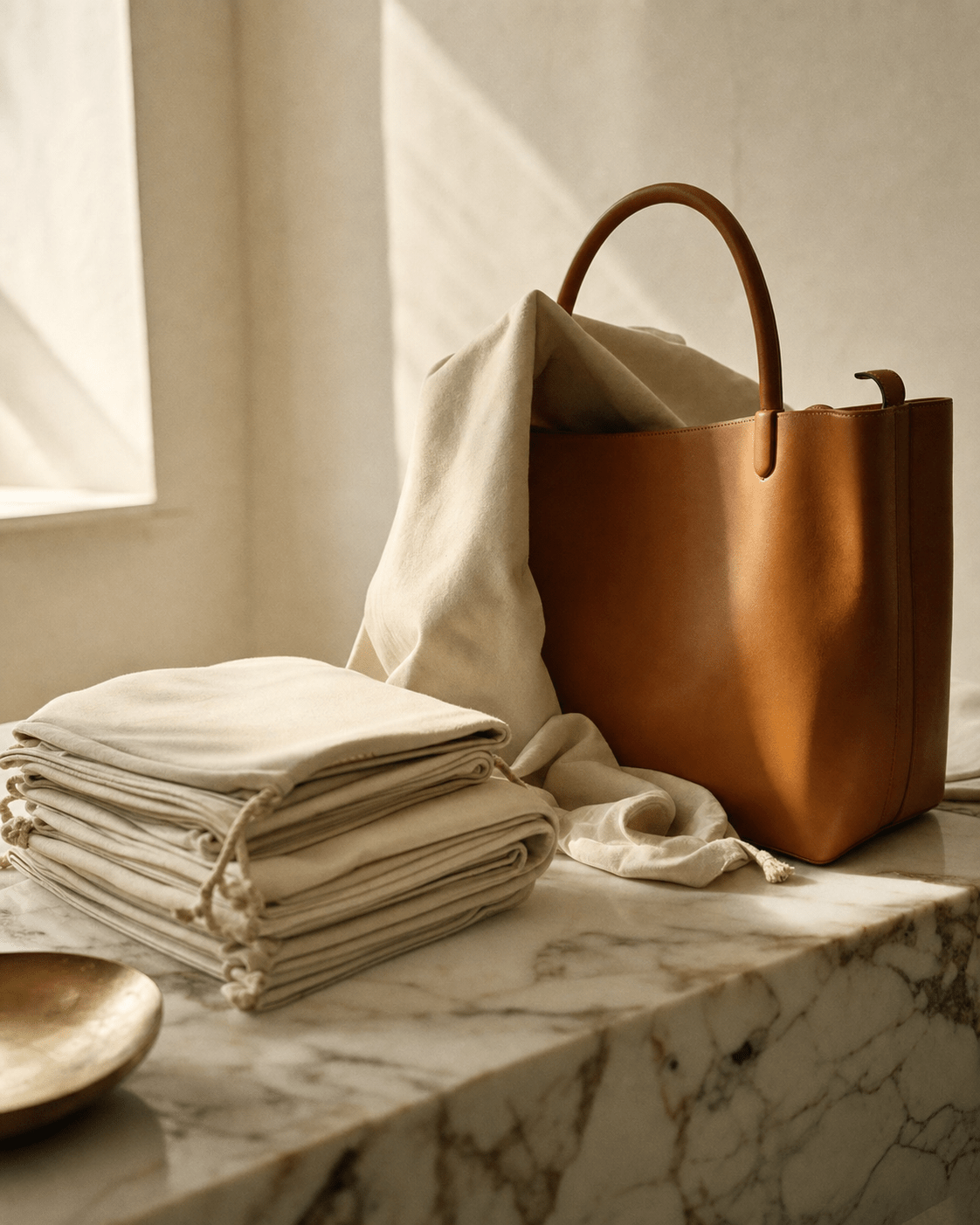
A purse dust bag is a soft, breathable fabric cover designed to sit over a handbag between wears. The best ones are made from tightly woven cotton or muslin, both of which allow air to circulate while blocking dust, light, and incidental abrasion. It is not a storage vault; it is a barrier between your bag and the environment around it, sized to fit closely enough that dust does not settle underneath but loosely enough that leather can breathe.

Why muslin and cotton, not plastic or velvet

Muslin and cotton breathe. That single property is what makes them safe for leather storage over months and years. Plastic, in contrast, traps moisture against the bag — the same reason plastic bags cause mildew on shoes and clothes in humid closets. Velvet and other pile fabrics can shed fibers onto lambskin and other delicate leathers, and some synthetic dust bags off-gas dyes or plasticizers that can transfer onto light-colored bags over long storage periods. If a dust bag came free with a bag from a luxury boutique, it is almost certainly made of cotton flannel or muslin for exactly these reasons.

What a dust bag protects against, honestly

The marketing around dust bags sometimes oversells them. Here is the accurate list of what they actually do, in order of impact:

Dust and airborne particulates

The obvious one, but worth stating precisely: household dust is not neutral. It contains skin cells, fabric fibers, cooking residue, and in some environments, fine soot from candles or cooking oils. Dust settling directly onto a leather bag over months does not just make it look dingy — the oily component of that dust binds to the leather's surface and becomes considerably harder to remove than fresh dust wiped off with a cloth. A dust bag stops this at the surface of the cover, not the surface of the leather.

Light exposure and color fading

UV light and, to a lesser extent, strong indoor light both fade leather and fabric over time. A cotton or muslin dust bag blocks the vast majority of this exposure while the bag sits on an open shelf. This matters most for light-colored, dyed, or exotic bags — a black caviar Flap fades much more slowly in indirect light than a pale pink lambskin one, but neither is immune.

Hardware and metal transfer

Bags stored next to each other on a shelf often touch at the hardware — a Chanel chain resting against a Kelly's clochette, a Boy Bag's push-lock pressing into a neighboring bag's leather. A dust bag creates a soft fabric layer between adjacent bags, preventing the metal-on-leather contact that leaves permanent imprints and scuffs over long storage periods.

Scratches and scuffs from handling

Pulling a bag off a high shelf, sliding it into a closet, or packing it into luggage all create opportunities for the surface to catch on something. A dust bag adds a layer of fabric friction between the bag and whatever it slides against — belts, zipper teeth, other bags, the edge of a shelf. This matters less at home and considerably more during travel.

What a dust bag does not do

A dust bag does not control humidity. It does not prevent mold if the closet itself is damp. It does not stop the bag from losing its shape if you store it empty and unsupported. A dust bag is a light-and-particulate barrier; it is not a substitute for a stable environment, a properly sized interior support, or occasional inspection.

How to use a dust bag properly

Stuff the bag first, then cover it

A dust bag over an empty, unsupported handbag protects the surface but does nothing for the shape. Every quilted, structured, or slouchy bag needs an interior support — a shaped pillow insert or acid-free tissue — before the dust bag goes over the top. The order is: bag empty, wipe down exterior, insert support, close bag, dust bag over the whole thing, upright on the shelf. For the full storage protocol behind this, see the complete storage guide.

Do not seal a dust bag inside plastic

This is the single most common mistake made with dust bags. Owners who want "extra protection" put the dust-bagged handbag inside a sealed plastic bin or bag, believing they have added a second barrier. What they have actually done is trap whatever humidity was inside the dust bag with the leather. Over months, this causes musty smells; in humid climates, it causes visible mildew on the interior lining. If you want a second layer, use the original cardboard box, or a fabric storage bin with airflow. Never a sealed plastic container.

Match dust bag size to handbag size

A dust bag that is too small stretches taut over the bag's hardware and can leave imprints in the fabric or leather where the tension is highest. A dust bag that is too large bunches under the bag on the shelf and creates uneven pressure points on the base or sides. The bag should fit like a loose pillowcase — enough slack to close comfortably at the top, without excess fabric folded underneath.

Wash them occasionally

Cotton and muslin dust bags do collect dust themselves, and eventually that dust is what is sitting against your handbag rather than being blocked by the bag. Wash dust bags on a gentle cycle in cold water with a mild, fragrance-free detergent every few months if they see regular use, or before starting a long-term storage cycle. Air dry them fully — never store a damp dust bag against a leather handbag.

When you need a dust bag most

Long-term storage

For any bag being rotated out for a season or longer, a dust bag is essential. The bag will not be handled or inspected as frequently, so the dust bag is doing weeks of work between check-ins. Pair it with a properly sized interior support and a stable-humidity closet, and the bag will come out looking essentially the same as it went in.

Travel

Suitcases are hostile environments for handbags. A dust bag inside luggage protects against zipper teeth, belt buckles from packed clothing, and the general shifting and pressure of a checked or overhead bag. If you are traveling with a designer bag as a checked item, a dust bag is the minimum protection; ideally the bag also travels inside its original box or a rigid packing cube. See how to travel with an Hèrmes Birkin for the broader travel protocol, which applies across brands.

Rotating multiple bags on the same shelf

Any time you are storing more than one handbag in the same closet or cabinet, each bag should have its own dust bag. The cost is low and the protection against hardware-on-leather transfer is meaningful, especially for structured bags with prominent metal fittings like Chanel Boy Bags, LV Capucines, or any Kelly.

Common mistakes with dust bag storage

  • Using a plastic bag instead of a dust bag — or a plastic bag over one. Traps humidity and accelerates mildew and clasp tarnish.
  • Skipping the interior support. A dust bag over an empty bag protects the exterior but lets the shape collapse.
  • Using colored or synthetic dust bags on light-colored leather. Dye or fiber transfer over long storage is difficult to reverse.
  • Wrong size. Too tight leaves pressure marks; too loose bunches unevenly under the bag.
  • Never washing the dust bag. The dust bag itself eventually becomes what is dirty against your handbag.
  • Storing a damp bag inside a dust bag. If the handbag was carried in wet weather, let it air out fully before covering it.

Expert tip: keep the original, but replace it when it wears out

The dust bag that came with your bag from the boutique is usually the correct size and the correct fabric for that specific handbag — luxury houses put real thought into the flannel weight, tie closure, and dimensions. Keep it. But dust bags do wear out: they thin, the ties fray, the fabric picks up permanent stains. When the original starts to fail, replace it with the same fabric type (muslin or cotton flannel) in a size that matches the bag, rather than making do with a stretched or stained cover for another decade.

Choosing a replacement dust bag

If you need a dust bag for a handbag that did not come with one — a vintage purchase, a bag whose original cover was lost, or a bag whose original dust bag no longer closes properly — the two things that matter are fabric and size.

Fabric

Choose 100 percent cotton muslin or cotton flannel, unbleached or dyed with color-fast dyes. Avoid polyester blends, velvet, and any fabric with a strong chemical smell out of the package (that smell is finishing chemicals or dyes that will off-gas onto your leather). A quality muslin dust bag should feel breathable when you hold it up to light and should not have any lingering smell out of the package.

Size

Measure your bag at its widest point in each dimension. The dust bag should be roughly 15 to 25 percent larger than the bag in width and height, so it closes comfortably without stretching. A common mistake is buying a dust bag by handbag style name rather than measurement — sizes labeled "fits Birkin 30" vary meaningfully between makers.

Color

For light-colored or delicate handbags, always choose a neutral, undyed muslin (natural cream or off-white) to eliminate any risk of dye transfer. For darker bags, colored dust bags are visually appealing and functionally identical — a dark navy or charcoal dust bag over a black Chanel is fine, and can make it easier to identify which bag is inside without opening the closure.

The dust bag is only half the job: what actually keeps the shape

Here is the most important part of dust bag storage that most guides skip entirely. A dust bag protects the exterior of your handbag — but it does absolutely nothing for the shape. The bag inside the dust bag will still sag, crease, and collapse over months of storage unless something is holding the interior open.

This is why every luxury handbag boutique — Hermès, Chanel, Louis Vuitton — ships new bags with a shaped filling inside as well as a dust bag over the outside. The filling is what preserves the silhouette; the dust bag is what protects the surface. Both matter, and doing one without the other leaves half the job undone.

Fabrinique's purse pillows are shaped inserts made for specific bag silhouettes:

A dust bag over an unshaped, sagging bag is like putting a raincoat on a wet dog — the outside is covered, but the underlying problem is still happening. The two pieces work together.

Beyond the dust bag: what else your storage needs

A dust bag alone is not a complete storage system. The other pieces are:

  • An interior support — a shaped pillow insert sized to the specific handbag. This is what actually keeps the bag's silhouette intact.
  • Stable humidity, ideally 45 to 55 percent, held steady year-round. A dust bag does nothing against a swinging-humidity closet.
  • Silica gel packets replaced every 3 to 4 months in humid climates, sitting alongside the bag but not touching the leather directly.
  • Upright storage, never flat, never stacked. The dust bag makes contact between adjacent bags safer, but bags still should not rest on each other.
  • Occasional inspection — every 2 to 3 months, take the bag out of the dust bag, check for any change, and let it air briefly before covering it again.

For the complete protocol behind all of this, our luxury handbag storage guide is the pillar reference. It covers the universal rules that apply to every brand in this library.

Closing thoughts

A dust bag is not glamorous. It costs less than a fraction of what any luxury handbag costs and asks nothing more from you than remembering to actually use it. Its whole job is to be an unremarkable, breathable, correctly sized layer between your bag and everything that would otherwise land on it. Pair a proper dust bag with a shaped interior support and a stable-humidity closet, and the collection you build now will still look like the collection you built ten years from now.

Frequently asked questions

Do I really need a dust bag for every handbag I own?
Yes, if the bags are being stored for more than a few days between wears. A dust bag is the single most effective and cheapest barrier against dust, light, and hardware-to-leather contact between adjacent bags on a shelf.
Can I use a plastic bag instead of a dust bag?
No. Plastic traps humidity against the leather, which causes musty smells over months and visible mildew in humid climates. Always use a breathable cotton or muslin dust bag, never plastic.
What fabric should a good dust bag be made from?
Tightly woven 100 percent cotton muslin or cotton flannel. Both breathe well and block dust and light. Avoid polyester blends, velvet (which sheds fibers), and any fabric with a chemical smell out of the package.
How often should I wash my handbag dust bags?
Every few months if they are in regular rotation, or before beginning a long-term storage cycle. Wash on a gentle cycle in cold water with fragrance-free detergent and air dry fully before using again.
Is it okay to store multiple handbags in the same dust bag?
No. Each handbag should have its own dust bag. Bags stored together inside one cover press their hardware into each other's leather, which is exactly what a dust bag is meant to prevent.
Can I use a colored dust bag on a light-colored handbag?
For light-colored or delicate leather, choose a neutral undyed muslin (natural cream or off-white). Some colored dust bags can transfer dye onto pale leather over long storage periods. For darker bags, colored dust bags are functionally identical to neutral ones.
Do I still need a dust bag if I store my handbag inside its original box?
Yes. The dust bag protects the bag from the box interior itself (which is often lined with paper that can dry out and shed particles) and adds a soft layer between the bag and any hardware, tissue, or documents packed alongside it in the box.
How do I know what size dust bag to buy?
Measure your handbag at its widest point in each dimension. The dust bag should be roughly 15 to 25 percent larger than the bag so it closes comfortably without stretching over the hardware. Do not rely on labels like "fits Birkin 30" without checking actual measurements, since sizing varies between makers.