Skip to content

Cart

Your cart is empty

Preservation Academy Hermès Birkin Togo, Clemence, Epsom, Swift

Why Birkins Sag — and How to Fix and Prevent It

Front-panel sag is the most common preventable Birkin issue and the biggest single driver of value loss on the resale market. Here's exactly what causes it, how to fix early sag, and the storage discipline that prevents it entirely.

⏲ 11 min read Updated

If you look at 100 pre-owned Birkins on the resale market, roughly 70 of them will show some degree of front-panel sag. It is the single most common form of preventable damage on the Hermès secondary market — and the single biggest driver of value loss on bags that would otherwise be in reference condition.

This guide explains exactly why Birkins sag, how to catch it before it becomes irreversible, and what to do at every stage — from very early bowing to severe collapse. Read it once, apply the storage discipline, and your Birkin will never develop the issue.

What Birkin sag actually is

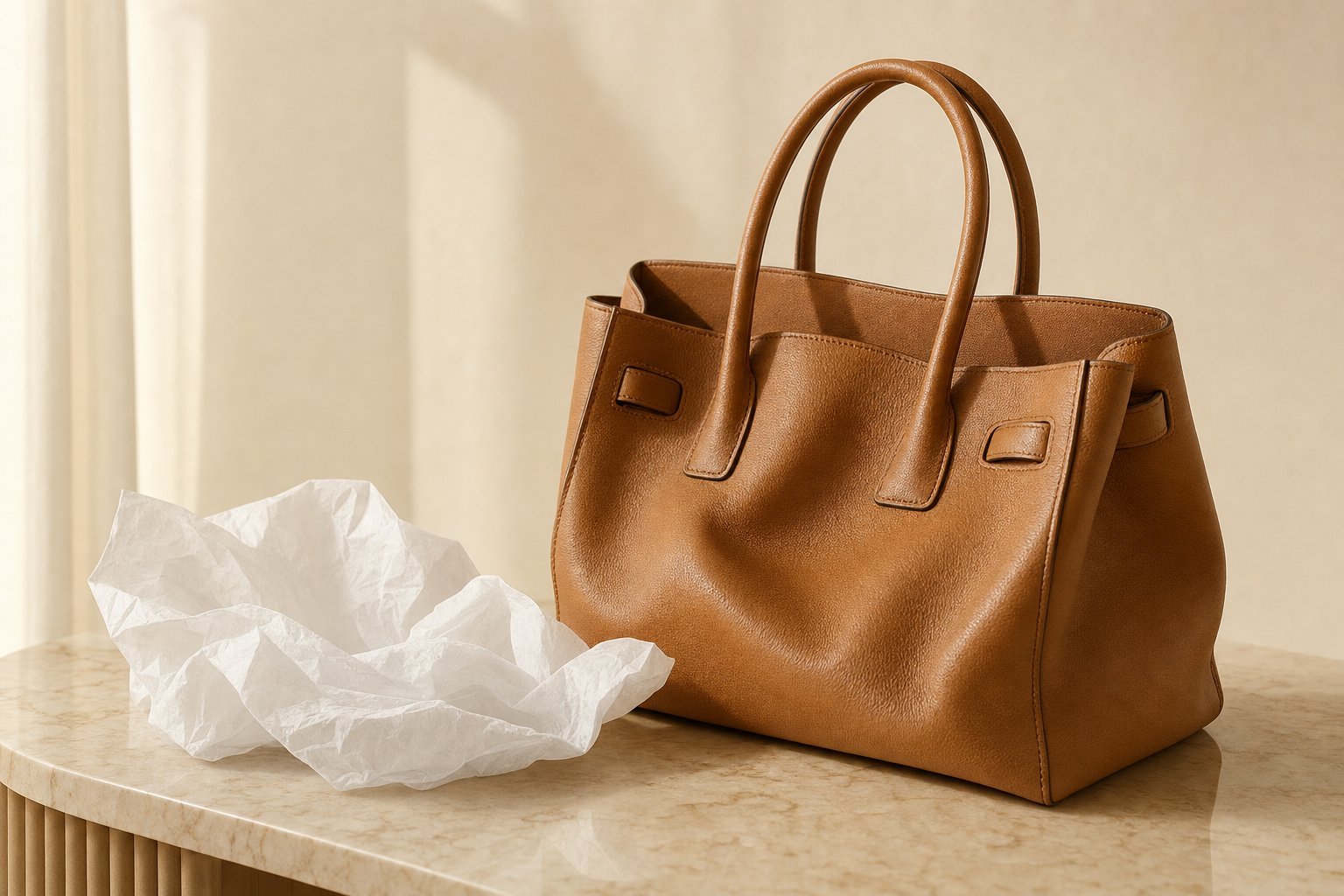
The technical description: over time, without internal support, the front and back leather panels of a Birkin bow inward toward the interior of the bag. Viewed from the side, the front should be perfectly vertical — a flat, taut plane rising straight up from the base to the top edge. In a bag with sag, the front panel curves inward, like a shallow bowl.

The reasons this happens are structural:

  • Hermès leathers, especially Togo, Clemence, and Swift, are supple and shape-memoryed. They remember whatever position they hold for extended periods.
  • The front and back panels of a Birkin have no internal armature. Unlike a bag with a rigid frame or a structured interior lining, the Birkin's shape is held only by the leather itself.
  • Without something inside pressing outward against the panels, gravity and time pull them inward.

The result: after weeks or months of unsupported storage, the panels take on a permanent inward curve. The bag no longer looks fresh from the boutique.

The three stages of sag

Stage 1: early bowing

Visible only from certain angles, or only under scrutiny. The front panel has begun to lose its vertical alignment but still looks structurally sound. Fixable with 2–4 weeks of sustained internal pressure from a properly sized pillow insert.

Stage 2: developed sag

Visible from 4–6 feet away when the bag is on a shelf. The front panel has a clear inward curve. Fixable but requires longer sustained pressure (6–12 weeks) and often benefits from professional restoration for a full return to reference condition.

Stage 3: severe collapse

Visible immediately, even from a distance. The front and back panels have both bowed significantly, the top edge no longer holds its shape, and the bag looks visibly deformed. Requires professional restoration through the Hermès spa. Not fully reversible at home.

What causes sag

Every case of Birkin sag traces to one of a small number of causes:

Storing without internal support

The single biggest cause. A Birkin stored empty — no pillow insert, no properly sized filler — will develop sag within weeks. Every day of unsupported storage adds to the deformation. Every week without support extends the recovery time when you finally correct it.

Storing with balled-up tissue paper

Tissue paper is acceptable for short storage (a few days to two weeks). Over longer periods, tissue compresses, dries out, and leaves the panels without meaningful support. It also leaves acid residue against the leather.

Storing on the side

A Birkin resting on its side (rather than upright on its feet) puts asymmetric pressure on one panel and none on the other. This creates uneven sag — one panel bows, the other stays vertical — which is harder to correct than symmetric sag.

Overloading during use

Carrying too much weight — heavy laptops, water bottles, books — stresses both the handles and the panels. Over time, contents pressing outward against the base and inward against the panels distort the bag's shape even during use.

Storing with contents inside

Loose contents left in a stored bag (keys in a corner, a wallet flat against the front panel) create localized pressure that shows as either indentations or bowing. Always empty the bag before storing.

Excessive humidity

Above 65% relative humidity, leather becomes softer and more prone to taking on stored shape. Bags stored in humid climates without dehumidification develop sag faster than bags in stable conditions.

How to fix early-stage sag

If the front panel is only slightly bowed and the bag otherwise looks structurally sound, home correction usually works. Here's the exact protocol:

Step 1: get the right insert

You need a pillow that fits the interior cavity precisely. For a Birkin 30, that's approximately 28 × 14 × 20 cm. For a Birkin 25, 23 × 11 × 18 cm. For a Birkin 35, 33 × 16 × 23 cm. Never substitute a smaller pillow — it won't create enough outward pressure. Never substitute a larger pillow — it will over-stretch the leather.

Step 2: insert with the flap open

Slide the pillow into the interior, position it flat against the base, and let it settle. The pillow should touch the front, back, and both side panels of the interior. If there's slack anywhere, the pillow is undersized.

Step 3: close the flap and rest

Close the flap, buckle the straps, and put the bag upright in its dust bag. Place it in a closet at stable temperature and humidity. Do not disturb.

Step 4: wait 2–4 weeks

Sustained internal pressure over weeks is what re-trains the leather back to its intended shape. Check weekly — you should see the front panel gradually returning to vertical. Most early-stage sag corrects in 2–4 weeks.

Step 5: maintain

Once corrected, keep the pillow in the bag whenever it's not in active use. Front-panel sag returns quickly if the bag is stored empty again.

Expert tip

If the sag is asymmetric — one panel bowed more than the other — the bag has been stored on its side. Correcting this takes longer (6–8 weeks) because the leather has developed asymmetric memory. Store upright throughout the correction.

How to fix developed sag

If the sag is visible from a distance and both panels are affected, home correction still works but takes longer. Follow the same protocol as above, but expect 6–12 weeks of sustained pressure. Check bi-weekly. If progress stalls after 12 weeks, book a Hermès spa evaluation.

When to send it to the Hermès spa

Book professional restoration if:

  • Sag is severe (visible from 10+ feet, obvious deformation)
  • Home correction hasn't produced progress after 12 weeks
  • Both front and back panels have bowed significantly
  • The bag has other structural issues (corner softening, handle fatigue, stitching wear)
  • You're preparing the bag for resale and want it in reference condition

The Hermès spa can address sag in ways home restoration cannot — including targeted heat treatment, custom internal reinforcement, and full re-blocking of the panel shape. Wait times are 3–12 months. Cost varies but is often 5–15% of the bag's original retail price for sag correction alone.

How to prevent sag entirely

Prevention is dramatically easier than correction. The rules:

Always store with a properly sized insert

Every time the bag is not in active use — overnight, over a weekend, for a season, for years — the pillow stays in. This is the single most effective preventive measure.

Store upright, on all four feet

Never on the side. Never on the flap. Never hanging.

Empty the bag before storing

No contents inside. The interior should be empty except for the pillow insert.

Control humidity

Keep the storage closet at 40–55% relative humidity. Below 40%, leather dries out and can crack. Above 60%, leather becomes more prone to sag and mildew.

Don't overload during use

Keep total contents under 3–4 kg. Distribute weight across the base of the bag rather than concentrating it against a panel.

Rotate during long storage

Every 6–8 weeks, take the bag out of storage, remove the pillow, let the interior air for 5–10 minutes, then reinsert the pillow and return to storage. This prevents any single stored shape from becoming permanent.

Sag by leather type

Some leathers are more prone to sag than others. From most to least susceptible:

  • Swift — the most sag-prone Hermès leather because of its softness
  • Clemence — soft and absorbent, prone to sag especially in humid conditions
  • Togo — firmer than Clemence, more forgiving, but still develops sag without support
  • Barenia — sag-prone until fully broken in, then stabilizes
  • Epsom — the least sag-prone leather; even stored without support, Epsom holds shape better than others
  • Box calf — highly polished and structured, minimally sag-prone

An Epsom Birkin stored without support might develop light sag over a year. A Clemence Birkin might develop the same sag over a month. Match your storage discipline to your leather's sensitivity.

The bottom line

Front-panel sag is the most preventable form of luxury handbag damage. It is caused, almost universally, by storing the bag without proper internal support. The fix is a properly sized pillow insert used consistently — a $150 solution that prevents thousands of dollars in resale value loss.

If your Birkin already shows sag, home correction usually works if you act early. If the sag is severe or has been building for years, the Hermès spa can restore the bag to reference condition. Either way, once corrected, prevention requires only that the pillow stays in whenever the bag is not being carried.

See the model-specific care guides for exact insert sizes: Birkin 25, Birkin 30, Birkin 35. Or return to the Bag Care Center for guides on every luxury handbag.

Frequently asked questions

How long does it take for a Birkin to develop sag?
In Clemence or Swift, 2–4 weeks of unsupported storage in a humid closet can produce visible sag. In Togo, 6–12 weeks. In Epsom, 6–12 months. Once developed, sag stops progressing when the bag is put back in active use — but doesn't reverse without sustained internal pressure.
Can I use a rolled-up towel instead of a pillow insert?
In an emergency, yes — a rolled towel is better than nothing. But a towel doesn't fill the interior cavity evenly, doesn't press outward against the panels uniformly, and often introduces lint. A properly sized pillow is dramatically better and lasts indefinitely.
How much sag is acceptable on a resale Birkin?
For a bag being sold at 90%+ of retail, no sag is acceptable — buyers scrutinize the front panel. For a bag being sold at 60–80% of retail, minor early sag may be tolerated. Any sag visible from 10+ feet reduces resale value by 15–30% depending on the leather and model.
Does sag affect any other part of the bag?
Yes. As the panels bow inward, the top edge of the bag loses its shape, the handles begin to lean inward, and the base can start to bow if the sag becomes severe. Untreated severe sag eventually distorts the entire bag structure.
Will insurance cover Birkin sag?
No. Sag is considered maintenance damage, not accidental. Insurance covers theft, fire, and specific accidents but not preventable wear. This is exactly why storage discipline matters — the damage is not insurable and is often expensive to restore.
Can I prevent sag with silica gel packs?
Silica gel controls humidity, which is one factor in sag development, but it doesn't provide the internal pressure that actually prevents panel bowing. Use both: silica gel to control humidity in the closet, a properly sized pillow to support the panels.