The Truth About Stuffing Handbags with Tissue Paper
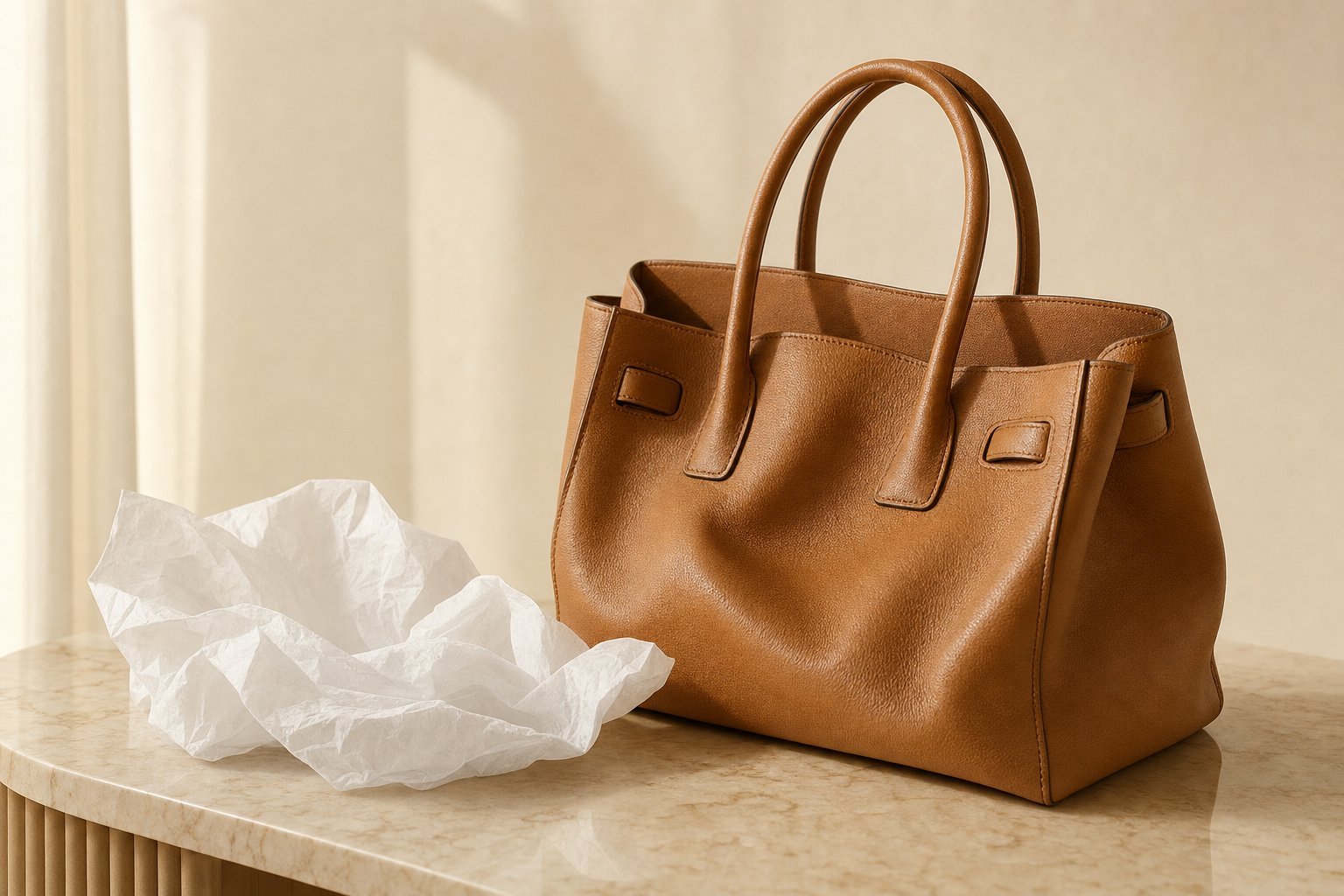
Tissue paper is commonly used as packaging and temporary interior support for handbags. For longer storage, the important questions are whether the material is clean and dry, whether it is packed loosely, and whether it continues to support the bag without creating concentrated pressure.
Tissue paper is useful, but not the only storage option
The tissue paper in your Birkin box is there for one purpose: to prevent crease damage during shipping. The bag travels from Hermès's Pantin workshop to a distribution center to a boutique to your home. Somewhere along that journey, another box will sit on top of it, or a pallet will shift, or a shipping vehicle will hit a bump. The tissue paper spreads the impact and prevents localized creasing.
Once the bag is in your closet, tissue paper's job is done. Many owners continue using tissue paper for routine storage because it is familiar and readily available.
It's not. Here's what's actually happening to your bag when you store it stuffed with tissue paper for months or years.
What to watch for with tissue paper
Tissue can compress and shift over time, so inspect it periodically and replace it if it becomes damp, dirty, degraded, or strongly flattened. Avoid printed paper, tightly packed bundles, and strongly dyed tissue against delicate or light interiors.
Acid-free tissue is commonly used for archival purposes, but that does not make every paper product universally appropriate for prolonged contact with every handbag material.
Reusable soft support
A reusable purse pillow can be more convenient for routine storage because it provides an enclosed, repeatable support surface. It still needs to fit gently and should not stretch or distort the bag.
Fabrinique's Individual Purse Pillow is sized specifically for luxury bag interiors — six sizes covering Chanel Minis through Louis Vuitton Keepalls. For collectors with multiple bags, the 4-Piece Bundle covers a typical rotation.
The One Correct Use for Tissue Paper
Keep the tissue paper your bag came with — but use it correctly. Wrap it around any hardware that touches the leather (like a Kelly's turn-lock or a Chanel Flap's chain when tucked into the bag) to prevent contact scratches. Change it every 60-90 days. For prolonged storage, the suitability of any paper depends on the paper itself, the handbag material, the fit, and the storage environment.
For interior volume and shape support, a correctly fitted reusable pillow is one practical alternative to loose paper.
Shop the Individual Purse Pillow →
Tissue paper vs. a purse pillow for a Louis Vuitton Speedy
For a Speedy, loosely arranged clean tissue can provide temporary support, but a reusable purse pillow is easier to fit consistently for routine storage. The important point is not to force the Speedy outward. Fabrinique makes model-specific Speedy 25, 30, and 35 Purse Pillows for owners who want repeatable soft interior support.
Tissue paper vs. a purse pillow for an Hermès Birkin
Clean, loosely arranged tissue can provide temporary interior support, but avoid tightly packed bundles or paper that becomes damp, dirty, degraded, or strongly compressed. For routine storage, a reusable soft insert is easier to fit consistently. Fabrinique makes dedicated Purse Pillows for the Birkin 25, Birkin 30, and Birkin 35.
Tissue paper vs. a purse pillow for an Hermès Kelly
Clean, loosely arranged tissue can provide temporary support, but avoid tightly packed bundles or paper that becomes damp, dirty, degraded, or strongly compressed. For routine storage, a reusable soft insert is easier to fit consistently. Fabrinique makes dedicated Purse Pillows for the Kelly 25, Kelly 28, and Kelly 32.