Louis Vuitton Water Stains: Rain, Vachetta & What to Do
Water does something to Louis Vuitton that it does not do to most other luxury bags: it causes permanent, visible damage on part of the bag while doing almost nothing to the rest of it. The coated canvas body of a Monogram or Damier bag sheds water without a second thought — the PVC-based coating is essentially waterproof. The vachetta leather trim stitched onto that same bag has no coating at all, and a single droplet left to dry on it can leave a mark that lasts for months. Understanding that split is the key to preventing and treating water damage on an LV bag correctly.
This guide covers why water behaves so differently on the two materials, how to treat a fresh water spot the moment it happens, what to do with an old, already-dried stain, and when the honest answer is to stop fighting it and let the patina catch up instead.
Why water stains vachetta but not canvas
Coated canvas — Monogram, Damier Ebene, Damier Azur — is cotton canvas sealed under a PVC-based coating. That coating is a genuine barrier. Water sits on top of it, beads up, and wipes away without penetrating the fibers underneath. This is why Louis Vuitton canvas bags have a long-standing reputation for handling rain better than almost any other luxury material; the design brief for coated canvas was explicitly to survive weather that would ruin a leather bag.
Vachetta is the opposite case entirely. It is raw, undyed cowhide with no finish, no sealant, and no protective topcoat of any kind. Water does not sit on the surface — it is absorbed immediately into the hide, the way water soaks into a paper towel rather than beading on a plastic sheet. As the water evaporates, it carries the leather's natural oils and tannins toward the surface unevenly, concentrating them at the edge of where the droplet sat. That uneven concentration is what you see as a dark ring or blotch once the spot dries. It is not dirt and it is not damage in the structural sense — it is a localized, accelerated patina event that has not had time to blend with the surrounding leather.
This is also why LV water damage looks so different from water damage on a Birkin or a Chanel flap. Hermès and Chanel leathers are typically finished or semi-finished, so water tends to cause texture change (stiffening, slight puckering) rather than the sharp tonal blotching you get on raw vachetta. Vachetta's total lack of finish is unique in this care library, and it is why LV gets its own water protocol rather than sharing one with the rest of the brands covered here.
Fresh water contact: what to do in the first hour
Speed matters enormously here. A droplet that is blotted within seconds behaves very differently from the same droplet left to air-dry on its own.
Step one: blot, do not wipe
The instant you notice water on vachetta, blot it with a clean, dry, soft cloth. Press straight down and lift — do not rub or wipe in circles. Wiping spreads the moisture across a wider area of leather and can push it toward drier surrounding sections, which just enlarges the eventual stain footprint. Blotting only removes surface moisture without spreading what has already been absorbed.
Step two: draw out the remaining moisture with cornstarch
After blotting, dust the damp area lightly with plain cornstarch (talc-free baby powder is an acceptable substitute) and let it sit for several hours, ideally overnight. Cornstarch is mildly absorbent and helps pull residual moisture out of the leather before it has a chance to dry unevenly and concentrate the tannins at the surface. Brush the powder away gently with a soft, dry cloth once it has done its work — do not leave it caked on the leather for days.
Step three: let it dry naturally, away from heat
Do not use a hair dryer, a heater vent, direct sun, or any other heat source to speed up drying. Heat sets whatever tannin concentration has already occurred and can also stiffen the leather at the affected spot. Let the bag air dry at normal room temperature, away from direct sunlight, over a day or two.
Step four: be patient about the outcome
Caught early and treated with this protocol, many small water spots fade significantly, though not always completely, over the following weeks as normal handling and light exposure blend the treated area back toward the surrounding tone. A spot treated within minutes typically resolves better than one left for even a few hours before treatment. This is the realistic outcome to expect — visible improvement, not always a full disappearance.
Old, dried water stains: the harder problem
A water spot that has already dried and set, especially one that is weeks or months old, does not respond to the fresh-spot protocol above. The moisture is long gone; what remains is a permanent tonal difference between that patch of leather and everything around it. At this stage, blotting and cornstarch will not do anything, because there is no moisture left to draw out.
The pro blending method: even, deliberate re-wetting
The technique some experienced restorers and collectors use for an old, set-in water stain is counterintuitive: intentionally darken the entire surrounding panel to match the stain, rather than trying to lighten the stain to match the panel. This works because it is far easier to add even color across a whole section than to selectively lighten one blotchy area without leaving a different kind of mark behind.
The method involves lightly and evenly dampening the entire panel — not just the stained spot — with a barely-damp, clean cloth, using light, even, overlapping strokes across the full surface so no section gets more moisture than any other. The panel is then allowed to dry slowly and evenly at room temperature, away from heat and direct sun. Done correctly, this evens out the tannin distribution across the whole panel rather than just the stained area, and the previously visible spot blends into a slightly darker, but uniform, overall tone.
This technique has real risk attached to it. Uneven application creates a second, larger blotch instead of fixing the first one, and it is easy to over-wet the leather and cause the exact problem you are trying to solve, just spread across more surface area. If you are not confident doing this yourself, this is a case where a professional leather restorer experienced with vachetta is worth the cost, particularly on a handle or high-visibility panel.
When to stop fighting it
Not every stain is worth chasing. If the mark is small, on a low-visibility part of the bag, or the bag already has several years of even patina built up around it, the most sensible move is often to leave it alone and let ordinary use and light exposure blend it in naturally over time, the way the rest of the vachetta continues to darken. Re-wetting an entire panel that is already most of the way to an even, deep patina carries real risk for a marginal cosmetic gain. Reserve the deliberate blending technique for stains that are genuinely disfiguring — stark, pale-leather water rings on a bag that is otherwise still light — rather than using it reflexively on every small mark.
What not to do to a water-stained vachetta bag
- Do not use a hair dryer or any heat source to speed drying. Heat sets the stain and can stiffen the leather permanently at that spot.
- Do not scrub the spot with a wet cloth or a magic eraser. Abrasive scrubbing on vachetta removes surface fibers and leaves a lighter, roughened patch that is more obvious than the original stain.
- Do not apply leather conditioner to "fix" a water spot. Standard conditioners are formulated for finished leather and typically darken vachetta unevenly, making a blotchy spot more visible rather than less.
- Do not use harsh household cleaners, alcohol, or vinegar on vachetta. These strip natural oils and tannins unevenly and can leave a dry, discolored patch that is harder to correct than the water stain itself.
- Do not panic and re-wet the whole bag immediately. The even-blending technique is a deliberate, careful process, not an emergency reaction to a fresh stain.
Preventing water stains in the first place
Prevention is far more reliable than any treatment, fresh or dried. A few habits cover most of the real-world risk:
- Avoid the rain outright when possible. A canvas LV bag with vachetta trim is not rain-proof just because the canvas itself is water-resistant. Plan around forecasted rain the way you would for any bag with exposed untreated leather.
- Use a rain cover or water-resistant carry sleeve while traveling. A simple slip cover over the bag during transit — getting in and out of cars, walking between terminals — removes most of the real-world exposure risk without requiring you to leave the bag at home.
- Keep the bag away from sinks, drink condensation, and damp countertops. A surprising share of water spots happen indoors, from a sweating glass set too close to the bag rather than from actual weather.
- Watch humidity in storage. Very high ambient humidity does not cause the same sharp blotching as direct droplet contact, but it does soften vachetta and make it more receptive to staining from incidental contact. Keep storage around 45 to 55 percent relative humidity, as covered in the pillar guide on storing luxury handbags.
Expert tip: carry a small microfiber cloth for exactly this reason
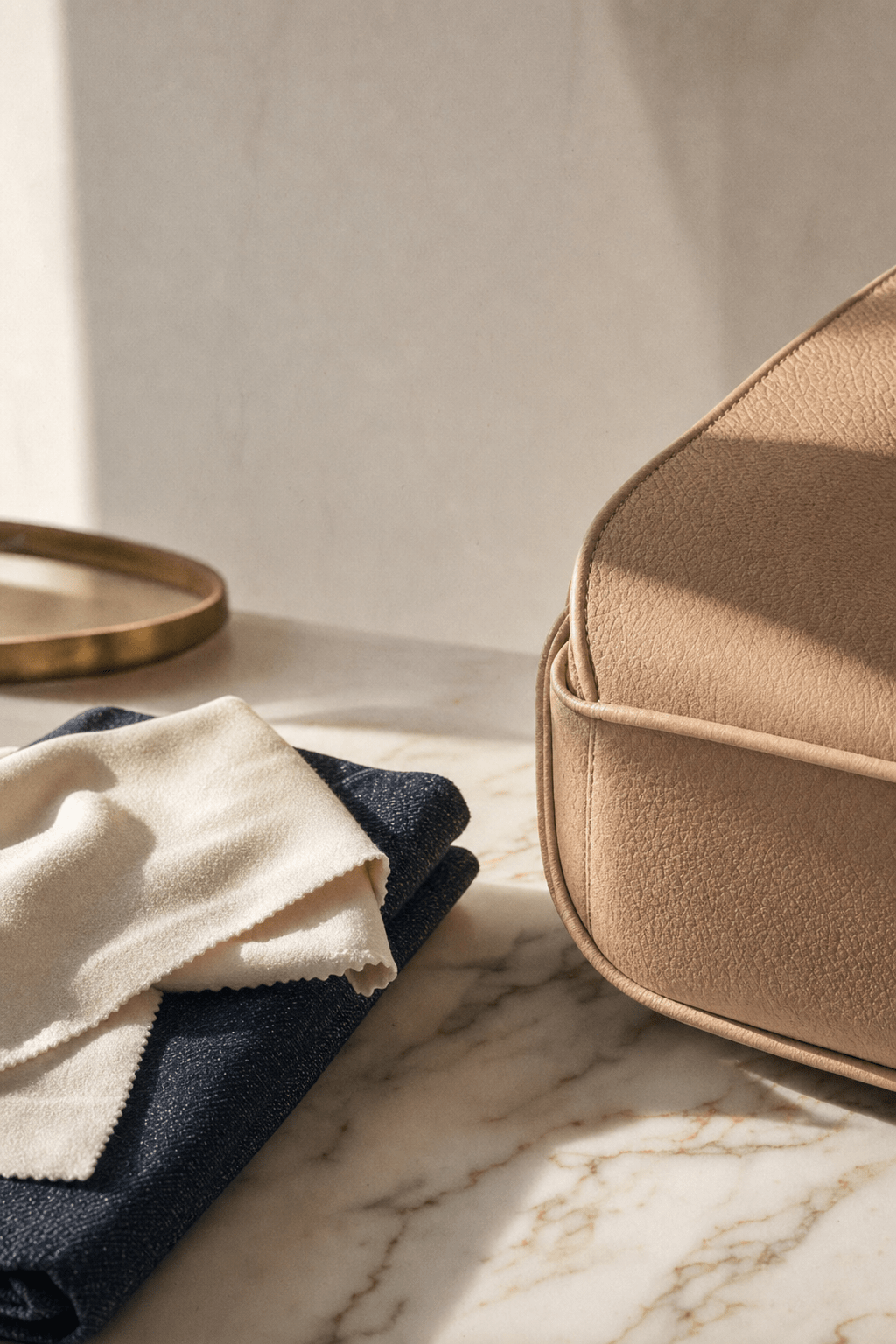
Keep a small, clean microfiber cloth in an interior pocket of any bag with vachetta trim. The single biggest variable in how visible a water spot ends up being is how quickly it gets blotted — a droplet caught in the first thirty seconds behaves completely differently from one left to sit for even a few minutes while you dig through a bag for something to blot it with.
How this fits into broader vachetta care
Water stains are a subset of a larger topic — vachetta's tendency to darken and change with any kind of exposure. If your goal is managing that process overall rather than just responding to a specific stain, see our guides on preventing vachetta patina and Louis Vuitton vachetta care, both of which cover the sun, oil, and handling side of the same leather.
Closing thoughts
Water is the one variable in Louis Vuitton ownership that behaves almost like a different material problem depending on which part of the bag it touches — a non-event on coated canvas, a real and sometimes permanent mark on vachetta. Treat fresh contact immediately with a blot-and-cornstarch approach, understand that old, set stains require a more deliberate and riskier blending technique rather than a quick fix, and put real effort into prevention, since no treatment fully undoes what water does to untreated leather. Get the prevention habits right and you will rarely need the treatment steps at all.