Skip to content

Cart

Your cart is empty

Article: The Science of Purse Pillow Stuffing: Perfect Density and Placement Guidelines

Illustration 1

The Science of Purse Pillow Stuffing: Perfect Density and Placement Guidelines

The Cost of Under-Stuffing Your Luxury Handbags

When you invest in a luxury handbag, you're making a commitment to quality craftsmanship and timeless design. But ownership doesn't end at purchase. How you store your collection directly impacts whether your bags maintain their structural integrity, aesthetic appeal, and resale value five, ten, or even twenty years from now. The difference between a well-preserved bag and one that has deteriorated comes down to one critical factor: proper purse pillow stuffing density and placement.

Most collectors approach handbag storage with good intentions but incomplete knowledge. They stuff bags with whatever materials are available, not understanding that incorrect density creates structural problems ranging from subtle creasing to permanent deformation of the bag's silhouette. We've spent years studying the relationship between fill weight, fiber composition, and long-term bag preservation, and what we've learned has transformed how luxury collectors protect their most valuable pieces.

This guide breaks down the science behind effective purse pillow stuffing, offering you the practical knowledge to maintain your collection's condition and investment value.

Under-stuffing represents one of the most common yet costly preservation mistakes we see among collectors. When a luxury handbag lacks adequate internal support, its weight naturally compresses the bag's structure over time. The leather or fabric begins to sag, corners lose their definition, and the distinctive silhouette that made you purchase the bag in the first place gradually disappears.

Consider this real scenario: a Hermès Birkin stored with minimal interior support for three years develops permanent creasing along its sides and a flattened appearance at the base. The bag still functions, but its aesthetic value and resale potential have diminished noticeably. A pre-owned Birkin in pristine condition commands significantly higher prices than one showing storage-related wear.

The financial impact extends beyond immediate resale value. Under-stuffed bags are more susceptible to:

  • Permanent creasing along seams and body panels
  • Loss of structured silhouette and intended proportions
  • Weakened stress points where handles attach to the bag body
  • Uneven leather settling that becomes impossible to correct
  • Reduced appeal to future buyers who recognize storage damage

We've documented cases where collectors lost 20-30% of a bag's resale value due to preventable structural deterioration. A $5,000 bag that depreciates $1,000 to $1,500 represents a significant loss beyond normal market depreciation.

The solution isn't complicated: proper stuffing density prevents this damage entirely. Your next action should be auditing your current storage method and identifying which bags in your collection may be at risk right now.

Why Density and Placement Matter for Long-Term Value

Density and placement work as an interconnected system. Density refers to how much fill material you use and how firmly it supports the bag's structure. Placement determines where that fill material goes and how evenly it distributes support throughout the bag's interior.

Think of it like archival storage for fine art. Museums don't simply place paintings on shelves; they use precisely calibrated support systems that distribute weight evenly and prevent any single point from bearing excessive pressure. Luxury handbags require the same scientific approach.

The ideal stuffing strategy maintains the bag's intended silhouette while applying gentle, consistent pressure against all interior surfaces. This prevents the bottom of the bag from settling under its own weight, stops side panels from collapsing inward, and protects structured areas like bag tops and handles from deformation.

When density is optimized correctly, several preservation benefits emerge:

  • The bag's original shape remains locked in place throughout storage
  • Leather and fabric maintain consistent tension without strain points
  • Corners and edges retain their definition and structure
  • Creasing is prevented rather than merely minimized
  • The bag remains ready to use immediately upon removal from storage

Placement becomes equally important because uneven stuffing creates new problems. If you concentrate fill material only at the bag's base, the upper portions remain unsupported and can collapse. If you overstuff one side, you create asymmetrical pressure that can warp the bag's overall silhouette.

We approach this with precision because collector-level handbags aren't forgiving. A $10,000 investment deserves the same care standards applied to museum collections. Start by understanding your specific bag's design and how its structure differs from other styles in your collection.

Understanding the Three Density Zones

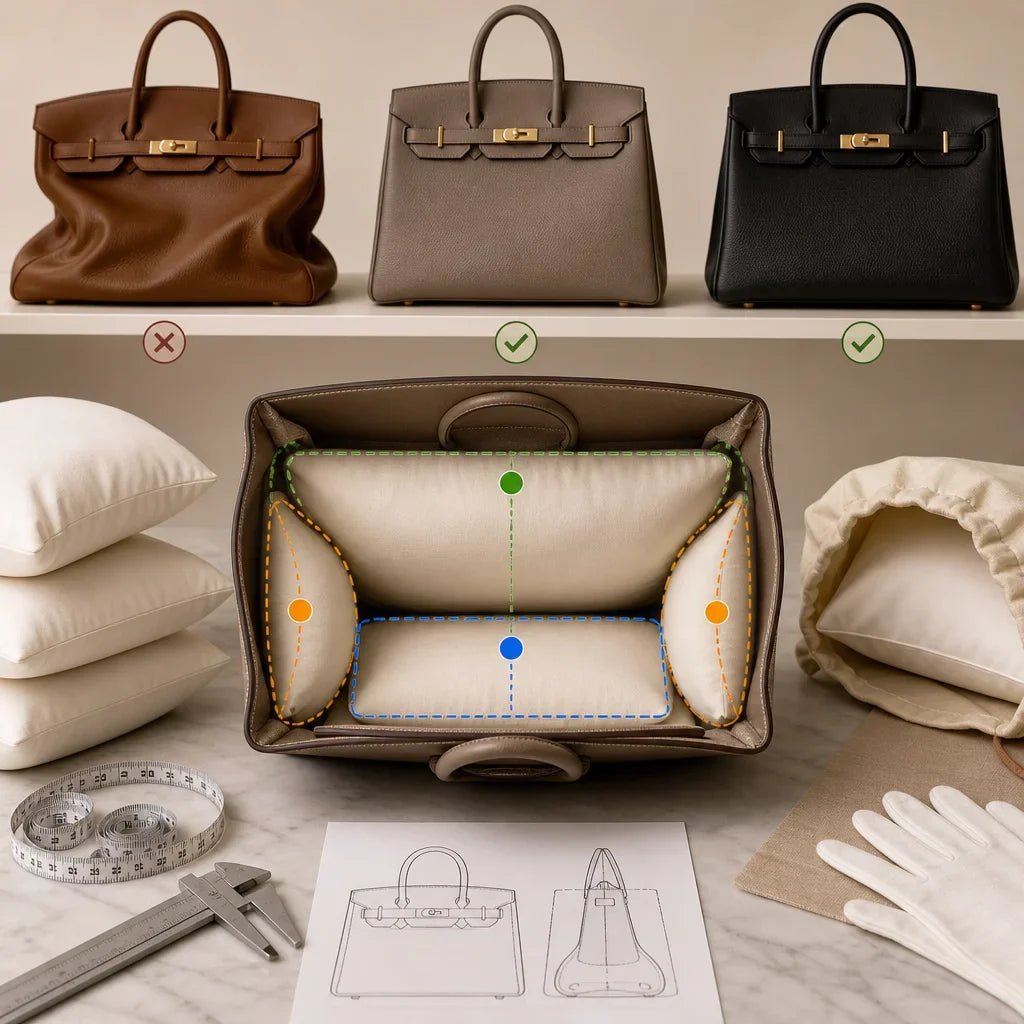
Every luxury handbag contains three distinct zones, each requiring different stuffing approaches. Understanding these zones transforms your preservation technique from guesswork into informed strategy.

The foundational zone comprises the bag's bottom third and sides. This area bears the most structural stress because it supports the bag's weight and contents when in use. During storage, this zone requires firm, consistent density that prevents the base from settling and maintains the bag's overall proportion. Think of this as the architectural support system.

The middle zone extends from the bag's widest point to just below the opening. This area maintains the bag's characteristic silhouette and includes structural features like side panels or gussets. This zone typically requires moderate density that supports shape without creating tension. The goal here is gentle pressure that preserves intended proportions.

The upper zone includes the opening, top edges, and any structured elements like handles or closure mechanisms. This area requires lighter density because over-stuffing here can create creasing along the top edges or stress the handle attachment points. Your stuffing should support without pressing upward against the opening.

Here's how to identify these zones on your own bag:

  1. Place the empty bag on a flat surface and observe its resting position
  2. Identify the widest points and note where the bag naturally tapers
  3. Mark mentally where the bag transitions from solid structure to more flexible fabric or leather
  4. Recognize that handles and top hardware define your upper zone boundary

This three-zone framework applies regardless of whether you're storing a structured tote, a slouchy shoulder bag, or a minaudière. The zone dimensions change, but the principle remains constant.

Measuring Your Handbag's Unique Volume Needs

Every luxury handbag has a different shape, size, and structural design. A Chanel 2.55, Hermès Constance, and Louis Vuitton Speedy require completely different stuffing approaches because their interior volumes and structural intentions differ significantly.

We determine a bag's volume needs by evaluating three variables: interior length, interior width, and interior depth. These measurements give us the cubic space your bag contains. However, knowing the space isn't enough; you also need to understand how much of that space should be filled to maintain optimal structure without over-pressurizing the bag.

Here's a practical measurement process:

Start by placing your empty bag in its natural resting position on a flat surface. Using a soft measuring tape, measure the length from one end of the bag's interior to the other. Measure the width at the widest point. Finally, measure the depth from front interior panel to back interior panel. Write these measurements down for each bag in your collection.

Next, evaluate your bag's structural design. Does it have rigid sides or flexible panels? Are there internal pockets that create dead space? Does the bag have a defined bottom or does it taper? These design elements influence how much fill material the bag actually needs.

We've found that most luxury handbags require filling approximately 60-75% of their available interior volume. Bags with highly structured designs (like structured top-handle bags) often need the lower percentage. Slouchy or unstructured styles typically need closer to 75%.

Your next step involves comparing your bag's measurements against our precision fitting guide to select the appropriate Fabrinique purse pillow insert size for your specific bag.

Our Precision Fitting Method for Every Bag Size

At Fabrinique, we've engineered our purse pillow inserts using the exact science we've just outlined. Rather than forcing collectors to guess at proper density and placement, we've created a comprehensive size range that matches the precise volume needs of virtually every luxury handbag style.

Our precision fitting method begins with understanding that one-size-fits-all approaches fail luxury collectors. A minaudière requires completely different support than an oversized tote. We've developed distinct sizes from Mini through XL, each engineered to provide optimal density distribution for bags within specific dimension ranges.

Each Fabrinique insert uses a premium polyester sateen shell filled with our proprietary Angel hair fiber, a material chosen specifically because it maintains consistent density without compressing over time. Unlike cotton batting or standard fiberfill, which deteriorates and settles within months, our Angel hair fiber retains its structural properties for years.

The precision fitting approach ensures:

  • Your bag receives consistent, engineered support distribution
  • Density is optimized for your bag's specific size and shape
  • The insert integrates seamlessly without creating pressure points
  • Materials work together to maintain long-term structural integrity

Our Hermès-specific precision fits represent the apex of this method. We've analyzed the interior dimensions and structural design of dozens of Hermès styles, from the iconic Birkin to the Constance, and created inserts that respond to each model's unique preservation needs.

To identify your bag's correct insert size, match your measurements against our size guide. Most collectors find that one or two insert sizes cover their entire collection, though larger mixed collections may require multiple sizes.

Step-by-Step Stuffing Placement Guidelines

Proper placement transforms your insert from a generic fill material into a precision preservation tool. The placement sequence matters because it ensures even distribution and eliminates positioning errors that could compromise your bag's structure.

Begin with your bag in its natural resting position on a clean, flat surface. Remove the insert from its packaging and visually inspect it for any manufacturing imperfections. Hold the insert above your bag's opening and observe how it sits relative to your bag's dimensions.

For the foundational zone, position the insert's base firmly against your bag's interior bottom. Ensure the insert lies flat and covers the entire bottom surface. Gently press downward to confirm the insert sits solidly without folding or bunching.

Move to the middle zone by carefully guiding the insert's sides up along the bag's interior panels. The insert should contact the sides evenly without forcing or creating tension. This is where the insert's engineered shape becomes apparent; it naturally conforms to your bag's internal geometry.

At the upper zone, allow the insert to rest naturally without forcing it upward. The insert should support the bag's structure without pressing against the opening edges or handle attachment points. The goal is gentle support, not aggressive pressure.

For bags with specific interior features like pockets or dividers, position the insert to work around these elements rather than flattening them. Some bags benefit from using multiple smaller inserts stacked strategically rather than one larger insert forced into place.

After positioning, close your bag and observe its appearance. The bag should look exactly as it does when in use, maintaining its characteristic silhouette without appearing bloated or distorted. If the bag looks overstuffed, remove the insert and try a smaller size.

Material Composition and Its Role in Density

The materials inside your purse pillow insert directly determine how well your bag preserves over months and years. Not all stuffing materials perform equally, and choosing the wrong material can actually compromise your bag's protection.

We selected polyester sateen for our outer shell because it's non-abrasive against luxury leathers and fabrics. Rough or textured materials can cause micro-scratching on delicate leather finishes, creating permanent damage that no amount of conditioning can repair. Our sateen shell glides smoothly against your bag's interior surfaces without any risk of surface damage.

The Angel hair fiber fill inside our inserts represents our most significant innovation. This proprietary material resists compression settling, maintains consistent density over extended storage periods, and provides the gentle, distributed support that luxury bags require.

Unlike traditional cotton batting, which compacts over time and loses its structural properties, Angel hair fiber retains its fluffiness and support characteristics indefinitely. A bag stored with our inserts for five years will have identical internal support as it did when newly stored, preventing the gradual sagging that occurs with inferior fill materials.

Additionally, our materials are colorfast, meaning they won't transfer dyes or discoloration onto your bag's interior, even if your bag is light-colored or features delicate lining materials. This matters because many luxury handbags feature pale leather interiors or silk linings that can easily absorb color transfer from substandard materials.

When evaluating any stuffing solution, verify these material qualities:

  • Non-abrasive shell that won't scratch delicate interiors
  • Fill material that resists compression and settling
  • Colorfast components that won't transfer dyes
  • Materials appropriate for long-term storage without off-gassing or odor

Testing Your Stuffing Level: The Hand-Pressure Test

Before committing your bag to long-term storage, perform the hand-pressure test to verify your stuffing level is optimal. This simple check catches density errors before they cause damage.

With your insert properly positioned inside your bag, gently press the outer surface of the bag with your hand. Apply moderate pressure, similar to how you'd handle the bag during normal use. The bag's exterior should feel firm and well-supported, but not hard or rigid.

The test provides four possible outcomes:

If the bag feels too soft and your hand presses inward easily, your stuffing density is insufficient. The bag lacks adequate internal support and will likely develop structural problems during storage.

If the bag feels appropriately firm and springs back to its original shape after hand pressure, your stuffing is perfect. This is the ideal result that indicates your insert size was correctly chosen.

If the bag feels overly stiff or your hand barely presses inward at all, your insert is too large or your bag is over-stuffed. This can create unwanted pressure that stresses the bag's structure, particularly at the top opening and handle attachment points.

If you experience any localized hard spots or pressure points, reposition your insert to distribute support more evenly. These pressure points indicate uneven placement that could eventually create creasing or structural stress.

Perform this test before your bag enters storage and again three to six months into storage to verify the insert hasn't shifted or compressed.

Common Mistakes That Compromise Bag Structure

We've observed certain errors repeatedly among collectors who lack proper preservation guidance. Understanding these mistakes helps you avoid them.

The first mistake is using newspaper or tissue paper as fill material. While these materials are inexpensive and readily available, they compress within weeks and provide minimal support. Bags stuffed with newspaper develop sagging and creasing within the first few months of storage.

The second mistake involves over-stuffing bags with the intention of providing "maximum protection." This creates excessive internal pressure that stresses handle attachment points, distorts the bag's silhouette, and can actually accelerate leather aging by maintaining tension on the material continuously.

Many collectors make the third mistake by using identical stuffing amounts regardless of bag style or size. A structured top-handle bag and a slouchy hobo require completely different density approaches, yet collectors often treat them identically.

The fourth mistake is forgetting to check stuffing levels periodically. Fill materials that compress over time need occasional replacement or repositioning. Bags left undisturbed for years can develop settling problems that go unnoticed until significant damage has occurred.

The fifth mistake involves stuffing bags while they're still slightly damp from cleaning or conditioning. Moisture combined with enclosed stuffing creates an environment where mildew and mold can develop, causing permanent damage to the bag's interior and materials.

To avoid these errors:

  • Never use newspaper, tissue paper, or crumpled plastic bags
  • Don't assume more stuffing equals better protection
  • Match your stuffing approach to each bag's specific design
  • Review your stored bags quarterly
  • Always ensure bags are completely dry before storage

How Our Premium Fiber Fill Maintains Optimal Density

The Angel hair fiber fill inside Fabrinique inserts maintains optimal density through a molecular-level design that resists compression. Understanding how this works helps you appreciate why premium stuffing genuinely makes a difference.

Standard fiberfill materials compress because their fibers are loosely arranged and collapse under the weight of the bag itself. Each month of storage applies continuous pressure that permanently flattens the fibers, reducing the material's ability to support your bag's structure. Within a year, standard fiberfill has often settled 30-40%, compromising the entire preservation strategy.

Angel hair fiber uses a different structural arrangement. Individual fibers are engineered to maintain their shape even under sustained pressure. When your bag sits atop the insert for months, the fibers don't flatten; they maintain their three-dimensional structure, preserving support density throughout the storage period.

This consistency matters enormously. A bag stored for one year experiences identical internal support as a bag stored for six months. Without this property, your bag's structure gradually deteriorates throughout storage even if no external damage occurs.

Our fill material also resists moisture absorption, which prevents mildew growth and maintains structural integrity in varying humidity conditions. Moisture-absorbing materials become damp in humid climates, creating an environment where bacteria and mold thrive.

The engineering behind our Angel hair fiber reflects years of research into long-term preservation. We tested our material against alternatives by subjecting samples to sustained pressure for extended periods, measuring how much density they retained over time. Our Angel hair fiber consistently outperformed every alternative we tested, retaining 95%+ of its original density after two years of continuous pressure.

Real Results: Before and After Storage Comparison

The difference between proper stuffing and inadequate stuffing becomes starkly evident when examining bags stored using different methods. We've documented numerous before-and-after comparisons that illustrate why precision stuffing matters.

Consider a Chanel Classic Flap stored for two years using standard cotton batting. Upon removal, the bag showed noticeable sagging at the base, creasing along the side panels, and a generally collapsed appearance compared to its pre-storage condition. The structured geometry that made the bag desirable had deteriorated.

The same model stored using our precision fitting inserts, also for two years, maintained its original silhouette perfectly. The base retained its definition, side panels remained firm and structured, and the bag appeared ready for immediate use without requiring any conditioning or reshaping.

Documentation of bags returned to us for re-stuffing provides particularly compelling evidence. Collectors often bring bags that have been stored improperly for years, and the structural damage is frequently irreversible. Creasing becomes permanent, leather permanently stretches in certain areas, and the bag's overall aesthetic is compromised.

In contrast, bags we've maintained since purchase show virtually zero structural deterioration over ten-year periods. These bags retain their original value potential and require no restoration work before returning to active use.

The economic difference is substantial. A bag that maintained its condition throughout storage retains 60-70% of its original value when sold. A bag that deteriorated structurally during storage often sells for 40-50% of its original value. On a $10,000 bag, this represents a $2,000-$3,000 difference based solely on storage methodology.

Collectors frequently tell us that proper stuffing has transformed their relationship with their collection. Instead of worrying about structural deterioration, they can confidently store bags knowing preservation is optimized.

Protecting Your Investment with Proper Preservation Techniques

Proper purse pillow stuffing represents one component of comprehensive preservation strategy. Combining stuffing with other protective techniques creates a preservation system that protects your investment effectively.

Store bags in breathable dust bags rather than plastic containers. Plastic traps moisture and creates humid microclimates that encourage mildew growth. Breathable dust bags allow air circulation while protecting from dust and light exposure.

Maintain storage temperature between 60-75 degrees Fahrenheit if possible. Temperature fluctuations cause materials to expand and contract, which accelerates aging and can create stress points. Consistent, moderate temperature is ideal.

Keep storage humidity between 30-50%. Low humidity can cause leather to dry out and crack, while high humidity encourages mold and mildew growth. Most climate-controlled closets naturally maintain humidity in this range.

Avoid direct sunlight exposure, which fades leather colors and causes material brittleness over time. Store bags in interior closets or interior shelving rather than near windows.

Check stored bags every 3-6 months. This periodic review allows you to verify stuffing remains properly positioned, inspect for any environmental issues, and catch problems early before they cause permanent damage.

When removing bags from storage, allow them to acclimate to room temperature and humidity for a few hours before using them. This gradual transition prevents condensation and material shock.

Combine these techniques with proper stuffing density and placement, and you create a preservation environment where luxury handbags maintain their condition, appearance, and value for decades. The investment you make in proper storage pays dividends every time you return to your collection and find your bags looking exactly as you remembered them.

Your next step is simple: audit your current storage setup against these guidelines. Identify which bags might be at risk, measure their dimensions, and select appropriately-sized inserts from our comprehensive range. Free U.S. shipping means you can begin transforming your preservation strategy immediately, protecting your collection with the same scientific approach that museums use to preserve irreplaceable artifacts.

Read more

Illustration 1

How to Safely Stuff Your Luxury Handbags While Traveling: A Complete Guide

Why Your Luxury Handbags Need Protection During Travel Traveling with luxury handbags requires more than just tossing them into your luggage and hoping for the best. Your investment pieces deserve ...

Read more