Skip to content

Cart

Your cart is empty

Article: How Purse Inserts Protect Your Luxury Handbag Investment and Resale Value

Illustration 1

How Purse Inserts Protect Your Luxury Handbag Investment and Resale Value

The Hidden Cost of Improper Handbag Storage

Most luxury handbag collectors focus on the initial purchase but overlook what happens during storage. A pristine Hermès Birkin or Chanel Classic Flap can deteriorate rapidly without proper support, losing its shape over months or years. The damage happens silently: the sides cave inward, the bottom corners crease permanently, and the overall silhouette flattens. By the time you notice, the structural integrity has already suffered.

The consequences extend beyond aesthetics. Buyers of pre-owned luxury bags conduct thorough inspections, looking for any sign that a piece wasn't maintained properly. Sagging sides, creased leather, and a collapsed interior send a clear message: this bag wasn't cared for. That perception translates directly into lower offers and reduced demand.

Storage conditions that collectors often consider "safe" are actually risky. Placing a handbag on a shelf without support, storing it in a dusty closet, or stacking other items around it creates the perfect environment for damage. Even climate-controlled closets don't prevent structural sagging if the bag lacks internal support during its idle months.

Actionable step: Before purchasing any storage solution, assess where your bags currently rest. Note whether they're displayed upright, laid flat, or folded. This baseline helps you understand which bags face the greatest risk.

Why Luxury Collectors Lose Thousands in Resale Value

Consider this scenario: you purchased a designer handbag for $3,500 five years ago. The current market value for the same model in excellent condition is $4,200. However, yours only fetches $2,800 because the interior has collapsed slightly and the leather shows minor creasing. That's a $1,400 gap between optimal and poor condition.

When luxury resale platforms evaluate bags, they use strict grading systems. A bag loses points immediately for shape deformation, even if the leather remains unblemished. The interior condition matters equally: pressed creases or indentations signal mishandling or inadequate storage. Resellers know that buyers expect investment-grade handbags to maintain their original silhouette.

The financial impact compounds across a collection. If you own five designer bags and each loses just $800 due to storage damage, that's $4,000 in preventable depreciation. For serious collectors with 15 or 20 pieces, the cumulative loss reaches tens of thousands of dollars.

Luxury authentication services and resale platforms increasingly emphasize structural condition. Platforms like Vestiaire Collective, Rebag, and The RealReal factor shape preservation into their valuation algorithms. A bag with perfect shape commands premium pricing even if it's a few years old.

Actionable step: Pull up your collection's original receipts and check current resale prices for similar models in "excellent" versus "good" condition. The pricing gap will reveal what structural integrity is worth in your market.

How Structural Damage Impacts Market Pricing

Structural damage manifests in specific ways that directly affect resale valuation. A Chanel flap bag with collapsed sides loses 15-25% of its potential resale value. Creasing across the interior bottom costs another 10-15%. A Louis Vuitton tote with permanently dented corners can drop 20% below market rate for an undamaged example.

Authentication experts examine several critical areas when evaluating condition. The bag's overall silhouette ranks first: does it maintain its original shape? Next comes the interior integrity: are there creases, indentations, or permanent folds? The bottom corners receive particular scrutiny because they're most vulnerable to sagging and creasing during storage.

Real-world pricing data supports this. A pre-owned Hermès Kelly bag in excellent structural condition recently sold for $3,100. An identical model with minor sagging sold for $2,650 just weeks earlier. That $450 difference (14% discount) reflects nothing more than shape deterioration during storage.

The secondary luxury market has become increasingly sophisticated. Collectors and resellers recognize that structural damage is often irreversible. Unlike scuffs or scratches that can be professionally cleaned, a permanently collapsed side panel cannot be restored. This permanence makes buyers extremely cautious, driving down offers for any bag showing shape issues.

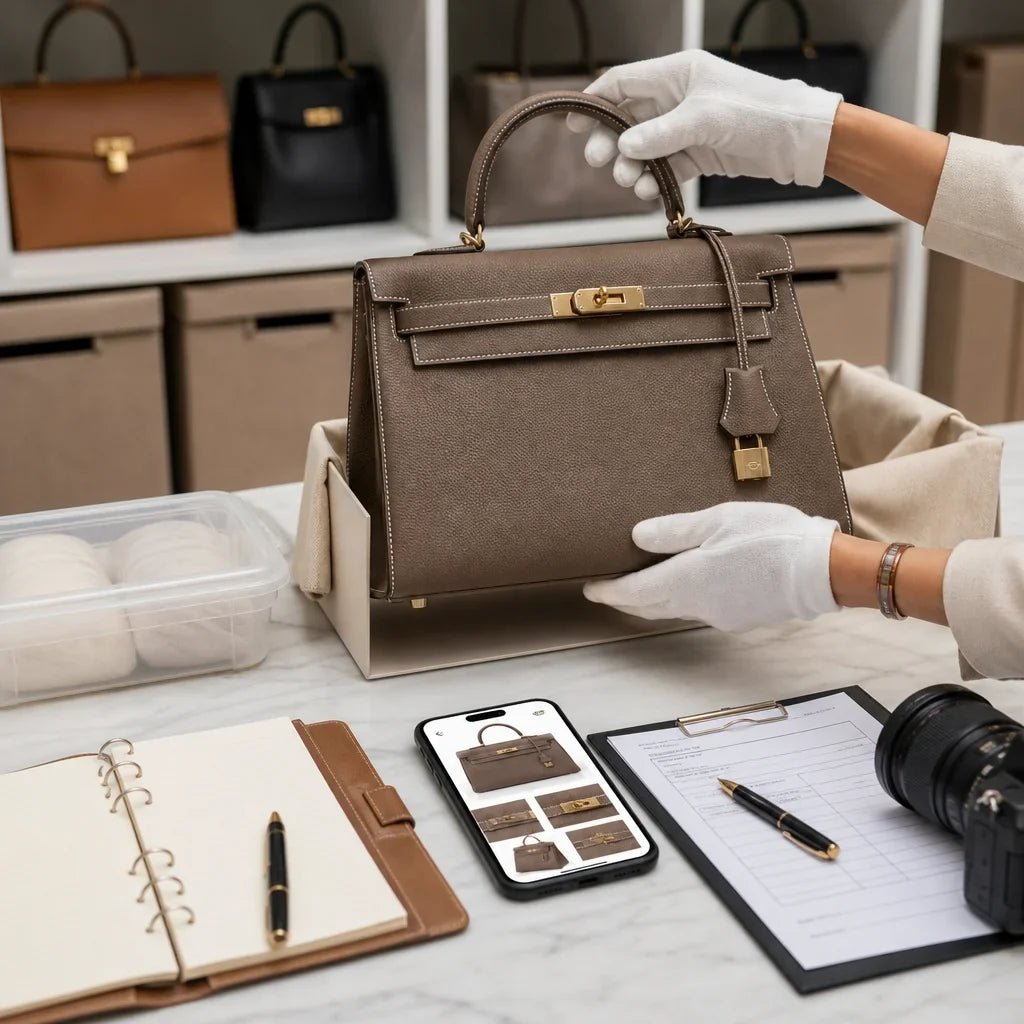
Actionable step: When preparing bags for eventual resale, document their condition with close-up photos of the silhouette from multiple angles. This baseline helps you identify any future deterioration and reinforces the value of preventative storage measures.

The Science Behind Handbag Sagging and Creasing

Leather is a natural material that responds to gravity, weight distribution, and environmental conditions. When a handbag sits unsupported, the leather stretches incrementally over time. The process is gradual but cumulative: after three months of improper storage, visible sagging appears. After a year, the damage becomes pronounced and often irreversible.

Creasing occurs through a different mechanism. When leather is folded or pressed against a hard surface for extended periods, the fibers compress permanently. The bag's interior bears weight from the structure trying to collapse inward, creating stress points that develop into creases. Once formed, these creases rarely disappear completely, even with professional restoration.

Humidity and temperature fluctuations accelerate both processes. Leather expands slightly in humidity and contracts in dryness. Without internal support to maintain shape during these cycles, the material weakens and begins to sag more rapidly. A bag stored in an inconsistent environment faces double damage: structural collapse plus material fatigue.

Luxury leather contains natural oils that give it flexibility and resilience. During storage, these oils can redistribute unevenly if the bag lacks proper support. Some areas become dry and brittle while others remain supple, creating inconsistent texture that reduces aesthetic appeal and resale value.

Our approach addresses these mechanisms directly. We design our inserts to maintain consistent internal support throughout storage, preventing the gravitational stress that triggers sagging. The premium materials we use don't absorb moisture or create pressure points that lead to creasing.

Actionable step: Store handbags in climate-controlled environments with humidity between 45-55%. This range preserves leather stability and works more effectively when paired with proper internal support.

Our Premium Insert Solution for Maximum Protection

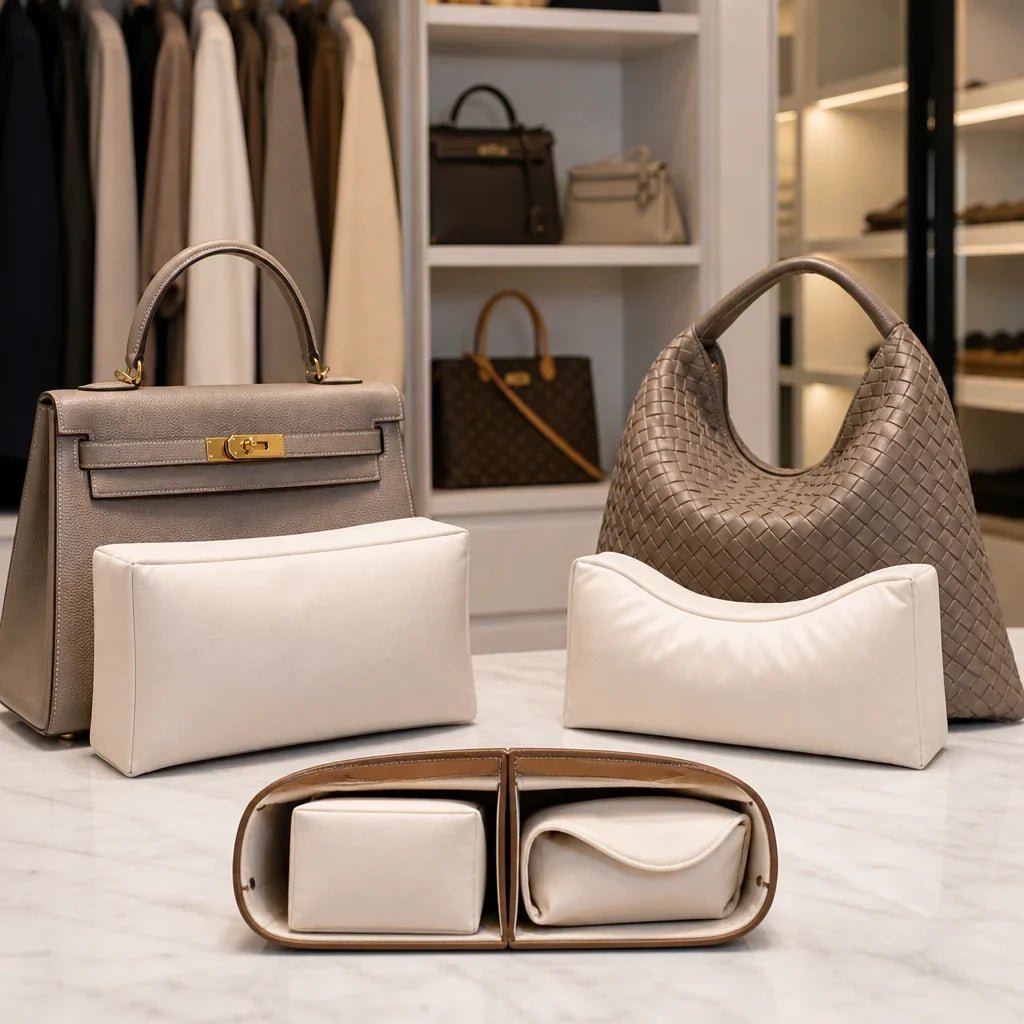
We create handcrafted purse pillow inserts designed specifically to counter the storage challenges that damage luxury handbags. Each insert is engineered with two critical components: a premium polyester sateen shell and Angel hair fiber fill. These materials work together to support the bag's structure while preventing damage to the leather itself.

The sateen shell provides a smooth surface that won't snag or mark delicate leather interiors. Unlike rougher fabrics, sateen allows the bag's material to rest gently against the insert without friction. The material is colorfast, so it won't transfer dye onto light-colored leather even during extended storage.

Our Angel hair fiber fill offers uniform support without creating pressure points. Unlike foam inserts that can compress unevenly or rigid materials that concentrate force in specific areas, Angel hair distributes support across the entire internal volume. This distribution prevents the creasing and indentation that rigid inserts sometimes cause.

We recognize that luxury handbags come in vastly different shapes and sizes. That's why we offer a comprehensive range from Mini to XL, with specific precision fits for popular models including Hermès bags. Our Hermès-specific inserts account for the exact dimensions and internal architecture of each model, ensuring optimal performance.

Our construction is entirely handcrafted. Each insert is assembled by skilled artisans who ensure consistent quality and attention to detail. We don't cut corners with mass production because we understand that corners matter when you're protecting investment-grade bags.

Actionable step: Measure your bags' internal dimensions (length, width, and height) to determine which insert size best matches your collection. Most collectors find that a few different sizes cover their entire collection efficiently.

Comparing Storage Methods: What Actually Works

Dust bags alone provide minimal structural support. They protect from dust and UV light but contribute nothing to maintaining shape. A Chanel flap wrapped in its original dust bag and placed on a shelf still faces sagging because the internal volume lacks support.

Tissue paper stuffing, a traditional approach, works partially but inconsistently. Paper shifts and compresses over time, creating uneven support that leads to deformation. After a few months, the tissue settles into the bag's lowest points, leaving upper areas unsupported.

Newspaper or plastic bags are problematic for different reasons. Newspaper transfers ink and can deteriorate, leaving residue inside the bag. Plastic bags trap moisture, creating environments where leather can develop mildew or mold.

Purpose-designed purse inserts represent a step forward, but material quality matters enormously. Low-quality inserts use rough fabrics that can catch on leather or synthetic fills that compress and become lumpy. These create their own problems: localized creasing where the compressed material sits against the leather.

Our premium inserts outperform these alternatives because they combine the right materials with precise engineering. The sateen shell won't damage leather, the Angel hair fill provides consistent support without compression, and the precision fits ensure that every bag receives support exactly where it needs it.

Some collectors combine dust bag storage with our inserts, creating maximum protection. The dust bag shields from environmental contaminants while our insert maintains structural integrity. This layered approach costs nothing extra but doubles the protective benefits.

Actionable step: Test one of our inserts in a single bag for 30 days. Compare the bag's silhouette and interior condition before and after use. Most collectors notice the improvement immediately and expand to their entire collection.

Investment-Grade Materials Make the Difference

The materials we choose directly determine how well our inserts protect your bags. We use premium polyester sateen exclusively, not cheaper cotton blends or synthetic alternatives. Sateen provides the necessary smoothness while maintaining structural integrity over years of use. It doesn't degrade in humidity, doesn't absorb moisture, and maintains its appearance through repeated storage cycles.

Angel hair fiber fill represents our highest material commitment. This specialized fill combines resilience with softness, supporting the bag without creating pressure points or impressions. It resists compression better than standard polyester fiberfill, maintaining consistent support year after year. Unlike foam products that break down over time, Angel hair retains its properties indefinitely.

We source our materials specifically for durability and performance in the luxury market. Every component is tested for colorfastness, meaning dyes won't transfer onto light-colored leather interiors. The materials meet conservation standards used in museum textile preservation, reflecting their quality and stability.

Cheaper inserts often use materials that compromise over time. Standard fiberfill becomes lumpy and uneven, creating the very pressure points we aim to prevent. Low-grade polyester can weaken in humidity or develop odors that transfer to the handbag. These shortcuts save manufacturers a few dollars but cost collectors thousands in bag deterioration.

Our commitment to material quality means our inserts outlast most handbags. An insert purchased today will perform identically in 10 years, supporting your bags without degradation. This consistency is impossible with lower-quality alternatives that degrade, compress, or deteriorate over time.

Actionable step: Request material samples or specifications from any insert manufacturer before purchasing. Ask specifically about colorfastness and long-term compression resistance. Premium materials require premium sourcing, and reputable manufacturers can document this.

Real Results: Before and After Storage Comparison

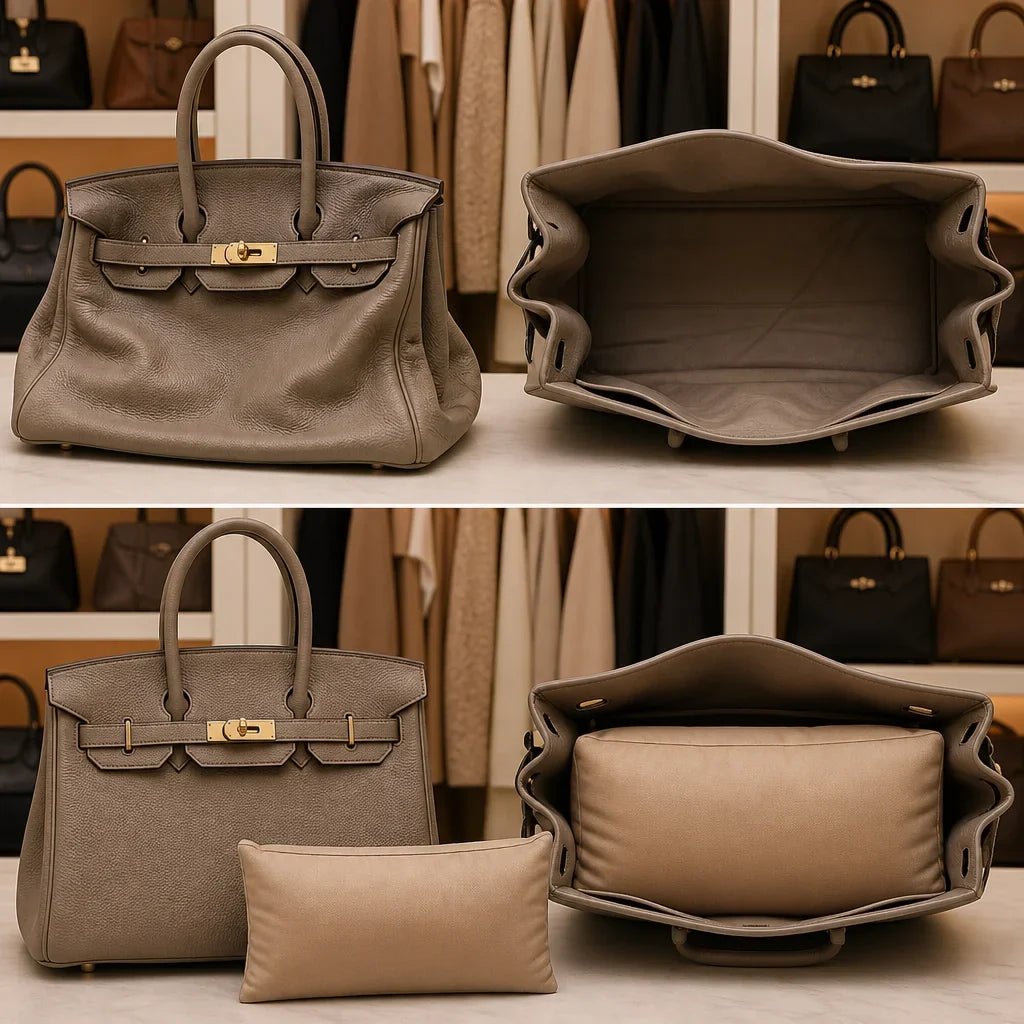
We've documented countless examples of bags stored with and without proper support. The differences are striking when examined side by side. A Hermès Birkin stored for 12 months without internal support showed visible sagging on the sides and permanent creasing across the interior bottom. An identical bag stored with our precision-fitted insert maintained perfect shape and showed no interior marks whatsoever.

Photography tells the story clearly. Images taken from directly above reveal how unsupported bags gradually collapse inward. The bag's natural shape is compromised first at the sides, then progressing toward the bottom. With proper internal support, the bag's silhouette remains unchanged even after years of storage.

One collector tracked her Chanel Classic Flap across six months of storage. Without support, the bag developed visible creasing on the interior lining and the leather began to show permanent compression marks. When we reinserted a Fabrinique insert, the interior marks gradually faded over several weeks. The leather's natural flexibility began to restore itself, though the previous damage never completely disappeared.

Another example involved a Louis Vuitton tote stored for two years without support. The bottom corners developed permanent dents that affected the bag's overall proportions. The interior showed multiple compression creases. Upon introducing our XL insert, the bag regained most of its structural integrity, though the corner damage proved partially irreversible. This case illustrates why prevention matters: some damage cannot be undone once it occurs.

We've also tracked bags stored with inferior inserts. Initial improvement lasted only a few months before the substandard fill began compressing and creating new pressure points. This reinforced our commitment to using only premium materials that don't degrade over time.

Actionable step: If you suspect your bags have existing storage damage, introduce proper inserts now to prevent further deterioration. While old damage may persist, new inserts prevent the situation from worsening.

Choosing the Right Insert for Your Collection

Insert sizing directly impacts protection effectiveness. An oversized insert will bunch up inside the bag, creating pressure points similar to structural collapse. An undersized insert leaves gaps, allowing the bag to sag around the edges. Correct sizing ensures the insert fills the internal volume fully and uniformly.

We offer five core sizes covering nearly all handbag styles. Our Mini size fits small crossbody bags and coin purses. Small accommodates bags like the Chanel WOC or Hermès Evelyne. Medium covers classic sizes including the Chanel Classic Flap and Hermès Kelly. Large fits bigger totes and hobos. XL handles oversized luggage and weekend bags.

For specific models, we provide precision fits. Our Hermès-specific collection includes inserts engineered for the Birkin, Kelly, Constance, and other popular styles. These precision designs account for the exact interior architecture of each model, maximizing support exactly where each bag needs it most.

Choosing the right size requires measuring your bag's internal dimensions. Measure the length from the front opening to the back, the width at the widest point, and the height from the bottom to where the sides meet the opening. Compare these measurements against our size guide. When in doubt, choose the smaller size to avoid bunching.

Collectors with diverse collections typically need multiple sizes. A typical assortment might include Small for evening bags, Medium for daily totes, and Large for weekend luggage. We offer collection packages that combine multiple sizes at savings, making it economical to protect your entire portfolio.

Actionable step: Create a simple spreadsheet listing each bag's model, interior dimensions, and current storage location. Use this to determine which sizes you need and prioritize protecting your highest-value pieces first.

How Our Precision Fits Ensure Optimal Performance

Precision fits go beyond simple sizing. They account for the specific shape variations and interior architecture of particular models. A Hermès Birkin has different proportions than a Chanel Flap, requiring different internal support geometry. Our precision inserts are engineered for these differences rather than treating all bags identically.

Our Hermès Birkin insert, for example, is designed to match the bag's distinctive structured shape. It provides extra support in the side panels where Birkins naturally want to collapse. The insert's height is precisely calibrated to fill the interior without extending above the opening, ensuring it sits invisibly when the bag is closed.

The Hermès Kelly presents a different challenge. Its more angular shape and divided compartments require a different insert design. Our Kelly insert provides targeted support in each section, maintaining the bag's signature proportions without creating bulk or visibility.

These precision fits derive from our deep understanding of luxury handbag construction. We've studied the interior architecture of popular models, identifying where sagging typically occurs and where support needs to be strongest. This research translates into inserts that feel custom-engineered for each bag.

When you use a precision fit, the insert becomes nearly invisible. It fills the interior completely but doesn't create obvious bulk. The bag maintains its original proportions and handling characteristics. Collectors often report that precision-fitted bags feel like they've just left the boutique.

Actionable step: Identify your collection's most valuable pieces or those most prone to sagging. Prioritize precision-fit inserts for these bags, then use standard sized inserts for secondary pieces.

Building Long-Term Value Through Proper Care

Structural preservation is foundational to maintaining your collection's value, but it works within a broader care strategy. Proper storage temperature and humidity, regular documentation, and appropriate handling all contribute to long-term value retention.

Store bags in climate-controlled environments where possible. Temperature fluctuations between cold winters and warm summers stress leather fibers. Humidity outside the 45-55% range causes leather to crack in dry conditions or become overly soft in humid conditions. Combine environmental control with our inserts for maximum protection.

Photographing bags regularly creates a documented record of their condition. These images serve multiple purposes: they help you track whether storage methods are working effectively, they provide evidence of condition for insurance purposes, and they support resale value when buyers want proof of careful maintenance.

Handle bags thoughtfully even during use. Overloading causes structural stress that compounds storage damage. When storing after use, remove all items from the bag completely, clean the interior gently, and insert our pillow insert before placing the bag away. This simple routine prevents items from creating pressure points during storage.

Professional leather care enhances rather than substitutes for proper storage. Occasional conditioning keeps leather supple and resilient. However, conditioning a bag that's been collapsed or creased by poor storage provides limited benefit. Prevention through proper storage inserts proves more effective than remediation after damage occurs.

Your collection's value appreciation depends on consistent care across years and decades. Proper storage with our inserts establishes this consistency, ensuring that each bag in your portfolio retains maximum value for eventual sale or generational transfer.

Actionable step: Create a storage care checklist for each bag: clean interior, insert protective pillow, photograph condition, record storage location. Execute this checklist consistently when storing bags after use.

Maximizing Your Luxury Handbag Portfolio

Viewing your handbag collection as a portfolio rather than mere accessories changes how you approach storage and care. Portfolio thinking recognizes that each piece represents capital, with appreciation potential if maintained properly. This perspective justifies investments in protective storage solutions that cost far less than the value they protect.

Portfolio diversification extends to insert selection. Just as you diversify handbag styles and colors, you should diversify storage protection based on each bag's specific needs. Premium investment pieces deserve precision-fit inserts. Secondary collection pieces work well with standard sized inserts. This tiered approach optimizes protection budgets across diverse collections.

Inventory management becomes clearer when you think in portfolio terms. Tracking which bags are stored where, their current condition, and the storage solutions protecting them creates visibility that serves multiple purposes. You know immediately which pieces need attention, you can calculate total portfolio value, and you maintain documentation for insurance purposes.

Resale planning begins years before you actually sell. Collectors who think long-term about portfolio strategy maintain bags specifically for eventual sale, keeping them in pristine condition through proper storage and insurance coverage. Our inserts support this strategy by preserving structural integrity year after year.

The true value of proper storage protection emerges over years. A bag protected with our inserts for five or seven years maintains resale value that unsupported bags lose entirely. When you eventually liquidate collection pieces, the incremental gains from maintaining perfect condition far exceed the modest investment in protective storage.

Actionable step: Calculate your collection's current market value by researching comparable models on resale platforms. Multiply this total by 20%, representing the conservative estimate of value loss from poor storage practices. This number illustrates what proper protection actually costs versus what it preserves.

We believe every luxury handbag deserves protection equal to the investment it represents. Our handcrafted inserts are built for collectors who understand that structural integrity directly translates to resale value and long-term portfolio growth. Start with your most valuable pieces and expand from there. Free U.S. shipping on all orders means protection comes without additional cost barriers. Your collection's future value depends on what you do during storage today.

Read more

Illustration 1

How to Document Luxury Handbag Care and Storage for Maximum Resale Value

Why Provenance Matters in Luxury Handbag Resale Luxury handbag collectors understand that their investments demand more than careful handling. Documentation transforms a pristine bag into a verifia...

Read more
Illustration 1

Structured vs. Slouchy Handbags: The Complete Storage Guide for Collectors

Why Your Handbag Storage Method Matters More Than You Think A luxury handbag isn't just an accessory—it's an investment. Whether you've acquired a structured Hermès Kelly or a soft Bottega Veneta, ...

Read more