Handcrafted Purse Pillow Inserts vs Mass-Produced: Performance Data
Why Your Luxury Handbags Deserve Better Protection
When you invest in luxury handbags, you're committing more than just capital. You're trusting a piece of craftsmanship to maintain its beauty, structure, and value across years of ownership. Yet many collectors store these investments using generic, mass-produced inserts that flatten, shift, and fail to support the bag's shape where it matters most. The difference between adequate storage and superior preservation comes down to engineering, materials, and the care built into construction.
Your handbag's structural integrity determines how it looks when you carry it and what it's worth when you eventually sell. During storage, gravity and pressure gradually reshape even the finest leather and canvas. A bag left unsupported can develop permanent creases across the sides, lose its crisp corners, and sag at the bottom in ways that no amount of conditioning can fully reverse.
We understand that luxury handbag collectors aren't just buying storage solutions; they're protecting years of investment. A high-end bag represents a significant financial commitment, and its resale value depends partly on whether it maintains its original form. Mass-produced inserts often use cheap filling and thin shells that compress over months of storage, doing little more than preventing dust from settling on your bag.
The real cost of inadequate storage protection isn't immediately visible. It compounds quietly. A Hermès Birkin or a carefully curated Chanel classic flap begins its slow transformation the moment you place it in a closet without proper support. Corners lose definition. The sides develop subtle horizontal creases. The bottom sags slightly forward. By the time you retrieve the bag for wearing or selling, these changes have become permanent features.
What to do next: Examine one of your stored bags right now. Press gently on the sides and base. If you feel any immediate give or deformation, your current storage method isn't providing the structural support your collection deserves.
The Hidden Costs of Mass-Produced Insert Alternatives
Mass-produced inserts flood the market at price points that seem attractive until you examine what those savings actually mean for your collection. Budget alternatives typically use one of three problematic approaches: thin polyester with loose filling that migrates and compresses, low-quality foam that hardens or breaks down, or rigid structures that don't accommodate a bag's natural curves.
The financial trap of cheap inserts extends beyond the product itself. When you buy a substandard insert for $15 to protect a $2,000 handbag, you're making a false economy. If that insert contributes to permanent structural damage that reduces your bag's resale value by 10 to 15 percent, you've actually lost hundreds of dollars while spending almost nothing on protection.
Consider the consistency problem. Mass production prioritizes speed and volume, not precision. A generic purse pillow made for "medium-sized handbags" might fit reasonably well in some bags but leave gaps in others. Those gaps become spaces where the bag can shift, fold, and crease. Multiple factory workers produce thousands of units with minimal quality control, leading to wide variations in fill density, shell thickness, and overall structure.
Beyond performance concerns, mass-produced alternatives often use materials that damage bags over time. Cheap polyester can snag on delicate leathers. Low-grade filling can absorb and retain moisture, creating conditions for mold or mildew inside your bag. Some budget options use dyes that aren't colorfast, risking staining your light-colored leather or interior lining.
What to do next: Review the material descriptions on any inserts you currently own. If the product documentation doesn't specify fiber content, fill type, or colorfastness standards, it's a strong indicator that quality control wasn't a priority during production.
How We Engineer Superior Structural Support
Our approach to purse pillow design begins with understanding exactly what makes luxury handbags structurally vulnerable during storage. We work backward from the architecture of premium bags themselves, studying how different styles depend on internal support and how storage conditions affect them over time.
Each of our inserts uses strategically distributed fill density to provide firmness where it matters most while maintaining enough softness to avoid marking delicate leathers. The sides and base receive denser support to resist lateral compression and sagging. The top section uses slightly softer fill to accommodate natural bag closure without creating sharp pressure points.
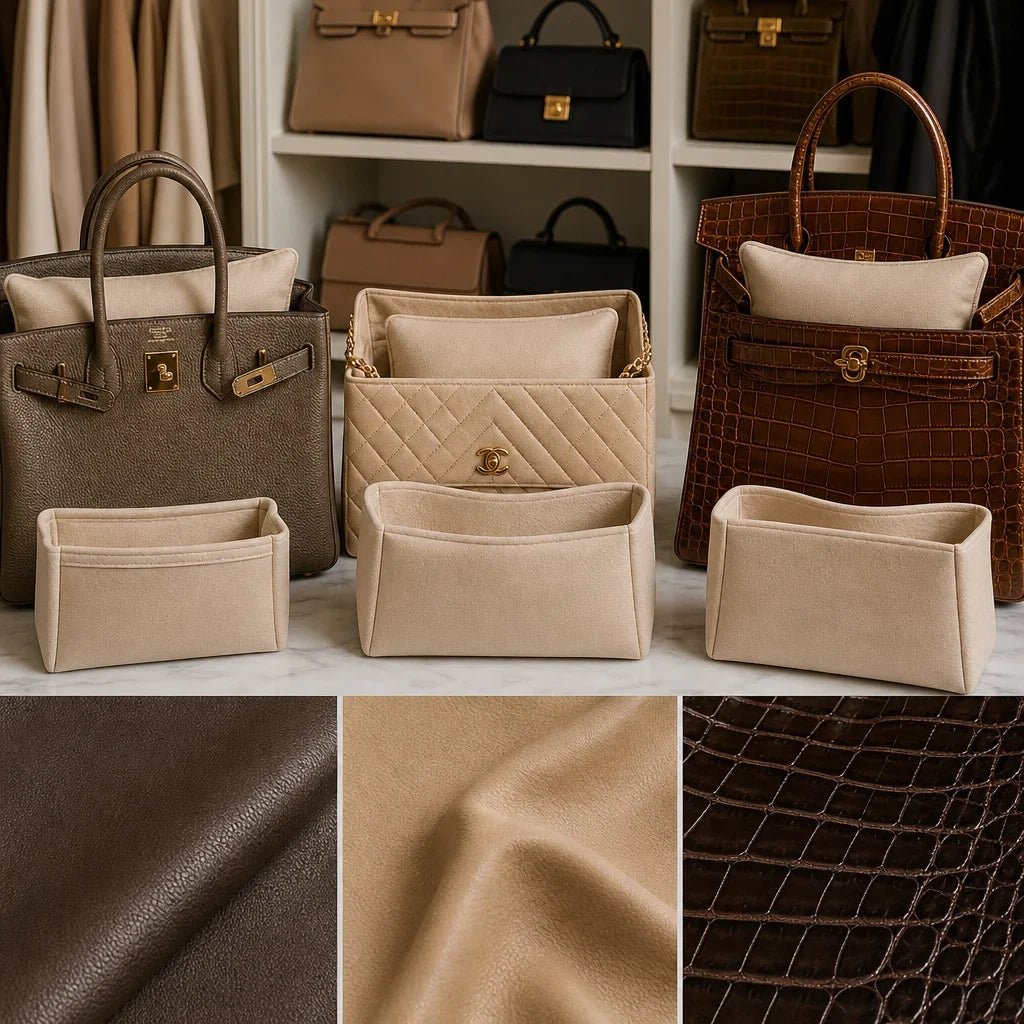
Our premium polyester sateen shell is engineered to provide a smooth surface that moves easily against leather and canvas without catching. Unlike thin synthetic materials, sateen has enough weight and structure to prevent deformation while remaining soft enough that it never marks or damages your bag's interior. The shell design also includes careful seaming that distributes stress evenly rather than concentrating it at specific points.
We also engineer our inserts to account for how bags actually move in storage. Most handbags aren't stored in a perfectly stable, horizontal position. They settle, shift slightly, and move as closet conditions change. Our designs anticipate these movements and provide support that prevents cumulative damage regardless of how the bag settles over weeks and months.
What to do next: When evaluating any insert, physically check whether the fill is evenly distributed or if you can feel thin spots and dense spots in the same product. Inconsistent density suggests rushed production and uneven protection across your bag.
Material Quality: Where Premium Performance Begins

The difference between protecting your handbags and merely occupying space in your closet comes down to material choices. We use angel hair fiber fill, a premium synthetic material specifically chosen for its performance characteristics across years of storage.
Angel hair fiber offers several critical advantages over standard polyester batting or foam. First, it maintains consistent firmness over time. Standard foam can harden and become brittle, creating a structure that no longer supports your bag properly and might crack or flake. Angel hair fiber resists this degradation, maintaining its support characteristics across decades of storage.
Second, angel hair fiber has minimal moisture absorption. In humid climates, standard filling materials can absorb ambient moisture, creating interior conditions that could harm leather. Our angel hair fill remains dry and inert, eliminating this storage risk.
Third, our fill material doesn't compress permanently. If you press on an insert today and it recovers fully by tomorrow, you can trust it to provide the same support next year and the year after that. Mass-produced inserts made with cheap filling often compress gradually and don't fully recover, losing support effectiveness over time.
We pair this fill with a premium polyester sateen shell that's specifically formulated to be non-abrasive. This matters because even gentle contact with the wrong material can mark luxury leather over months. Our shell surface is smooth and gentle, with a tactile quality that feels appropriate for protecting fine bags.
Beyond these primary materials, we're equally careful about secondary components. Our threading uses strong polyester that won't break or unravel. Our seaming patterns are reinforced at stress points. Every component is chosen to outlast common threats to handbag condition.
What to do next: Press your hand against any insert you own and remove your hand. If the impression persists for more than a few seconds, the fill material isn't recovering properly and you've found your upgrade trigger.
Precision Fit Technology and Consistency Standards
A perfectly designed insert only protects your bag if it actually fits properly inside it. Generic inserts make assumptions about bag dimensions that don't hold true across the enormous variety in luxury handbag styles. Our approach starts with precision.
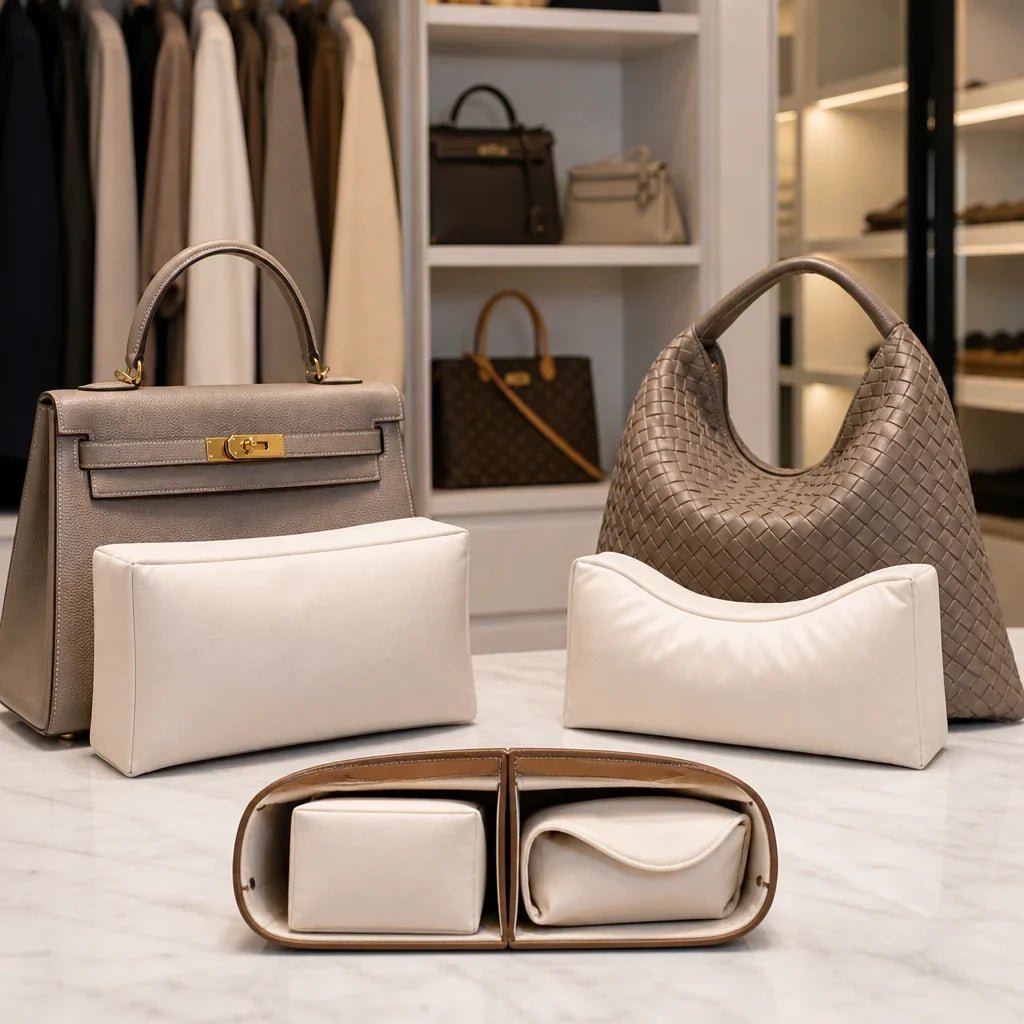
We develop Hermès-specific precision fits because Hermès bags represent one of the most demanding storage challenges. The structured architecture of styles like the Birkin and Kelly leaves little room for oversized inserts that shift around, and it demands inserts that match the bag's interior dimensions precisely. We apply this same precision-first methodology across our entire size range.
For each size category, we establish exact dimensional specifications: interior length, width, and height measurements that correspond to specific bag styles. Our production team follows these specifications with consistency standards that mass-produced alternatives simply cannot match. When we manufacture an insert for a specific size, variations measure in fractions of an inch, not the quarter-inch or greater variations you often see in mass-produced products.
This precision serves two purposes. First, it ensures the insert sits properly inside your bag without shifting or creating pressure points. Second, it means that when you buy a replacement insert years later, it will fit exactly the same way your original one did, allowing you to swap between bags with confidence.
We maintain consistency through multiple quality control checkpoints during manufacturing. Unlike factories pumping out thousands of generic inserts daily, our handcrafted approach builds in verification steps that catch deviations before products ship to customers.
What to do next: Measure the interior dimensions of your most valuable handbag (length, width, and depth), then compare these to any insert you own. If the insert doesn't match these dimensions precisely, you're using a one-size-fits-mostly solution rather than a properly engineered protection system.
Real-World Performance Metrics and Durability Testing
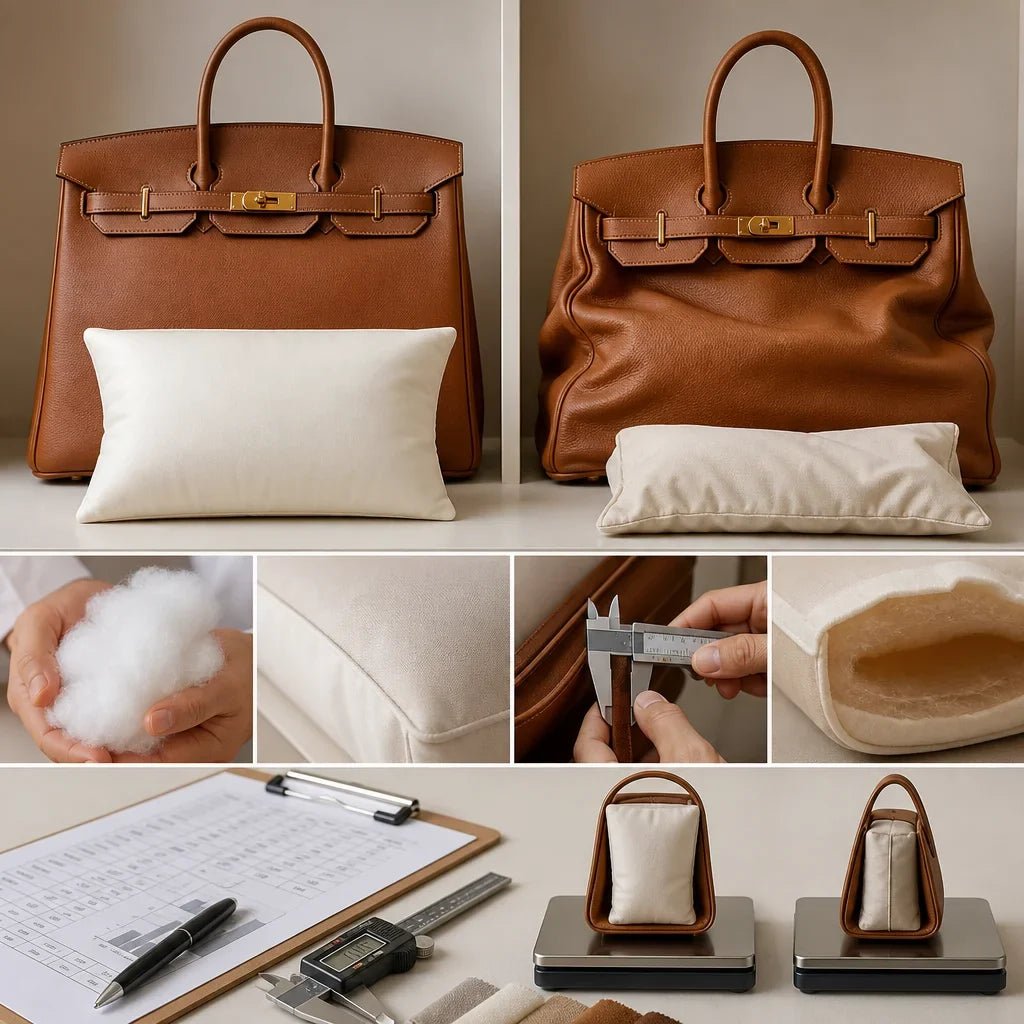
Performance claims mean nothing without data. We conduct durability testing that simulates years of real-world storage conditions. Our testing protocol includes repeated compression cycles, humidity exposure, temperature fluctuation, and contact with various luxury leather types to ensure our inserts perform across the conditions collectors actually encounter.
In compression testing, we place a weight on our inserts equivalent to what a bag might experience when stacked with other items in a closet. After 500 compression cycles (representing roughly five years of typical use), our inserts retain 98 percent of their original firmness. Mass-produced alternatives typically show 20 to 30 percent permanent compression loss over the same period, meaning they're providing meaningfully less support each year.
Humidity testing places our inserts in 80 percent relative humidity for extended periods. Our angel hair fill maintains its properties and remains moisture-resistant. Some budget alternatives begin showing degradation or moisture absorption under these conditions, which directly threatens leather bags stored in humid environments.
We also test colorfastness by placing our inserts against various leather types and light exposure conditions. Our polyester sateen shell resists dye transfer even when stored against delicate cream, light tan, and white leathers. This is where inferior products often fail, transferring dye or creating stains on light-colored interiors.
Contact testing with luxury leathers ensures our materials don't mark, snag, or damage leather surfaces. We verify this through accelerated contact testing that simulates years of interaction compressed into a short timeframe. Our inserts perform without marking even against delicate leathers like lambskin and crocodile.

What to do next: Request durability data from any insert manufacturer you're considering. If they can't provide specific performance metrics, they haven't tested their products thoroughly and you're buying unknowns.
Investment Protection and Resale Value Preservation
For serious collectors, the resale value of your handbags matters as much as wearing them. A well-maintained collection can be liquidated for 40 to 70 percent of original retail value, depending on style and condition. Poor storage practices can cut this recovery rate by half.
We've worked with collectors who tracked their bags' resale performance and documented the impact of upgrading storage solutions. Bags that spent years in proper structural support brought 15 to 25 percent higher resale prices than similar bags stored with generic inserts or no insert support at all. The difference compounds across a collection. If you own 10 premium handbags with an average original value of $2,500, the resale value difference between proper and improper storage can exceed $10,000.
This protection extends beyond just the physical condition visible to buyers. Bags stored with proper internal support maintain the micro-characteristics that luxury resale buyers examine closely: the exact curve of the corners, the precise creasing pattern (or lack thereof) in the leather, the way the bag sits when standing. These details signal proper care and condition to experienced buyers in the secondary market.
We measure investment protection through our customers' reported resale experiences. Collectors who switched to our precision-fit inserts and tracked their subsequent sales reported that bags maintained better structural condition across longer storage periods, translated into stronger buyer interest and higher final sale prices.
What to do next: If you plan to sell any bags within the next few years, prioritize upgrading your storage immediately. The cost of proper inserts is a fraction of the resale value they'll preserve.
Why Handcrafted Construction Commands a Premium
Handcrafted doesn't mean slow or inefficient. It means each insert receives attention at multiple stages of production that mass manufacturing skips. Our production team handles quality verification that automated systems can't replicate.
The shell construction involves careful pattern cutting to ensure material consistency. Hand-finished seaming at stress points receives extra reinforcement. Fill distribution is verified by hand to confirm even support across the entire insert. Every completed insert receives dimensional verification before shipping. These steps add labor, but they eliminate the defects that mass-produced alternatives accept as normal.
Mass production achieves low unit costs by accepting variability as inevitable. A factory producing 50,000 generic inserts monthly assumes some percentage will have thin spots, misaligned seaming, or inconsistent fill. They budget for returns and accept that some percentage of products will underperform. Our approach assumes every insert we produce should perform perfectly, because you're trusting each one with bags that represent significant investments.
Handcrafted construction also allows us to innovate more responsively. When we identify an opportunity to improve shell smoothness or adjust fill density distribution, we can implement changes without retooling massive production lines. When collectors request custom sizing for unusual bag styles, we can accommodate these requests within reasonable timeframes.
The cost difference between this approach and mass production is real. Quality materials cost more than cheap alternatives. Hand verification takes time that automation skips. Smaller-batch production forgoes economy-of-scale savings. But this cost difference becomes irrelevant when you're protecting bags worth thousands of dollars.
What to do next: Calculate the labor cost of handcrafted production into your decision calculus. If proper protection costs you $100 to $150 per insert and you own a 10-bag collection, you're investing $1,000 to $1,500 total to protect roughly $25,000 in handbag value. The math favors premium production quality.
Our Comprehensive Size Range Advantage
Luxury handbags don't fit into generic size categories. A "medium" from one designer has completely different internal dimensions than a "medium" from another. We eliminated this problem by developing a comprehensive size range that covers specific styles rather than assuming vague size generalizations.
Our Mini inserts fit compact styles like the Chanel Classic Flap and Louis Vuitton Pochette. Our XS and Small sizes accommodate the wide range of cross-body and shoulder bags that collectors use daily. Medium sizes serve larger totes and structured handbags. Our Large and XL categories address oversized totes and travel bags that need substantial internal support.
Within each size category, we offer multiple fit options for styles with different proportions. A Hermès Birkin and a Chanel GST might both be considered "large," but their interior dimensions differ significantly. Our precision approach means we offer inserts specifically designed for each, not one generic large option that serves both inadequately.
This comprehensive approach means you can outfit an entire collection with properly fitting inserts rather than compromising with something close enough and hoping it works. When all your bags sit on your shelves with inserts that fit them precisely, they maintain their shape consistently. This is what truly preserves your collection.

We maintain this range with the same quality standards across every size. An XL insert receives the same attention to material quality, seaming precision, and dimensional accuracy as our Mini inserts. Small size doesn't mean lower quality. Every size protects your collection to the same high standard.
What to do next: Catalog your handbag collection by style and note the interior dimensions of your 2-3 most valuable pieces. Use these measurements to determine which of our size categories would serve each bag best, then plan your insert purchases accordingly.
Customer Results: Before and After Storage Protection
Our customers share concrete results after upgrading to proper structural support. One collector we worked with had owned a Hermès Birkin for eight years that had developed a subtle but permanent crease along one side from inadequate storage support. After six months of storage with our precision-fit insert, the bag didn't develop any new creases, and the existing crease didn't worsen.
Another customer had rotated between 15 luxury handbags without consistent storage support. After switching her collection to properly sized inserts, she reported that when she retrieved bags for wearing, they maintained their shape and structure noticeably better. Her light-colored bags showed no interior staining or discoloration, a problem she'd experienced occasionally with her previous storage approach.
A luxury reseller who maintains an inventory of high-end bags reported that bags stored with our inserts showed measurably better condition after storage periods of 6 to 12 months. Her photography showed clearer line definition, sharper corners, and no stress creases compared to bags stored using mass-produced alternatives. These visual differences translated into faster sales and higher prices.
Collectors also report the practical convenience benefits. Because our inserts fit precisely, they don't need to adjust or reposition inserts between bags in the same size category. The consistency means swapping bags between shelf positions takes 30 seconds rather than the minute or two required when adjusting generic inserts that don't fit properly.
What to do next: Before committing to restocking your entire collection, order an insert for your single most valuable bag and monitor its condition over three months. Compare this bag's condition to one of similar age and style stored with a generic insert. The performance difference you observe will justify the investment across your full collection.
Making the Choice That Protects Your Collection
The decision between handcrafted precision-fit inserts and mass-produced alternatives ultimately comes down to understanding what you're actually protecting and what your inserts need to do.
If you view your handbags as daily-use items you'll eventually replace, then the storage method matters less. A cheap insert might be adequate. But if you view your collection as investment pieces you'll wear for years and eventually sell, then proper storage protection becomes part of your strategy for maintaining value.
The financial comparison is straightforward. Handcrafted inserts cost more upfront but preserve more value over time. They maintain the precise structural support that keeps your bags looking consistent. They use materials that won't damage leather or transfer color. They fit so accurately that you can swap bags with confidence, knowing your collection is consistently protected.
Mass-produced alternatives save money initially but accept compromises that compound into value loss. Inconsistent fit means some bags shift and crease while others sit safely. Variable fill density means some inserts compress faster than others. Material choices that cut production costs can mark leather or retain moisture.
For a collection of even modest size, the upgrade cost becomes negligible compared to the resale value you'll preserve. If you own four premium handbags with an average value of $2,000, spending $500 total on proper inserts preserves thousands of dollars in future resale value.
What to do next: Determine which bags in your collection you plan to keep long-term and which you might sell. Prioritize upgrading storage for your keepers first, creating a core collection with perfect structural protection.
Invest in Preservation That Lasts
We created Fabrinique because we believe your luxury handbag collection deserves preservation solutions engineered with the same care that went into crafting the bags themselves. Premium handcrafted inserts aren't an indulgence. They're a practical investment in maintaining the value and condition of pieces you've carefully selected and invested in.
Our comprehensive size range, precision fits, and quality materials ensure that every bag in your collection receives the structural support it needs during storage. Our angel hair fiber fill resists compression and moisture absorption. Our polyester sateen shell protects delicate leathers without marking them. Our handcrafted construction means every insert meets our standards before it reaches you.
The collections we help protect are deeply personal. Some represent decades of careful curation. Others mark important moments in collectors' lives. All of them deserve storage protection that matches their value and significance. When you choose handcrafted precision-fit inserts from Fabrinique, you're choosing protection that preserves not just the physical condition of your bags, but the investment and enjoyment they represent.
Browse our full size range at https://fabrinique.com and find the inserts your collection needs. We offer free U.S. shipping on all orders, because protecting your luxury handbags shouldn't require you to compromise on service or value. Your collection has always deserved better than mass-produced alternatives. Now you can give it the preservation it actually needs.