Skip to content

Cart

Your cart is empty

Article: Calfskin vs Lambskin vs Exotic Leathers: Choosing the Right Handbag Storage Protection

Illustration 1

Calfskin vs Lambskin vs Exotic Leathers: Choosing the Right Handbag Storage Protection

Understanding Leather Types and Storage Challenges

Your luxury handbag collection represents years of careful curation and significant financial investment. Yet many collectors store these pieces without understanding how different leathers respond to pressure, humidity, and time. A Hermès Kelly in supple lambskin requires entirely different protection than a structured calfskin Birkin or an exotic crocodile clutch. The wrong storage approach can transform a pristine investment into a sagging, creased, discolored disappointment within months.

We've spent years studying how premium leathers behave in storage environments and what causes permanent damage. This research revealed that leather type fundamentally determines which storage solutions actually work. A generic tissue-stuffed purse won't protect lambskin the same way it fails exotic leathers. Understanding these differences is the first step toward preserving your collection's value and appearance.

Luxury handbag leathers fall into three distinct categories, each with unique structural and compositional properties that affect how they age in storage.

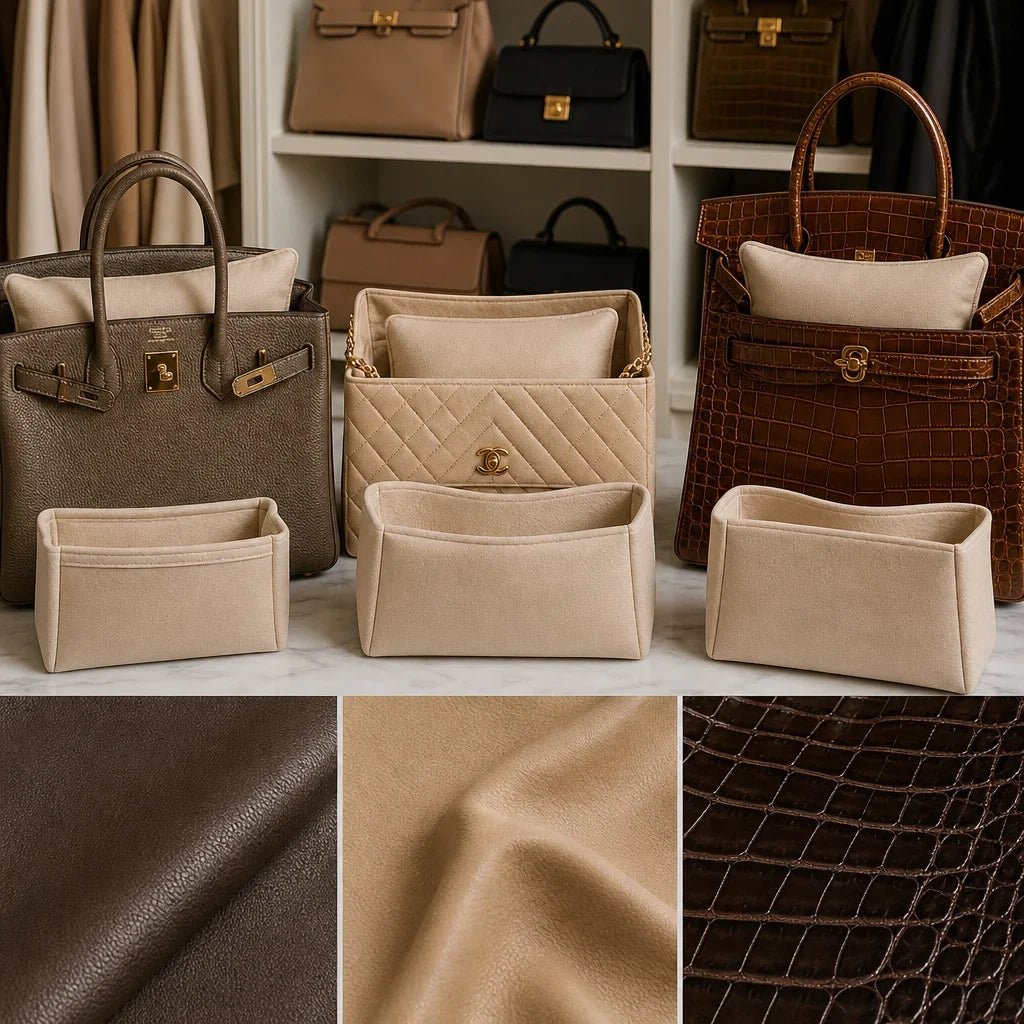
Calfskin represents the foundation of many classic luxury pieces. This leather comes from younger animals, producing a fine grain pattern and buttery smooth surface. Calfskin has natural rigidity that helps bags maintain their intended silhouette, but this structure requires support during storage to prevent the leather from stretching under its own weight. Extended pressure against a bag's walls causes permanent creasing patterns that damage resale appeal.

Lambskin offers unmatched softness and luxurious hand-feel, making it highly desirable for handbags that prioritize comfort and elegance. The trade-off is vulnerability. Lambskin lacks the structural density of calfskin, meaning it compresses easily and develops creases that become permanent when exposed to prolonged pressure. This leather also shows surface marks more readily, making it sensitive to contact with storage materials.

Exotic leathers like crocodile, python, and ostrich bring distinctive texture and prestige to any collection. These leathers have specialized surface structures and variable thickness that react unpredictably to improper support. Pressure against exotic leather patterns can deform the natural quilting or scale arrangement, fundamentally altering the bag's appearance and significantly reducing resale value.

Your storage approach must account for each leather's unique vulnerability profile. Generic solutions treat all handbags similarly, which means they protect none of them adequately.

Why Standard Storage Methods Fail Premium Leathers

Most collectors default to convenient but counterproductive storage methods: hanging bags on hooks, storing them flat in dusty closets, or stuffing them with newspaper and plastic. Each approach creates predictable damage patterns.

Hanging bags by their handles concentrates enormous stress on attachment points and stretches the leather across the body of the bag. Over time, this causes permanent handle elongation and structural deformation that's nearly impossible to reverse. The bag's silhouette warps, and these distortions significantly impact resale value even when the leather itself remains undamaged.

Flat storage without support allows the bag's weight to compress internal structure unevenly. Lambskin settles into compacted patterns that become permanent creases. Calfskin loses its intentional shape and develops stress points where the leather naturally folds. Exotic leathers' unique surface patterns get disrupted by uneven pressure distribution, permanently altering their visual texture.

Newspaper and plastic introduce moisture, odor absorption, and color transfer problems. Newspaper ink migrates onto light-colored leathers, while plastic traps humidity against the leather surface, creating an environment where mildew thrives. These materials also have abrasive fibers that scratch delicate lambskin and exotic leathers when the bag shifts during storage.

Tissue paper seems gentle but actually works poorly for leather preservation. Standard tissue has a rough fiber structure that creates micro-scratches on luxury leather surfaces. The material doesn't provide structural support, so bags still collapse under their own weight. Tissue also doesn't prevent humidity fluctuations, leaving leather vulnerable to seasonal moisture changes that cause stretching and shrinkage.

What makes these methods fail is their assumption that leather simply needs protection from dust and light. In reality, leather needs active structural support to maintain its shape, materials that don't transfer color or odor, and controlled micro-environments that stabilize humidity levels.

Material Composition: How Our Inserts Protect Each Leather Type

We design every Fabrinique insert around three protective principles: maintaining the bag's structural integrity, preventing material transfer and abrasion, and stabilizing the microenvironment around the leather.

Our premium polyester sateen shell creates a smooth, non-abrasive barrier between your leather and external pressure. Unlike cotton or tissue, sateen's tightly woven surface has no rough fibers to scratch delicate leathers. This material actively resists color transfer and odor absorption, protecting your bag from environmental contaminants. Sateen maintains structural consistency across seasons, so it doesn't expand or contract in ways that would create uneven pressure on the leather.

Angel hair fiber fill provides cushioning that actively supports leather structure without compressing into permanent shapes. Traditional fills like polyfill or down flatten over time, eventually offering zero support. Our angel hair maintains its loft indefinitely, continuously supporting the bag's sides and preventing the internal collapse that creates visible creasing. This material is naturally breathable, allowing controlled air circulation that prevents moisture concentration.

This combination of outer shell and fill accomplishes something generic stuffing cannot: it maintains your bag's intended silhouette while adapting to the leather's response to storage conditions. The sateen prevents damage at the material level, while the angel hair provides the structural support each leather type requires to resist deformation.

Calfskin Handbags: Superior Sateen Shell Benefits

Calfskin's natural rigidity is simultaneously its strength and its vulnerability in storage. The leather wants to maintain its structured form, but extended pressure against the bag's walls forces calfskin to compress and crease in ways that become permanent.

When you place a calfskin Hermès Birkin or Kelly into storage without proper support, the leather immediately begins responding to gravitational stress. The bottom of the bag bears the entire weight of the leather itself, creating a concentrated pressure zone. Over weeks and months, this pressure doesn't simply press the leather temporarily. It causes permanent stress marks and creasing patterns that remain visible even after the bag is removed from storage.

Our sateen shell provides uniform pressure distribution that prevents stress concentration. The material's smooth surface allows the calfskin to rest against support without friction-based damage. Unlike rougher materials that grab at the leather surface, sateen creates a frictionless interface that lets the leather settle into its natural resting shape.

The thermal and humidity stability of sateen becomes critical for calfskin during seasonal transitions. Calfskin expands and contracts in response to humidity changes, and this movement creates micro-stresses across the leather surface. When sateen provides consistent micro-environment conditions, calfskin expands and contracts uniformly rather than experiencing stress concentration in specific areas.

Our precisely sized inserts for calfskin bags fill the interior space completely, eliminating empty areas where the leather could collapse inward. A Birkin insert that's undersized allows the bottom corners of the bag to compress inward when stored. An oversized insert creates pressure points that dent the leather. We engineer each size to match the exact dimensions of specific Hermès models and other luxury calfskin handbags, ensuring support without excess pressure.

Lambskin Protection: Angel Hair Fiber Advantage

Lambskin's softness represents a fundamental challenge for storage. Unlike calfskin's structural rigidity, lambskin readily compresses into whatever shape pressure imposes on it. A poorly supported lambskin bag develops creases within days that persist for years even with professional restoration.

Angel hair fiber addresses this vulnerability through constant structural support that responds to the leather's natural weight without creating pressure points. The fiber's three-dimensional structure creates microscopic air pockets that cushion the leather while preventing compression. When you place a lambskin bag on an angel hair-filled insert, the fiber doesn't flatten into a solid block. Instead, it maintains distributed support across every millimeter of the leather surface.

This is fundamentally different from polyfill or down, which compress into dense masses that actually increase pressure on the leather underneath. After a year of storage, traditional fill has compressed so completely that it offers virtually zero support. Lambskin stored on compressed fill experiences exactly the same damage as storing it without any support.

Our angel hair maintains its loft and support characteristics indefinitely, so year one of storage provides identical protection to year ten. The fiber's natural breathability also prevents moisture accumulation against the lambskin, a critical factor since trapped humidity causes lambskin to develop stains and discoloration.

The combination of our sateen shell and angel hair fill creates what we call "floating support" for lambskin. The leather rests on a cushioning platform that continuously adapts to its weight and shape without creating friction-based damage or pressure concentration. Lambskin bags stored in our inserts emerge from years of storage with their original softness, color, and structural integrity intact.

Exotic Leather Compatibility: Our Precision Engineering

Exotic leathers demand precision because their surface patterns and structural characteristics vary significantly from traditional leather. A crocodile quilt isn't simply texture; it represents the leather's internal structural arrangement. Uneven pressure can deform these quilts, permanently altering the bag's visual appearance and reducing its value.

Python leather has highly variable thickness across the hide, with some areas significantly thinner than others. Generic support applies uniform pressure, which means thinner sections experience disproportionate pressure concentration. Our engineering accounts for these variations through insert designs that accommodate exotic leathers' unique structural profiles.

Ostrich leather features a distinctive quill pattern created by follicle impressions. Pressure applied perpendicular to these follicles can crush them, permanently flattening the texture. We design exotic leather inserts to support the bag in ways that don't concentrate pressure against the quill directions, preserving the leather's natural surface character.

Our precision sizing for exotic leather handbags extends beyond simple dimensions. We engineer inserts that account for how exotic leathers respond to temperature and humidity changes differently than traditional leathers. Crocodile leather expands and contracts at different rates than the hardware and lining materials in the same bag, creating micro-stresses at attachment points during storage. Our materials and sizing minimize these stresses through consistent internal support that doesn't amplify the leather's natural expansion and contraction cycles.

We've developed Hermès-specific fits for exotic leather pieces because Hermès' crocodile and python handbags represent the apex of exotic leather craftsmanship and carry valuations where even minor damage significantly impacts resale price. Each exotic insert we design is engineered for the exact interior dimensions and structural characteristics of specific Hermès models.

Moisture and Humidity Control Across All Leather Types

Storage environments naturally experience humidity fluctuations that cause leather to expand when humidity increases and shrink when it decreases. Without environmental stabilization, these cycles create micro-stresses that accumulate into visible damage over months and years.

Calfskin responds to humidity changes through dimensional shifts. When humidity increases, calfskin expands uniformly. When it decreases, the leather shrinks back down. This expansion and contraction wouldn't cause damage if it happened evenly, but it typically doesn't. Concentrated moisture areas cause uneven expansion, creating warping and stress marks that become permanent as the leather cycles through wet and dry periods.

Our inserts prevent this damage by maintaining a microenvironment with stable humidity levels around the leather. The polyester sateen shell creates a barrier that buffers external humidity changes, preventing rapid moisture penetration. The angel hair fill's breathability allows slow, controlled moisture movement without creating concentration areas. This combination gives the leather time to respond gradually to humidity changes rather than experiencing shock cycles that cause stress.

Lambskin is particularly sensitive to humidity fluctuations because its thin structure means moisture penetrates quickly and unevenly. Dry air causes lambskin to shrink and become brittle, while high humidity can cause mildew and discoloration. Our materials create stable conditions that keep lambskin in its optimal moisture range, preventing both the damage from excessive dryness and the problems caused by trapped moisture.

Exotic leathers often have protective surface coatings that can be disrupted by moisture concentration or rapid drying. Crocodile leather's quills are particularly vulnerable to drying too quickly, which causes them to crack. Our inserts prevent the rapid drying cycles that damage these leathers while also preventing moisture concentration that could damage surface coatings.

The key difference from generic storage is intentionality. We engineer our materials specifically to create stable microenvironments, not to simply fill space. This distinction transforms storage from a passive process of keeping bags out of the way into active protection that preserves leather condition.

Preventing Creasing and Structural Collapse

Creasing represents the most visible and permanent form of handbag storage damage. Unlike fading or minor discoloration, creasing can't be completely eliminated through professional restoration. Once leather deforms into a crease pattern, that pattern usually remains visible.

Creasing happens through two mechanisms: pressure from above compressing the bag's structure, and lack of support allowing the bag's weight to compress it from below. Most storage methods fail on both fronts. Hanging bags creates pressure from above while also concentrating stress on the handles. Flat storage without support allows the bag's weight to create compression creases.

Our inserts eliminate both mechanisms. The angel hair fill provides continuous upward support that prevents the bag's weight from creating compression damage. The precisely engineered sizing ensures the insert fully occupies the bag's interior, leaving no empty spaces where leather could collapse inward. For bags with structured designs like Birkins, our engineers ensure the insert supports the distinctive architectural shape that makes each bag valuable.

The protection against creasing extends to the specific areas where creases are most likely to develop: bag bottoms, side panels, and handle attachment points. Our sizing accounts for how stress naturally concentrates in these areas during storage, providing additional support where pressure naturally accumulates.

We also consider the bag's original manufacturing process when designing inserts. A Hermès Kelly's body panels are hand-stitched into a specific shape through precise techniques. Our Kelly insert supports that exact shape, preventing the stress that would warp the panels and become visible as creasing around the stitching lines.

Color Preservation: Colorfast Technology for Luxury Pieces

Color damage during storage typically comes from two sources: dye transfer from storage materials onto the leather, and material-based reactions between the bag and its storage environment.

Standard materials like tissue, newspaper, and even some fabrics can transfer color onto light-colored handbags. This transfer happens through moisture, temperature changes, or simply through direct contact over extended periods. Once color transfers onto lambskin or light calfskin, it's extremely difficult to remove without professional restoration that risks damaging the leather itself.

Our polyester sateen shell is engineered to be absolutely colorfast. The dye is chemically bonded to the fiber rather than simply coated onto the surface, preventing any color migration to your bag regardless of storage duration. We test every batch of material to ensure it meets colorfast standards, so you can confidently store a white or cream luxury handbag for years without worrying about material-based discoloration.

The angel hair fill is similarly colorfast and doesn't degrade in ways that create color-causing byproducts. Lower-quality fills sometimes develop yellowish discoloration as they age, and if that fill contacts your bag, it can create permanent stains. Our fill maintains its neutral color indefinitely, eliminating this risk.

The internal stability we create also supports color preservation by preventing the moisture concentration that causes uneven color fading. Leather fades differently when exposed to concentrated moisture versus uniform humidity levels. Stable conditions allow uniform fading across the entire bag if fading occurs at all, preventing the obvious damage of uneven discoloration that characterizes poorly stored pieces.

Light-colored exotic leathers are particularly vulnerable to color transfer. A cream crocodile bag stored with substandard materials can develop permanent stains that are virtually impossible to address without professional restoration that risks the leather's structural integrity. Our inserts eliminate this risk entirely.

Why Fabrinique Inserts Deliver Superior Results

We've engineered every element of our inserts specifically for luxury leather preservation rather than generic purse storage. This specialization manifests across every aspect of our product.

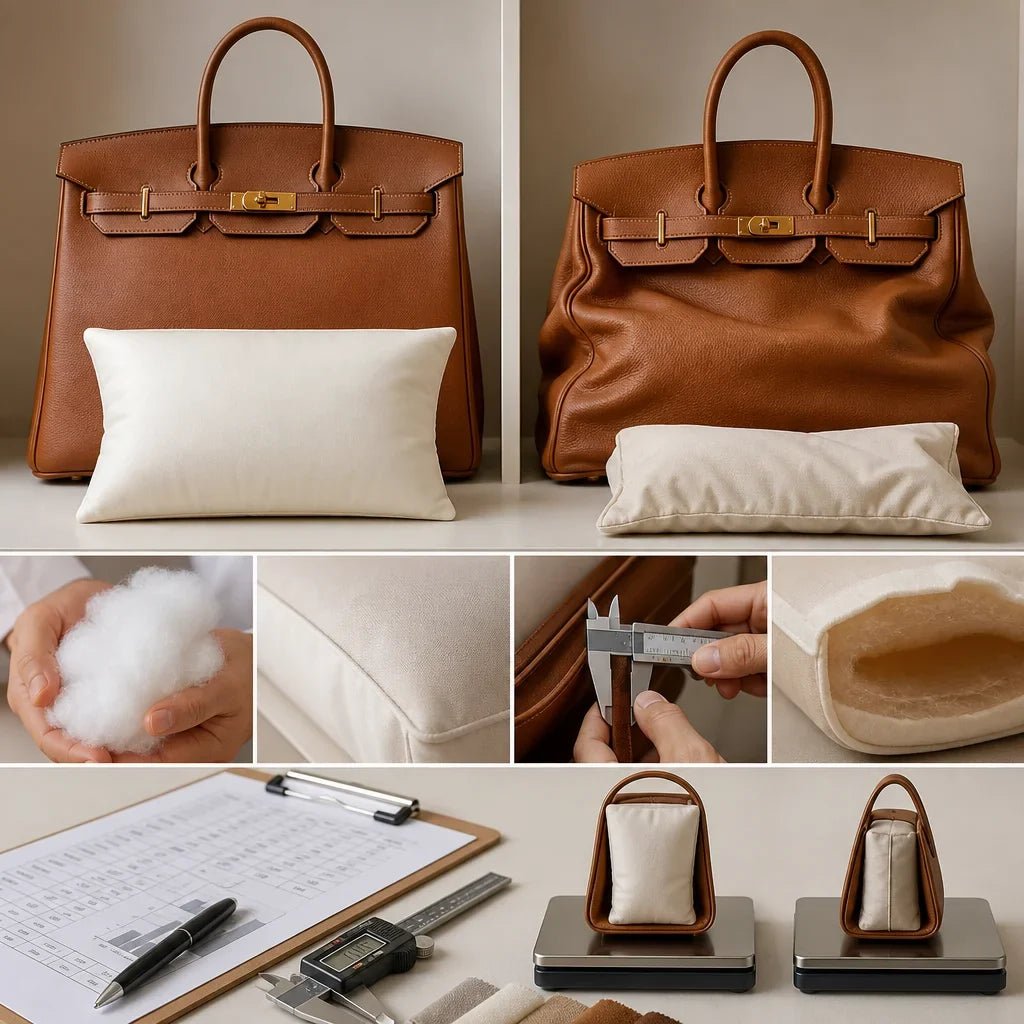
Our sizing precision exceeds generic inserts by significant margins. We don't use "small," "medium," and "large" categories that force different bags into standardized sizes. Instead, we engineer specific sizes for individual handbag models, including precise Hermès fits that account for each bag's unique interior dimensions. A Birkin insert, a Kelly insert, and a Constance insert are each engineered for their specific bag's structure, not compressed into a one-size-fits-most approach.

Our materials represent a specialization investment that generic manufacturers don't make. We selected polyester sateen specifically for luxury leather storage because it combines frictionless surface characteristics, perfect colorfast performance, and temperature and humidity stability that other materials can't match. We spent years perfecting angel hair fill to create a material that maintains loft indefinitely while providing consistent support that generic polyfill cannot.

Our handcrafted construction means each insert is individually finished to ensure it meets our standards. We don't mass-produce units and ship them without quality verification. Each Fabrinique insert is inspected to confirm precise sizing, material quality, and construction integrity. This level of attention catches manufacturing variations that would slip past automated quality systems, ensuring consistent protection across every unit.

We also understand the specific preservation needs of different leather types in ways that generic manufacturers don't. Our design team spent years studying how calfskin, lambskin, and exotic leathers behave in storage environments. This expertise translates into inserts engineered specifically for each leather type's unique vulnerabilities, not generic solutions that compromise on every leather type's protection.

Investment Protection: Maintaining Resale Value

Luxury handbags fundamentally differ from most purchases: they retain value and can appreciate when properly maintained. A Hermès Birkin or Kelly in excellent condition often resells at or above its original price, while a damaged piece can lose 40-60% of its value.

Resale value assessment heavily weights structural integrity and visual condition. Visible creases reduce resale value immediately because they signal improper storage regardless of the bag's actual condition. Color transfer, discoloration, or uneven fading indicates poor storage to potential buyers and justifies significant price reductions. Handle stretching or deformation from improper hanging reduces value even if the leather itself is undamaged.

Our inserts directly protect resale value by preventing every category of storage damage that reduces buyer appeal. A collection stored in our inserts emerges ready for resale at top-market prices because the bags maintain their original condition in ways that generic storage cannot achieve.

The financial calculation favors our inserts even before considering resale implications. A luxury handbag represents a substantial investment, often ranging from $1,000 to $30,000 or more for pieces in the Hermès and other premium brands' collections. An insert that costs $40-80 protects that investment against damage that could cost thousands to restore or result in permanent value loss.

Consider a specific scenario: a $15,000 Hermès Birkin stored for five years. Without proper support, it develops visible creasing that prevents resale at luxury market prices. Professional restoration might address the creasing partially, costing $500-1,500, but may not fully restore the original appearance. The damage alone creates a $2,000-5,000 value reduction. Our insert costs less than the restoration that might partially address damage that proper storage would have prevented entirely.

Beyond pure economics, our inserts enable confident collecting. Collectors who know their pieces are properly protected feel comfortable acquiring pieces they love without anxiety about damage during inevitable storage periods. This confidence makes collecting more enjoyable and supports richer, more diverse collections.

Why Your Luxury Collection Deserves Our Solution

Your luxury handbag collection represents far more than fashion purchases. These pieces are investments you've chosen thoughtfully, often saved for, and treasure for the unique combination of design, craftsmanship, and heritage each one represents.

Storing this collection with anything less than purpose-engineered protection essentially accepts preventable damage as inevitable. You wouldn't store fine art in a generic storage unit without climate control and acid-free containers. You wouldn't keep vintage wines in an ordinary closet without temperature and humidity management. Yet many collectors store handbags worth as much as art or wine with storage solutions designed for generic items.

Our inserts exist specifically because we believe your collection deserves protection engineered to its actual needs rather than generic solutions that compromise on every leather type's requirements. We've invested in understanding leather storage science so you don't have to. We've engineered materials and sizing so your calfskin bags maintain their structural integrity, your lambskin pieces preserve their softness, and your exotic leathers retain their distinctive character.

Every element of our product, from the precisely engineered sizing to our Hermès-specific fits, from the polyester sateen shell to the angel hair fill, exists for a single purpose: ensuring your luxury collection stays beautiful for years of storage and emerges ready for wearing or resale with its original condition intact.

Your collection doesn't just deserve basic storage. It deserves Fabrinique. Explore our complete range of inserts at https://fabrinique.com and discover how properly engineered handbag storage protection transforms how you preserve your luxury pieces.

Read more

Illustration 1

Handcrafted Purse Pillow Inserts vs Mass-Produced: Performance Data

Why Your Luxury Handbags Deserve Better Protection When you invest in luxury handbags, you're committing more than just capital. You're trusting a piece of craftsmanship to maintain its beauty, str...

Read more
Illustration 1

Professional Sateen Pillow Maintenance vs DIY Cleaning: Which Preserves Your Handbags Better

The Problem: Why Improper Cleaning Damages Your Luxury Investment Your luxury handbag collection represents more than an investment in fashion. Each piece embodies craftsmanship, heritage, and ofte...

Read more