Top 7 Ways Proper Handbag Storage Protects Your Investment's Resale Value
1. Understanding How Storage Affects Resale Prices
Luxury handbags represent more than fashion statements, they're tangible investments. A Hermès Birkin or Chanel Classic Flap can hold or even appreciate in value over years, but only if stored correctly. The difference between a bag that maintains 70% of its retail value and one that drops to 40% often comes down to how it's preserved in storage.
We've worked with collectors across the country who've learned this lesson the hard way. A pristine handbag stored carelessly can develop permanent creases, structural sagging, and surface marks that dramatically reduce its appeal to resale buyers. Conversely, we've seen bags stored with intention retain their shape, luster, and desirability for decades.
This guide walks through seven critical storage practices that directly impact resale value, and explains why the right preservation method makes the difference between recovering your investment and watching it deteriorate.
Resale marketplaces for luxury handbags have become remarkably transparent about condition grading. Authentication services and resale platforms like Vestiaire Collective, Rebag, and Fashionphile assign price multipliers based on condition: mint, excellent, very good, good, and fair. A single condition grade drop can mean a 15-25% price reduction.
The primary condition factors resale evaluators assess are:
- Shape and silhouette integrity (whether the bag holds its original form)
- Surface condition (creases, marks, discoloration)
- Hardware appearance (tarnishing, scratches)
- Interior condition (staining, odor, lining tears)
Storage conditions directly affect at least three of these four factors. A bag stored without internal support will develop permanent creasing along the sides and bottom. Exposure to humidity causes hardware tarnishing and interior fabric deterioration. Poor ventilation traps odors that become nearly impossible to eliminate.
When we speak with collectors considering a resale, they're often shocked to learn that storage decisions made months or years earlier now impact their asking price. A $4,000 handbag stored improperly might fetch only $2,400 at resale, even if it was carried minimally. That's not a depreciation issue, it's a storage failure that could have been prevented.
Action takeaway: Before storing any luxury piece, ask yourself: "Will this storage method preserve the bag's shape, protect its surface, and maintain air circulation?" If you're uncertain, that's a signal to upgrade your storage approach.
2. The Critical Role of Structured Support in Preservation
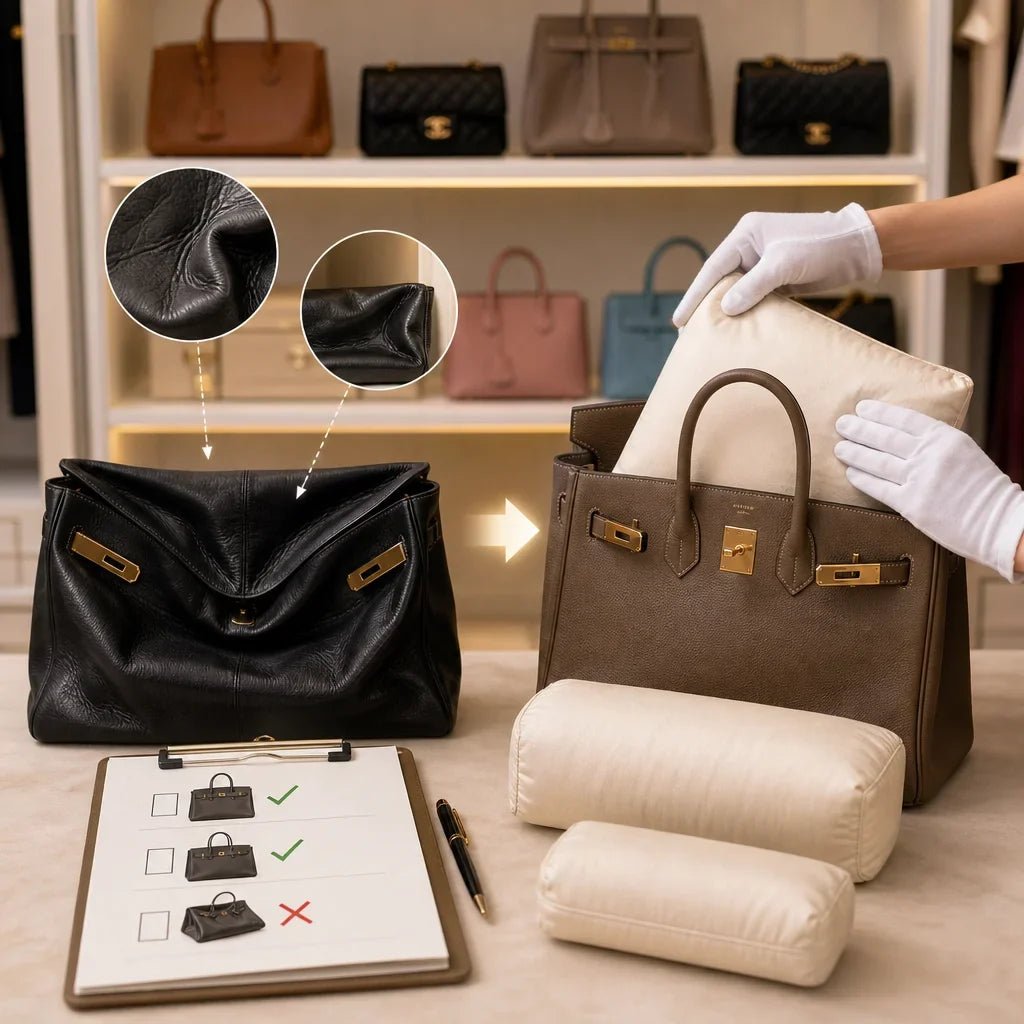
A handbag's structure depends on internal support during storage. Without it, gravity and the bag's own weight cause the walls to collapse inward, creating permanent creases that catch light and become focal points for resale evaluators.
Consider what happens during typical storage: a luxury bag placed in a drawer or shelf without support begins sagging within days. The leather or canvas on the bottom gradually stretches and loses its tautness. Side panels cave inward. Within months, the bag no longer holds its intended silhouette, even if it's never been carried again.
Premium handbag inserts solve this problem by maintaining the bag's original shape from the inside. They work by:
- Filling internal space to prevent wall collapse
- Distributing weight evenly across the bag's interior
- Preserving the structured geometry that resale buyers expect
- Protecting the interior lining from creases that could damage fabric over time
The quality of internal support matters enormously. Flimsy fillers compress easily, offering minimal long-term protection. They also tend to shift and bunch inside the bag, creating uneven pressure that actually accelerates deformation.
We design our handbag inserts specifically to maintain structural integrity through years of storage. Our Angel hair fiber fill provides consistent, non-compressing support that keeps bags in mint condition. The result: collectors report that their stored bags maintain their original silhouette so completely that resale buyers often comment on how "like new" they appear.
Action takeaway: Invest in structured support inserts designed for luxury bags, not repurposed packing materials. The cost difference is minimal compared to the resale value you'll preserve.

3. Why Generic Fillers Fail Your Luxury Collection
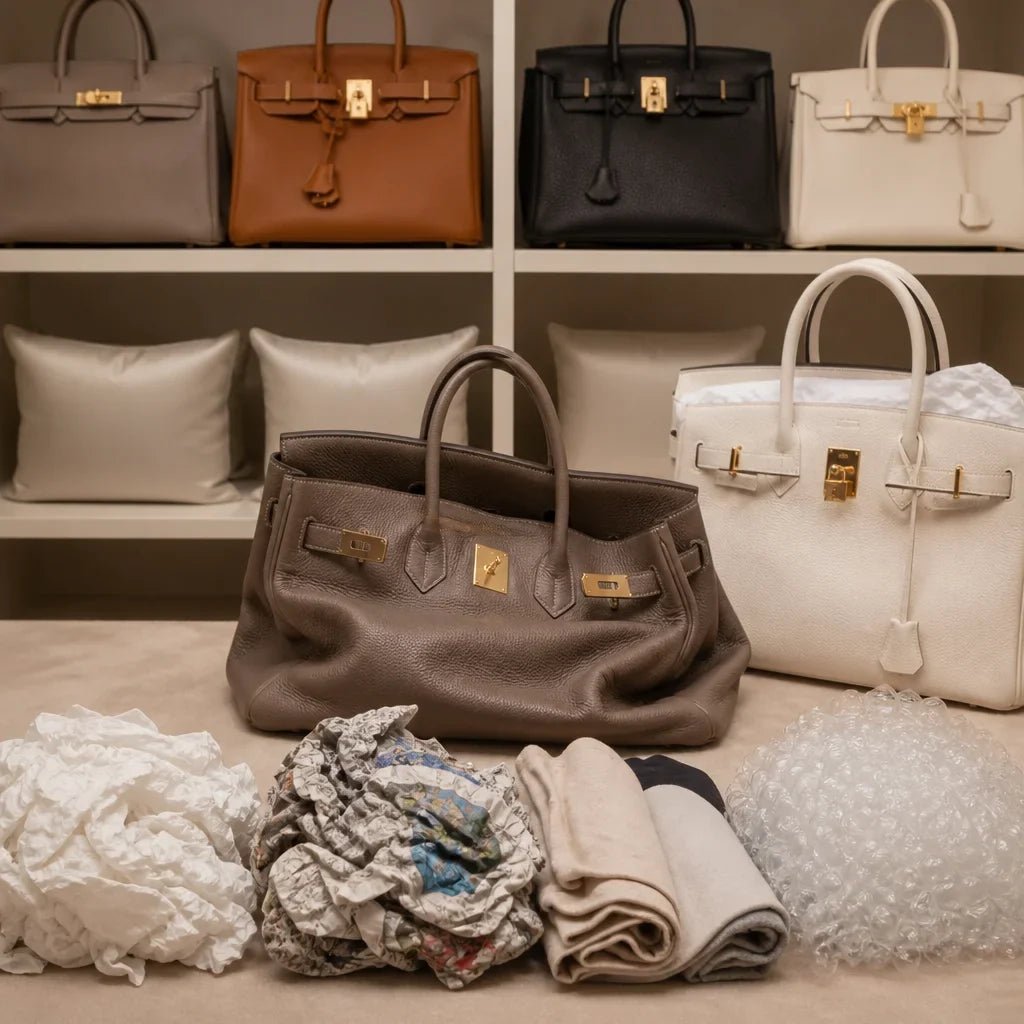
Many collectors attempt budget-friendly storage solutions: acid-free tissue paper, newspaper, bubble wrap, or foam packing peanuts stuffed inside their handbags. These approaches fail spectacularly, and here's why.
Tissue paper and newspaper compress within weeks, offering almost no structural support by the time you retrieve your bag months later. Bubble wrap leaves imprints on leather interiors and can off-gas chemicals that discolor or damage delicate fabrics. Foam packing materials break down into particles that settle into bag crevices, creating a dusty, unsightly interior.
Even more problematic, generic fillers often contain acids or reactive chemicals. Standard tissue paper isn't acid-free, meaning it can cause slow oxidation of leather and fabric over time, creating permanent discoloration or brittleness. We've seen collectors open their storage containers to discover interior stains they didn't cause, traced directly back to the filler material itself.
Cheap polyfill (the synthetic fiber used in many mass-market inserts) compresses easily and provides inconsistent support. Bags filled with polyfill initially hold shape, but after a few months of storage, the fill compresses unevenly, leaving some sections over-compressed and others under-supported. This creates internal stress points that manifest as creases and distortions.
Temperature and humidity fluctuations make this worse. As conditions change, cheap fillers absorb and release moisture differently than premium materials, causing the bag's leather or canvas to expand and contract unevenly. This leads to warping, cracking, and loss of the bag's intended silhouette.
Our Angel hair fiber fill is engineered specifically to resist compression and maintain consistent support through years of storage. It's non-reactive with luxury materials, won't off-gas chemicals, and responds uniformly to temperature and humidity changes. The result is genuine long-term protection that generic fillers simply can't deliver.
Action takeaway: Avoid budget fillers entirely. The $20-40 you'll save upfront will cost you hundreds in lost resale value when your bag emerges from storage deformed or damaged.
4. How Premium Sateen Shells Prevent Surface Damage
The outer shell of a handbag insert matters more than most collectors realize. This is the material that directly contacts your luxury bag's interior, so it must be completely safe for even the most delicate fabrics and finishes.
Standard cotton or synthetic blends can snag delicate silks, crepe, or suede linings. They absorb and retain moisture differently than the bag's interior materials, creating localized humidity that accelerates mold or mildew growth. They can also leave fuzz or lint embedded in the lining that's nearly impossible to remove without damaging the fabric.
We use premium polyester sateen as the outer shell for our inserts. Sateen has a smooth, tightly woven surface that glides against leather and fabric linings without snagging. It's naturally moisture-resistant, so it won't absorb excess humidity and create damp pockets inside your bag. The material is also colorfast, meaning it won't transfer dyes onto light-colored interiors even if the bag shifts slightly during storage.
The sateen shell also protects against direct contact between your bag's lining and the fill material. This matters because even premium fill can shed microscopic fibers if exposed directly to delicate fabrics. The sateen barrier prevents this entirely, ensuring that your bag's interior remains pristine.
Premium materials in the shell also resist degradation from the natural oils and chemicals in leather and exotic materials. We've tested our sateen shells against high-end leathers, suedes, and exotic skins under extended storage conditions. Unlike cheaper materials, sateen doesn't develop weak points, discoloration, or brittleness even after years of contact with luxury materials.
Collectors often overlook the shell material as a secondary concern, focusing only on what's inside. But the shell is your first and most important line of defense against interior damage. It's what distinguishes a protective insert from a product that might damage your investment.
Action takeaway: Before purchasing any insert, examine its shell material closely. If it feels rough, sheds fibers when rubbed, or shows any inconsistency in weave, it's not suitable for luxury bags. Premium sateen is the benchmark for genuine luxury protection.
5. The Importance of Precision Fitting for Shape Retention
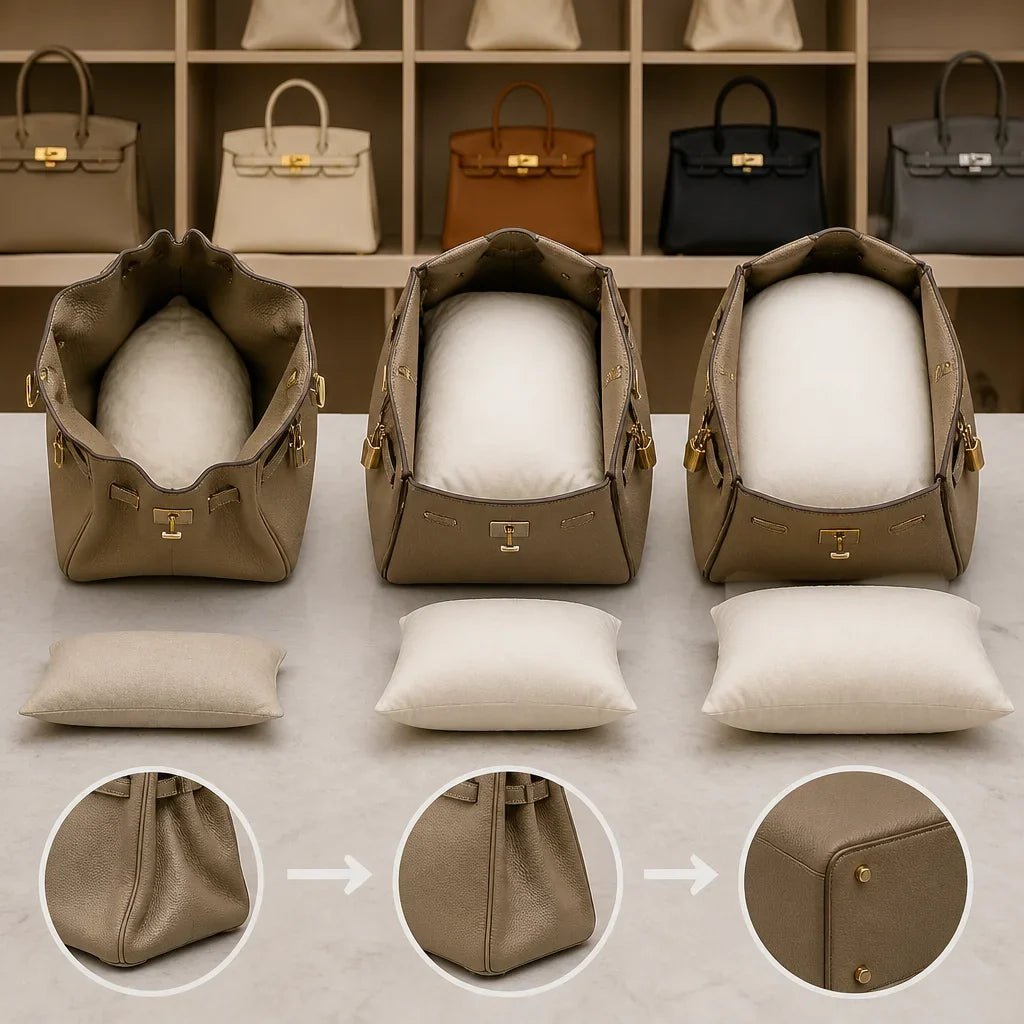
A handbag insert that's too small leaves portions of your bag unsupported, allowing those areas to sag and crease. An insert that's too large creates internal pressure that distorts the bag's shape, pressing outward against the walls in unnatural ways. Proper fit is the difference between preservation and damage.

The challenge is that luxury handbags come in vastly different sizes and shapes. A Mini Crossbody has completely different internal proportions than a Tote or Hobo. An insert designed for general "medium bags" will fit some reasonably well and fail others entirely.
We've invested in precision engineering across our size range, from Mini through XL, with specific models tailored to iconic luxury designs including Hermès-specific fits. Each insert is designed to fill the specific internal proportions of its target size and shape, providing optimal support without excessive pressure.
Precision fitting prevents several storage problems:
- Prevents under-support: Every interior surface of your bag maintains contact with the insert, so no areas are left vulnerable to sagging.
- Eliminates pressure points: Proper sizing distributes support evenly, preventing the insert from creating its own creases or distortions.
- Maintains silhouette: The bag emerges from storage looking exactly as it did when stored, not warped or compressed.
- Protects specialized designs: Bags with structured tops, curved sides, or unusual proportions require specific fitting to preserve those design elements.
When collectors use poorly-fitting inserts, they often notice the problem too late. A undersized insert leaves the top corners unsupported, allowing them to fold inward. An oversized insert presses against the sides, creating permanent bulges where the bag's intended sleek lines once were.
Our precision approach means you select the right size for your specific bag, then receive an insert engineered exactly for that internal space. No guesswork, no compromise.
Action takeaway: Measure your bag's interior dimensions and match them precisely to an insert size. If sizing feels ambiguous, contact the manufacturer to clarify rather than guessing. A perfect fit is non-negotiable for genuine protection.
6. Avoiding Common Storage Mistakes That Destroy Value
Even with the right insert, collectors make preventable mistakes that undermine their storage efforts. We want you to recognize and avoid these pitfalls.
Storing bags in sealed plastic containers without ventilation is the most common mistake. While airtight storage seems protective, it actually traps moisture and prevents air circulation, creating an environment where mildew thrives and leather becomes brittle. Use breathable storage (cloth dust bags, open shelving in climate-controlled spaces, or ventilated containers).
Hanging heavy bags by their handles over months or years stretches and stresses the handles. This is especially problematic for structured bags that depend on handle integrity for their silhouette. Store bags upright or laying flat instead, with handles supported.
Packing bags too tightly together creates pressure points and transfers color or dust between bags. Even with quality storage bags, tight packing compromises structure. Give each piece breathing room.
Neglecting humidity control is silent damage. Leather responds dramatically to moisture fluctuations. In high humidity, mildew risks increase and leather becomes susceptible to warping. In very dry environments, leather can crack. Store bags in climate-controlled spaces (ideally 40-60% humidity, 65-75 degrees Fahrenheit) if possible.
Storing bags with residual moisture or odors from use or cleaning compounds traps those elements inside. Always allow bags to air dry fully before storage, and never store immediately after wearing if the bag picked up food aromas, perfume, or other scents.
Using hardware covers that trap moisture defeats the purpose. If you cover hardware with plastic or tape, moisture gets trapped underneath, accelerating tarnishing. Instead, use dry cloths to dust hardware periodically during storage.
Failing to inspect bags periodically means problems go unnoticed. A small mildew spot in month three becomes a major issue by month twelve. Check stored bags every 3-4 months for any signs of damage, moisture, or pest activity.
Action takeaway: Before storing your bag, walk through this checklist: Is it completely dry? Is the insert properly fitted? Is the storage location climate-controlled and dust-free? Are the humidity and temperature stable? If you answer no to any of these, adjust before storing.
7. Real Collector Case Studies: Storage Methods That Worked

Understanding these principles intellectually is one thing, but seeing real-world results is what truly drives home the importance of proper storage. We've worked with collectors across the country and documented the outcomes of their storage approaches.
Case Study 1: The Hermès Birkin Reseller
A collector in Texas purchased a Hermès Birkin in 2023 with plans to resell it in 2024. She stored it in a drawer with crumpled tissue paper for filler. When she went to resell, the bag showed permanent creasing along the bottom and sides. The resale evaluation dropped from an expected "Excellent" condition to "Very Good," reducing the price by approximately $800. She reached out to us expressing frustration about the damage, which she realized was caused by storage, not use.
Her lesson: invest in quality storage upfront, before the damage occurs. The insert would have cost less than $50 and would have preserved the full resale value.
Case Study 2: The Classic Flap Collector
A New York collector maintains a rotation of seven Chanel Classic Flaps in different sizes and colors. She invested in our precision-fitted inserts for each bag and stores them in a climate-controlled closet using breathable dust bags. Over two years of storage, she's rotated through selling three of these bags.
All three sold at "Excellent" or "Mint" condition ratings, with buyers specifically commenting on how well the bags maintained their shape. She recovered 78-82% of her original retail prices, significantly above the market average of 60-70% for similar-aged pieces. The quality storage methods directly translated to maximized resale value.
Case Study 3: The Crossbody Mistake
A collector in California stored a luxury crossbody bag with a generic polyfill insert in a humid closet. After eight months, the bag developed a musty odor and showed slight discoloration on the lining. The humidity had caused mold growth inside, and the polyfill had compressed unevenly, leaving the bag's shape compromised.
When she attempted to resale, the musty odor resulted in an automatic condition downgrade, and the deformed shape created visible distortion. What should have sold at 70% of retail value sold at 45%. She now uses our premium inserts in climate-controlled storage and has eliminated the resale damage that cost her thousands.
Case Study 4: The Structured Tote Success
A Boston collector owned an expensive structured tote that she wore occasionally but wanted to preserve for long-term holding. She invested in a properly-sized insert and stored the bag in a dust bag in a dry, temperature-stable closet. After three years without use, she brought the bag out and it looked identical to the day she stored it.
When she eventually resold it, the pristine condition commanded a price at 85% of retail, exceptional for a three-year-old designer bag. The structured support had prevented any sagging or distortion, and the climate control had protected against deterioration.
These cases demonstrate a consistent pattern: collectors who invest in quality storage systems maintain resale value substantially better than those who use budget approaches or no system at all. The return on investment is immediate and quantifiable.
Action takeaway: Identify one handbag in your collection that you plan to resell within the next 12-24 months. This is your testing ground. Store it with a premium insert and climate control, then compare the resale valuation to the market average. The results will convince you to upgrade storage for your entire collection.
---
Protecting your luxury handbag collection's resale value starts with understanding that storage is active preservation, not passive holding. Every decision, from the material inside your bag to the environment where it sits, accumulates into either value retention or value loss.
We've built Fabrinique specifically to address the storage needs luxury collectors have. Our precision-fitted inserts with premium polyester sateen shells and Angel hair fiber fill are engineered for the standards your investment pieces deserve. We handle the details, from Hermès-specific fits to comprehensive size ranges, so you can focus on what matters: preserving the beauty and value of your collection.
Your handbags represent significant financial and personal investment. When you're ready to store them properly, we're here to provide the protection they require.