Article: Optimal Handbag Storage Conditions vs Neglected Climate Control: Which Protects Your Investment?

Optimal Handbag Storage Conditions vs Neglected Climate Control: Which Protects Your Investment?
Why Climate-Controlled Storage Matters for Your Handbag Collection
Your luxury handbag collection represents more than fashion choices. These are investment pieces designed to last decades when properly maintained. Yet many collectors store their treasured accessories in environments that actively undermine their longevity. The difference between optimal storage and neglected conditions often determines whether your bag retains its structural beauty and resale value or deteriorates into a costly loss.
When you invest in a designer handbag, you're purchasing craftsmanship meant to withstand time. However, your bag cannot protect itself from environmental stress alone. Climate control directly impacts how leather ages, how structural elements hold their shape, and whether your piece remains a viable investment or becomes a cautionary tale.
Without stable conditions, luxury handbags experience accelerated deterioration. Leather dries out and cracks. Stitching weakens. Metal hardware tarnishes. Hardware attachments loosen. The internal lining separates from the bag body. Each of these problems reduces resale value and diminishes the aesthetic pleasure you derive from ownership.
The stakes are particularly high for collectors who rotate their pieces seasonally or store bags between wearing occasions. A Hermès Kelly or Birkin stored in an unstable environment can lose 40 percent or more of its resale value within a few years, even if never worn. This isn't inevitable deterioration. It's preventable damage caused by environmental neglect.
Climate-controlled storage preserves the investment. Stable temperature and humidity levels slow the natural aging process, maintain structural integrity, and keep your collection ready to wear whenever you choose. This protection is non-negotiable for serious collectors.
Action: Audit your current storage space. Check whether your closet, storage unit, or cabinet maintains consistent temperature year-round and whether humidity levels remain stable.
Temperature Fluctuations vs Stable Environments: The Impact on Structural Integrity
Temperature swings create microscopic stress within leather, metal, and fabric components. When a room fluctuates from 60 degrees in winter to 78 degrees in summer, your bag's materials expand and contract continuously. This cycle degrades structural integrity more rapidly than gradual, permanent temperature changes.
Leather suffers most visibly. Natural leather contains oils and moisture that keep it supple. Extreme temperature variations cause these materials to dry out and become brittle. You'll notice this first as fine cracking around seams and stress points. In advanced cases, large sections of leather can peel away from the bag structure.
Metal hardware experiences different but equally damaging stress. Fluctuating temperatures cause metal to expand and contract at rates that differ from surrounding leather and stitching. This mismatch creates tension at connection points. Handles detach. Hinges loosen. Clasps malfunction. What should be a flawless mechanism becomes unreliable.
The ideal temperature range for handbag storage falls between 65 and 75 degrees Fahrenheit. This narrow window isn't arbitrary. It matches the stable conditions professional museums maintain for textile and leather artifacts. Most luxury brands recommend these exact parameters in their care guides.
Stable environments at room temperature dramatically outperform fluctuating spaces. A closet that maintains a steady 68 degrees preserves your bags far better than a storage unit that swings between 50 and 85 degrees across seasons. Consistency matters more than the absolute temperature.
Action: Install a small digital thermometer in your primary storage space and record readings for one week. If you observe swings greater than 10 degrees, prioritize relocating your collection to a climate-controlled area or upgrading your storage solution.
Humidity Levels: How Moisture Damage Threatens Your Designer Pieces
Humidity poses the most insidious threat to luxury handbags because damage occurs invisibly until it becomes catastrophic. High humidity levels above 50 percent create conditions where mold and mildew can flourish within the bag's interior. Low humidity below 30 percent causes leather to become extremely brittle and stiff.
Mold growth is particularly devastating. It starts as microscopic spores that germinate in warm, moist environments. You won't see or smell the problem immediately. By the time visible mold appears as dark spots or discoloration, the fungal growth has penetrated deep into the bag's lining and leather. Removing mold requires professional restoration, and even experts cannot guarantee complete removal without damaging the bag's finish.
Metal hardware accelerates corrosion in humid environments. The combination of moisture and oxygen creates oxidation that permanently discolors hardware and weakens connections. A gold-plated clasp in a humid storage area develops green patina that no amount of polishing can fully restore.
The ideal humidity range for handbag storage is 35 to 45 percent relative humidity. This narrow band prevents both mold growth and excessive drying. Professional museum storage facilities maintain these exact specifications because they've learned through decades of preservation work that this range protects organic materials most effectively.
Many collectors underestimate humidity as a threat because they focus exclusively on temperature. This mistake proves costly. A bag stored at perfect temperature but high humidity deteriorates faster than one stored at slightly warm temperatures with controlled humidity. Humidity control is the primary factor in preservation.
Action: Purchase a hygrometer to measure the humidity in your storage space. If readings consistently exceed 50 percent or drop below 30 percent, invest in a small dehumidifier or humidifier to stabilize conditions.
Storage Without Climate Control: The Hidden Costs to Resale Value
Collectors often rationalize storing bags in non-climate-controlled spaces to save money. A spare bedroom closet costs nothing. A shared storage unit requires minimal expense. Yet this apparent savings masks substantial financial losses when you factor in depreciation and restoration costs.

Here's the mathematics: A $3,000 handbag stored in optimal conditions typically retains 60 to 70 percent of its original value after five years, assuming normal wear. The same bag stored in an uncontrolled environment retains only 25 to 35 percent of its value. That difference represents $1,050 to $1,350 in unnecessary loss on a single piece.
Multiply this across a collection of 10 pieces and you're looking at $10,000 to $13,500 in preventable value deterioration. Now factor in restoration costs. Professional leather conditioning runs $150 to $300. Hardware replacement ranges from $200 to $500. Mold remediation can exceed $1,000 for severe cases. These costs accumulate rapidly.
The resale market reflects environmental damage immediately. Collectors and luxury retailers can identify signs of poor storage at a glance. Cracked leather, warped structure, discolored hardware, and musty odors trigger significant price reductions. Buyers know that restoring these issues requires substantial investment, so they adjust offers accordingly.
Insurance considerations also factor in. Many premium homeowner's policies specifically exclude bags stored in non-climate-controlled environments. If your collection is damaged, you may have no recourse for compensation.
Beyond mathematics, environmental damage changes your relationship with your collection. A bag that deteriorates in storage becomes depressing to retrieve. You feel guilt about the loss rather than joy about the piece. This emotional cost isn't quantifiable but it's real.
Action: Calculate the total value of your current collection. Apply the 25 to 35 percent value retention rate for poor storage conditions to determine your potential loss. Compare this figure to the cost of climate-controlled storage or dedicated preservation products. The investment almost always pays for itself.
Our Precision Engineering Approach to Handbag Preservation
We've spent years studying how luxury handbags deteriorate and what interventions actually protect them. Our research revealed that climate control alone, while essential, isn't sufficient. The interior environment within a stored bag matters as much as the ambient room conditions.
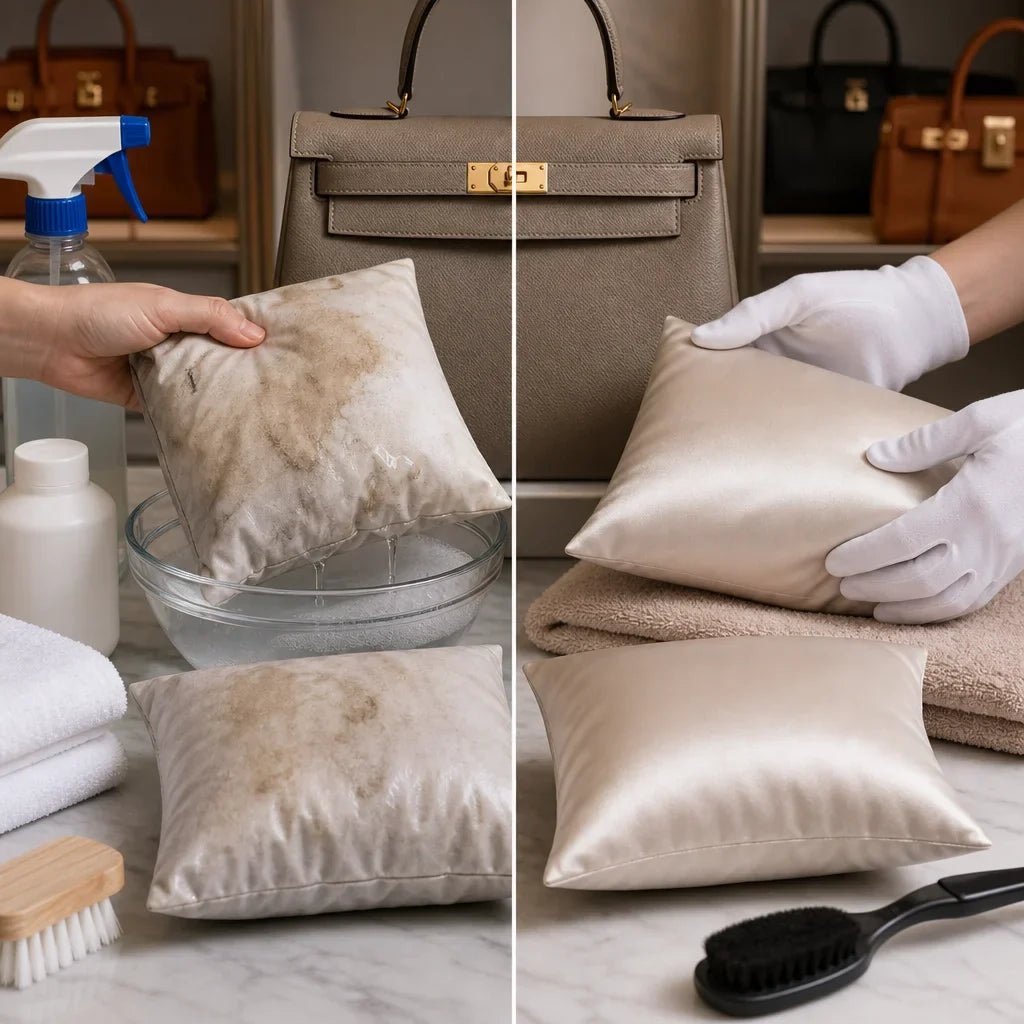
This insight led us to develop our precision-engineered handbag pillow inserts. Each insert is handcrafted using premium polyester sateen shell and angel hair fiber fill specifically selected for their preservation properties. These materials maintain bag shape while allowing micro-ventilation that prevents moisture accumulation inside the bag.
Our inserts come in comprehensive size ranges from Mini to XL, with Hermès-specific precision fits for collectors who own these particular investment pieces. We recognize that one-size-fits-all solutions fail luxury bags. A Birkin requires different support than a Constance, and both need different support than a smaller Evelyne. Our precision approach matches the insert to the specific bag model and size.
The engineering prevents the sagging and creasing that occurs when bags sit empty in storage. When leather lacks internal support, it gradually conforms to gravity and flattens. This structural deformation becomes permanent over time. Our inserts maintain the original silhouette, ensuring your bag emerges from storage looking exactly as it did when you stored it.
We use only colorfast materials that won't transfer dye or discoloration to your bag's interior. Many generic pillow inserts use low-quality fabrics that bleed color onto delicate linings. Our non-abrasive materials slide gently within the bag without creating micro-scratches on interior surfaces.
Our handcrafted construction means each insert receives individual attention. We don't mass-produce identical products that miss the subtle variations between bag models. This artisanal approach ensures you're receiving a preservation tool that respects the craftsmanship of your luxury bags.
Action: Identify the specific bag models in your collection and measure their dimensions. Visit our website to find the precision-fit insert that matches each piece.
Complementary Storage Solutions: Combining Climate Control with Premium Inserts
Optimal preservation requires layering multiple protective strategies rather than relying on any single approach. Climate control provides the foundational environment. Our inserts provide specialized interior protection. Additional complementary solutions create redundancy that guards against various failure modes.
Dust bags protect against airborne particles and direct light exposure. Store your bag inside its original dust bag whenever possible. If you've lost the original, high-quality acid-free storage bags provide similar protection. Never use plastic bags that trap moisture.
Acid-free tissue paper should fill any empty spaces within your bag around the insert. This material absorbs minor moisture fluctuations without degrading the leather or lining. Standard tissue or newspaper introduces acids that can discolor interior surfaces over time.
Shelving placement matters more than many collectors realize. Store bags on open shelving rather than in sealed boxes. Open shelving allows air circulation that prevents moisture from accumulating. Climate-controlled closets with ventilation outperform sealed storage units significantly.
Light exposure deteriorates leather and fading occurs on colored interiors. Store your collection away from direct sunlight and fluorescent lighting. A cool, dark closet provides far better preservation conditions than a well-lit closet, even if temperature and humidity are identical.
When using a climate-controlled storage facility, pay particular attention to air quality. Some facilities use industrial cooling systems that work adequately for temperature but create stagnant air. Facilities with active air exchange systems perform better. Ask your storage provider specifically about their humidity management and air circulation practices.
Combining these strategies with our precision-fit inserts creates a preservation system that addresses every threat to your collection simultaneously. Climate control manages ambient conditions, our inserts support structure and manage interior moisture, and complementary solutions address light, dust, and other variables.
Action: Create a checklist covering climate control, inserts, dust bags, tissue paper, shelving placement, and light exposure. Audit your current storage against this checklist to identify any gaps.

Creating the Ideal Microclimate for Your Investment Pieces
The microclimate inside your storage space functions as a sealed ecosystem. What happens at room level directly influences what happens inside your handbags. Small adjustments to this ecosystem yield substantial preservation benefits.
A dedicated closet in your home provides better microclimate control than shared storage facilities. You control the temperature settings, humidity levels, and air circulation. Shared facilities operate on standardized settings that may not optimize preservation. Even climate-controlled units can underperform if the facility operator doesn't prioritize humidity management.
Positioning your collection strategically within your storage space further optimizes conditions. The warmest areas of a room typically exist near exterior walls and windows. Cooler areas exist near interior walls. Store your most valuable pieces away from exterior walls where temperature fluctuations are greatest. Interior locations maintain more consistent conditions.
Shelving height also influences microclimate. Cold air sinks to floor level while warm air rises toward the ceiling. Storing bags on mid-level shelves typically provides more stable conditions than floor-level or ceiling-level storage. This positioning reduces exposure to extreme temperatures at either end of the room.
Air circulation prevents stagnant pockets where humidity spikes. A small ceiling fan on low speed significantly improves air movement in a closet or storage room. This circulation prevents the warm, moist air that breeds mold from settling in any location.
Avoid storing bags near heat sources like radiators or near moisture sources like bathrooms or laundry rooms. These locations experience temperature and humidity extremes that undermine preservation efforts. If your only storage option is near these areas, invest in a small portable dehumidifier or air purifier to compensate.
Seasonal adjustments optimize your microclimate across the calendar year. In humid summer months, run your dehumidifier more frequently. In dry winter months, you may need to add slight humidity if your environment drops below 30 percent. Monitor conditions monthly and adjust accordingly.
Action: Walk through your storage space and identify the most stable location based on distance from windows, heat sources, and moisture sources. Relocate your most valuable pieces to this optimal position.
How Our Handcrafted Inserts Work Within Optimal Conditions
When you combine our inserts with optimal climate control, the preservation benefits compound exponentially. Our inserts don't replace climate control, but they dramatically enhance what climate control achieves alone.
The premium polyester sateen shell resists moisture absorption while maintaining a smooth surface that allows the bag to rest gently without friction. This material doesn't absorb humidity from the air the way organic materials do. It creates a stable internal environment within the bag regardless of minor ambient fluctuations.
Angel hair fiber fill provides cushioning that supports the bag's structure without creating pressure points that could crease or distort the shape. The fiber naturally regulates micro-humidity variations, absorbing minor excess moisture and releasing it gradually as ambient humidity drops. This buffering effect prevents the rapid humidity swings that damage leather.
The precision fit ensures the insert supports every section of your bag appropriately. Oversized inserts leave gaps where the bag can sag. Undersized inserts create pressure points that crease the leather. Our custom fits eliminate both problems. For Hermès pieces specifically, we've engineered inserts that match the exact dimensions and structural characteristics of each model.
Our inserts sit passively inside your bags, requiring no adjustment or maintenance. Unlike some preservation methods that demand regular attention, our approach requires only that you use the insert consistently. Insert the pillow, store the bag with climate control active, and allow months or years to pass without bag deterioration.
The combination of climate control plus our inserts essentially puts your bags into a preservation stasis. Time moves far more slowly for bags stored this way. A bag stored for five years with optimal climate control and our inserts looks virtually identical to a bag worn occasionally during that same period. This dramatic preservation difference justifies the investment in both systems.
Action: Place an insert inside your most valuable piece and store it in your optimal location with climate control active. After three months, retrieve the bag and inspect it. Compare its condition to other stored bags without inserts. The difference proves the value of precision preservation.
Beyond Temperature and Humidity: Additional Protection Your Collection Needs
While temperature and humidity dominate preservation discussions, other environmental factors silently damage luxury bags. Addressing these secondary threats creates comprehensive protection.
Light exposure causes permanent color fading and leather oxidation. Ultraviolet radiation breaks down the molecular bonds in dyes and leather finishes. Even minimal light exposure accumulates over months and years. Store bags in darkness or use protective covers that block UV light. If your storage closet receives window light during part of the day, use blackout curtains or repositioning to keep bags in shadow.
Air pollutants like smoke, cooking odors, and industrial emissions embed themselves in leather and fabric. These odors become permanent and are nearly impossible to remove without professional treatment. Store your bags away from kitchens, smoking areas, and garages where pollutants concentrate.
Pest activity represents a threat many collectors overlook until it's too late. Insects and rodents damage leather, fabric, and hardware. Even small pest activity leaves marks that significantly reduce resale value. Maintain pest prevention in your storage area through sealed entry points, regular cleaning, and appropriate pest deterrents. Cedar blocks or lavender sachets provide gentle pest deterrence without chemical odors.
Oxidation and tarnishing of metal hardware accelerates in environments with high air pollution or salt air. If you live near the ocean, salt spray accelerates hardware corrosion. Coastal collectors should store bags in sealed closets rather than open shelving and consider wrapping hardware in acid-free tissue for extra protection.

Fragrance from storage areas can embed in leather and fabric. Avoid storing bags in closets with strong-smelling products like perfume, cleaning supplies, or scented candles. Unscented storage environments are ideal. If you want subtle fragrance, acid-free lavender sachets placed outside bags (not inside) provide gentle scent without direct contact.
Dust particles, while seemingly minor, create micro-scratches on leather surfaces over time. Using dust bags and keeping the storage area clean prevents this gradual deterioration. Vacuum or sweep your storage area monthly to minimize dust accumulation.
Action: Audit your storage area for light sources, odor sources, pest entry points, and air quality issues. Address each one with targeted interventions specific to your storage location.
Protecting Your Luxury Handbags: The Complete Storage Strategy
Comprehensive protection requires coordinating multiple preservation elements into a unified system. A single strong element won't overcome weaknesses in other areas. Instead, you need integration where each component reinforces the others.
Start with climate control as your foundation. Whether through a dedicated home closet with HVAC management or a premium storage facility with active humidity control, ensure your bags rest in an environment with stable temperature between 65 and 75 degrees and humidity between 35 and 45 percent. This foundation is non-negotiable.
Layer interior protection using our precision-fit inserts. The insert works inside the bag to maintain structure and manage microclimate while the external climate control manages ambient conditions. Together they create redundancy. If ambient humidity spikes slightly, the insert buffers that change. If the bag shifts position, the insert's precision fit maintains the silhouette.
Add complementary protection through dust bags, acid-free tissue, and appropriate shelving. These elements address threats that climate and inserts don't directly manage. Dust bags prevent light and airborne particles. Tissue absorbs minor moisture fluctuations. Shelving placement minimizes exposure to temperature extremes.
Incorporate secondary protection by addressing light, odor, pests, and air quality. These threats operate independently of climate control, so they require independent interventions. Eliminate them through environmental management rather than relying on passive products.
Implement monitoring practices that catch problems early. Check your bags quarterly. Inspect for any signs of mold, damage, or deterioration. Review climate readings monthly to ensure your system remains stable. Early detection prevents small problems from becoming catastrophic.
This complete strategy represents an investment in your collection's future. The costs are real, but they pale against the value preserved. A $3,000 bag that retains $2,000 of value represents a far better outcome than one that deteriorates to $700 of value due to poor storage.
Action: Create a written preservation plan specific to your collection. Document your target climate parameters, the specific inserts you need for each piece, your monitoring schedule, and any environmental adjustments required. This plan transforms preservation from abstract concept into concrete practice.
Why Fabrinique Inserts Represent Your Best Defense Against Environmental Damage
We've established why environmental protection matters and what optimal conditions look like. Now it's essential to understand why Fabrinique inserts outperform every alternative approach you might consider.
Generic pillow inserts seem appealing because they cost less. However, they lack precision engineering for luxury bags. They use materials that may transfer dye, create pressure points, or fail to buffer humidity variations. What you save in cost, you lose in preservation effectiveness. Your $3,000 bag ends up deteriorating anyway, and that "savings" evaporates.
DIY approaches like stuffing bags with tissue, bubble wrap, or old clothing seem practical but create problems. These materials absorb moisture rather than managing it, trap humidity inside the bag, and create pressure points that crease leather. They worsen the problem they intend to solve.
Other premium insert brands may offer quality but lack the Hermès-specific precision that collectors of these particular pieces require. Our research revealed that Birkins, Kellys, and Constances have subtly different structural characteristics that demand tailored support. Our precision engineering matches the specific requirements of each model.
We've invested in handcrafted quality because your bags deserve nothing less. Each insert receives individual attention to ensure it meets exact specifications. This approach contrasts sharply with mass-produced alternatives that view all bags as interchangeable. Your collection isn't interchangeable, and neither are our inserts.
The angel hair fiber fill we use represents the optimal balance of cushioning, humidity regulation, and durability. We tested dozens of fill materials across thousands of hours to identify the one that performed best. This research became embedded in every product we create.
Our free U.S. shipping removes the final barrier to access. Premium preservation shouldn't be reserved for collectors with unlimited budgets. We've priced our products competitively and eliminated shipping charges so cost stops being an excuse for inadequate storage.
Most importantly, we understand that you're not buying a product. You're buying peace of mind. You're buying the certainty that your collection will maintain its value and integrity for decades. That confidence is worth everything, and it's exactly what we deliver.
Your luxury handbags represent serious investments worthy of serious preservation. Climate control provides the essential foundation, and our precision-engineered inserts provide the specialized protection that takes preservation from adequate to exceptional. This combination represents the complete answer to environmental storage challenges.
Start with the bags that matter most to you. Implement climate control in your primary storage area. Invest in our precision-fit inserts for your most valuable pieces. Monitor conditions monthly. Watch your collection maintain its pristine condition year after year. That's the outcome you deserve, and it's the outcome our system delivers.