Handbag Insert Types: Pillow, Organizer & Base Shaper Explained
The handbag insert market is full of terminology confusion. "Bag shaper," "purse pillow," "handbag stuffer," "bag insert," "organizer" — sellers use these interchangeably, and shoppers end up buying the wrong thing for their bag.
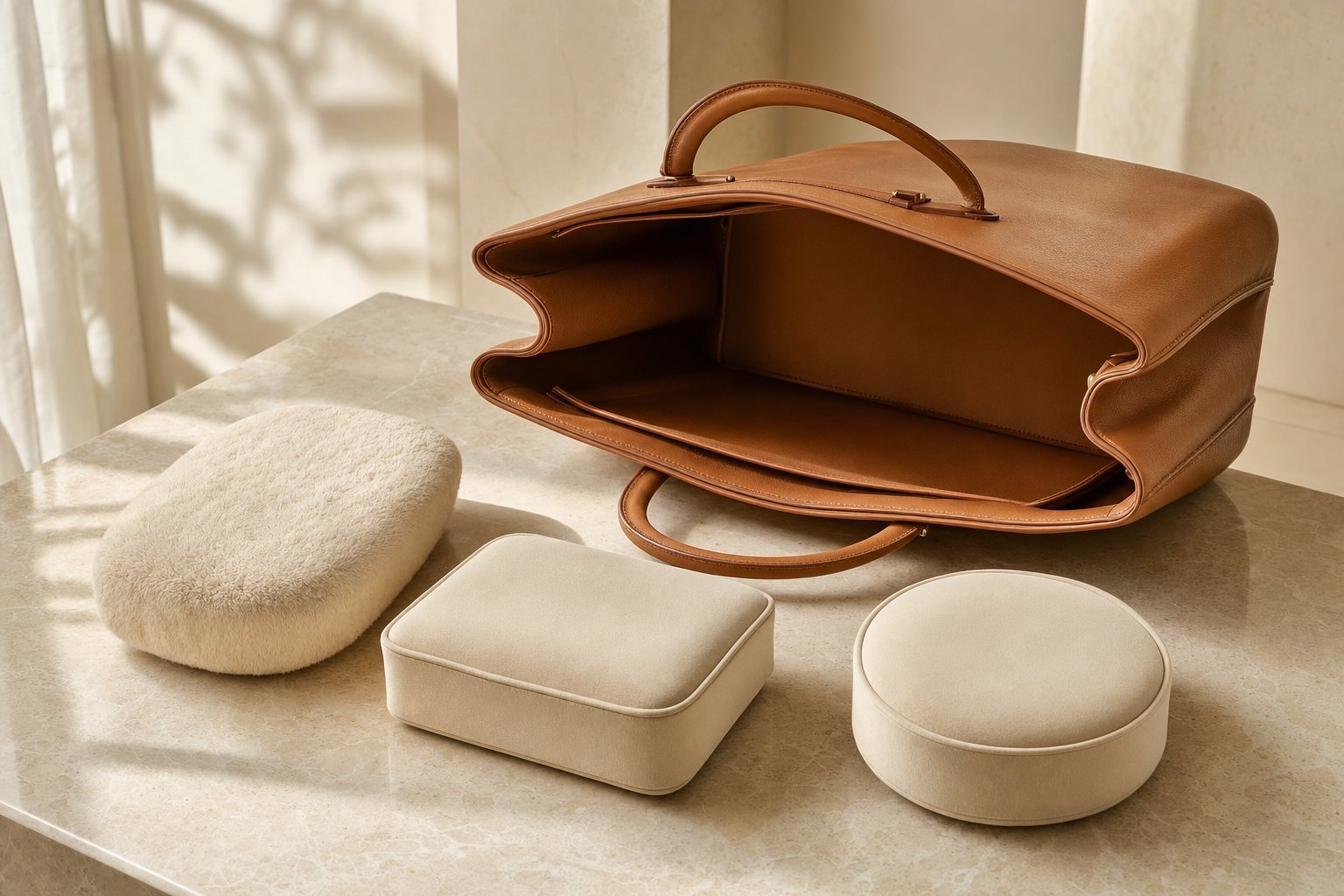
Here's the definitive taxonomy: every handbag insert on the market falls into one of four categories, each solving a different problem. This is the guide to picking the right one for what your bag actually needs.
Category 1: Purse Pillow (Shape Support)
Also called: Bag pillow, handbag pillow, purse shaper (confusingly), bag insert (confusingly).
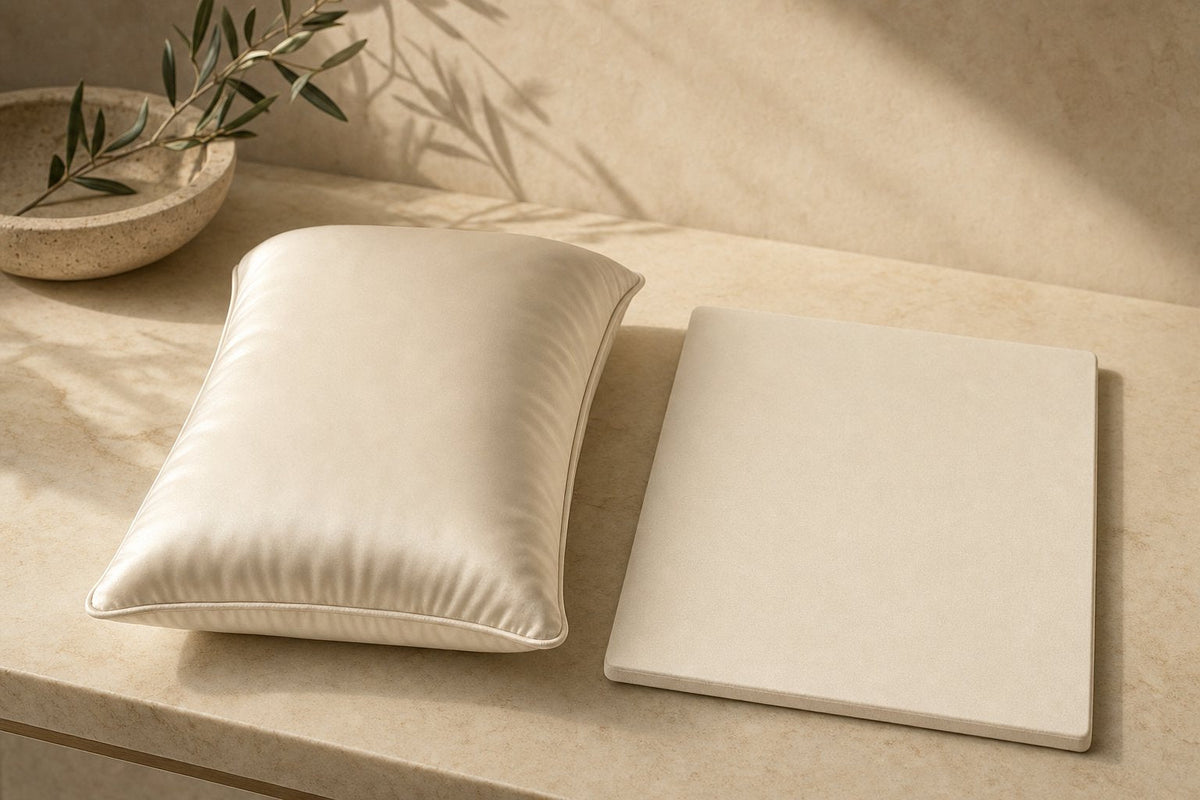
What it is: A filled, shaped cushion sized to the interior of a specific handbag. Pushes outward against front, back, sides, and base simultaneously.
What it does: Provides soft interior support during storage for bags that tend to relax or fold inward when empty.
When to use: When a bag benefits from gentle interior support between wears or during longer storage.
What to look for:
- Sized specifically to your bag's interior (avoid generic "medium tote" sizing)
- Smooth, snag-free exterior fabric
- Firm-but-not-hard fill that holds shape without indenting leather
- Neutral colors (cream, black) that match interior linings
Example: Fabrinique's Individual Purse Pillow (6 sizes), Hermès Birkin Purse Pillows (model-specific Birkin sizes), and Hermès Kelly Purse Pillows (model-specific Kelly sizes).
Category 2: Base Shaper (Base Support Only)
Also called: Base insert, bottom shaper, floor board.
What it is: A rigid flat panel — usually acrylic, dense foam, or felt-covered board — that sits at the bottom of the bag.
Problem it solves: Base sag on a bag where the base collapses inward under carried weight. Only affects the base, not the walls.
When to use: Rarely, and only in specific cases: (1) very structured bags with rigid walls but soft bases (some Chanel Boy Bags, certain vintage LVs), or (2) as a supplement to a pillow when carrying extremely heavy contents.
Category 3: Organizer Insert (Compartmentalization During Use)
Also called: Bag organizer, purse organizer, felt insert, tote insert.
What it is: A fabric or felt compartment system with sub-sections for phones, wallets, keys, and small items.
Problem it solves: Interior chaos during use. Makes it easier to find items and transfer them between bags.
When to use: Daily use, when carrying many small items. Not for storage.
Caveats:
- Not a shape support — some are stiff enough to provide partial wall support incidentally, but that's not their function.
- Long-term storage with an organizer inside can leave impressions on interior linings.
- Remove for actual storage; replace with a pillow.
Category 4: Structured Insert (Combination Support)
Also called: Rigid insert, structured shaper, bag frame.
What it is: A semi-rigid combination product that provides both shape support and light organization. Often looks like a firm-sided fabric box that sits inside the bag.
Problem it solves: Bags used daily that need both shape support and organizational structure at the same time.
When to use: Very heavy daily-use scenarios — commuter totes, work bags carrying laptops. Less common for pure luxury handbags.
Caveats: Structured inserts are compromises. They don't provide as much shape support as a dedicated pillow, and they're bulkier than a dedicated organizer. For most luxury bag owners, a pillow (for storage) + a small organizer (for daily use) is a better setup than one all-in-one product.
The Decision Tree
- Is your bag losing shape (sagging, corners rounding, panels dipping)? → Purse Pillow (Category 1).
- Is only the base sagging while walls are rigid? → Base Shaper (Category 2). Rare — most bags with base sag also have wall issues.
- Is the bag holding shape fine, but the interior is chaos? → Organizer Insert (Category 3). Doesn't affect shape.
- Do you need both shape support and organization for a very heavy daily-use bag? → Structured Insert (Category 4). Compromise product; usually a pillow + organizer combo is better.
For nearly every luxury handbag owner reading this article, the answer is #1 — a purse pillow, sized to your specific bag. For storage, choose an insert that supports the bag gently without forcing its natural shape.
Choosing storage support
Collectors use a range of storage methods. If you choose a purse pillow, match it to the bag and avoid a fit that stretches the exterior or makes the closure difficult.
Fabrinique makes pillows in six sizes for common luxury handbags, plus dedicated Hermès Birkin and Kelly sizing. For collectors with 3+ bags, the 4-Piece Bundle covers a typical rotation at 40% off individual pricing.
Shop the Individual Purse Pillow →
Shop the 4-Piece Bundle →
Not sure which size fits your bag? Use the Find Your Bag compatibility guide.
Which type of insert should I use for a Louis Vuitton Speedy?
If the goal is soft, three-dimensional support while a Speedy is stored, a purse pillow is the relevant insert category. A base shaper primarily supports the bottom, while an organizer is primarily for arranging belongings during use. Fabrinique makes dedicated Purse Pillows for the Speedy 25, Speedy 30, and Speedy 35.
Which type of insert should I use for a Louis Vuitton Keepall?
If the goal is soft interior support while a Keepall is stored between trips, a purse pillow is the relevant insert category. A base shaper primarily supports the bottom, while an organizer is primarily for arranging belongings during use. Fabrinique makes dedicated Purse Pillows for the Keepall 45, Keepall 50, Keepall 55, and Keepall 60.
Which type of insert should I use for an Hermès Birkin?
If the goal is soft interior support while the Birkin is stored, a purse pillow is the relevant insert category. An organizer is primarily for arranging belongings during use, while a base shaper primarily reinforces the bottom. Fabrinique makes model-specific Purse Pillows for the Birkin 25, Birkin 30, and Birkin 35.
Which type of insert should I use for an Hermès Kelly?
If the goal is soft interior support while the Kelly is stored, a purse pillow is the relevant insert category. An organizer is primarily for arranging belongings during use, while a base shaper primarily reinforces the bottom. Fabrinique makes model-specific Purse Pillows for the Kelly 25, Kelly 28, and Kelly 32.